

Published Dec 04, 2025 | 1:04 PM ⚊ Updated Dec 04, 2025 | 2:27 PM

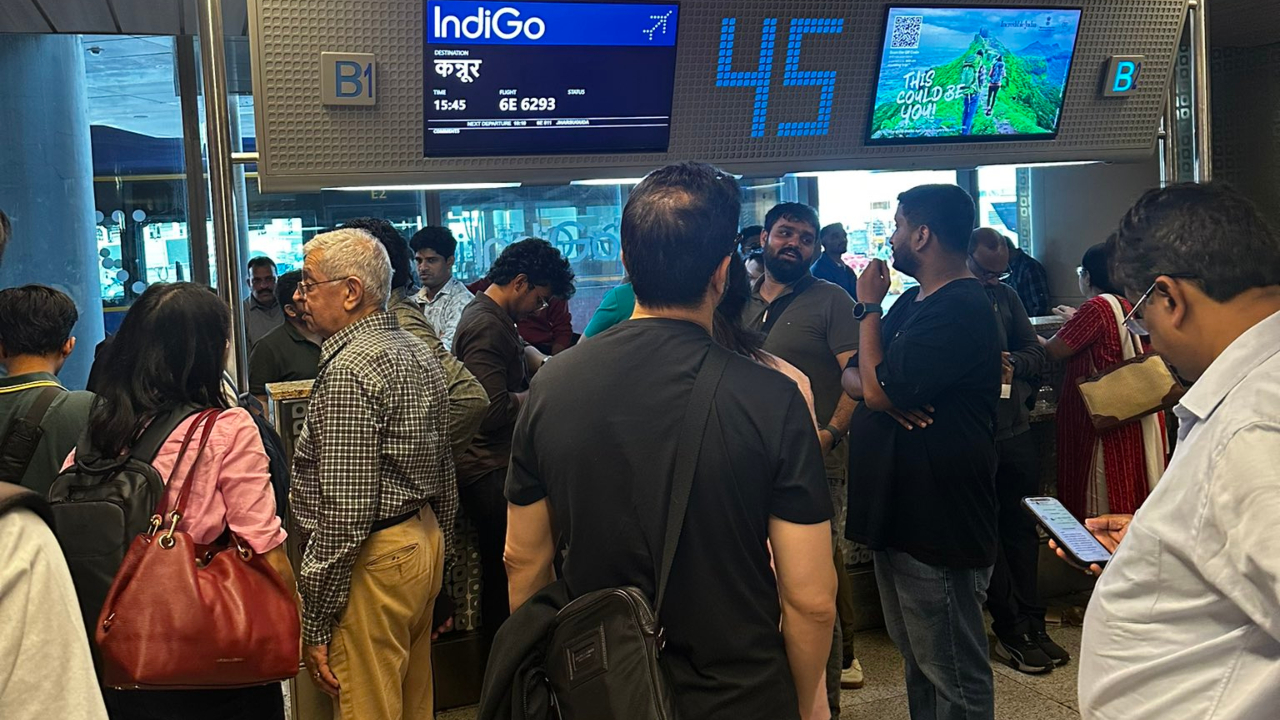
IndiGo, which operates approximately 2,200 flights a day, admitted that its operations had been “severely disrupted” and issued a sincere apology to affected customers. Credit: x.com/rahulpandita
Synopsis: IndiGo cancelled over 170 flights on Thursday, the third straight day of chaos triggered by acute crew shortages after stricter pilot rest norms took effect on 1 November. Delhi, Mumbai, Hyderabad, and Bengaluru were worst hit, with thousands of passengers stranded, some for over 12 hours. The DGCA has summoned IndiGo officials as November on-time performance plunged to 67.7%.
Budget airline IndiGo continues to suffer as it cancelled further flights at airports across the country on Thursday, 4 November, as it entered a third consecutive day of widespread operational disruption, primarily caused by crew shortages.
The airline, which holds the largest share of the domestic market, experienced major interruptions in Delhi, Mumbai, Hyderabad, Bengaluru, Ahmedabad and several other cities, leaving thousands of passengers stranded.
In the national capital Delhi, more than 30 IndiGo departures were cancelled on Thursday morning. Hyderabad reported around 33 cancellations, while Bengaluru airport scrapped 73 IndiGo flights for the day. Services were also disrupted in Mumbai.
Passengers took to X to vent their angst.
“IndiGo has made Pune Airport look like a railway station today, too much chaos,” posted a user.
IndiGo has made Pune Airport look like a railway station today, too much chaos. pic.twitter.com/spQDOE1X9N
— Rishikesh Taksale (@rishilectual) December 4, 2025
Another described “absolute chaos” at the same airport, alleging that staff repeatedly delayed the flight by “just two more hours” while refusing to provide hotel accommodation, citing the same reason: “crew is on the way.”
“Catastrophic service failure by IndiGo6E today. Lots of flights cancelled 1 hour before departure. ”Plan B” digital rebooking link dead. Customer Care unreachable. Result: 100+ angry passengers forced into physical queues to negotiate with overwhelmed staff.” read one tweet.
Catastrophic service failure by @IndiGo6E today.
– lots of Flight cancelled <1 hr before departure.
– ”Plan B” digital rebooking link dead.
– Customer Care unreachable.Result: 100+ angry passengers forced into physical queues to negotiate with overwhelmed staff. #indigo
— Hardik (@hardikasawa) December 3, 2025
On Wednesday, the four major metros — Delhi, Mumbai, Bengaluru, and Hyderabad — collectively recorded around 200 IndiGo cancellations.
Experts are flagging the near-duopoly of IndiGo and the Air India Group for contributing to disruptions in India’s aviation sector, though it’s not the sole cause. However, it does amplify vulnerabilities like crew shortages and regulatory compliance issues, leaving passengers with few alternatives when one major player falters.
Someone promised to put hawai chappal walas on flights and ended up creating a duopoly with a complicit regulator! One way economy class Delhi -Kolkata ticket is going at even 32k, Indigo is at 21k! Can we shove this Amritkaal up you know where and get back those beautiful… pic.twitter.com/gQRTnVLhSb
— sanjoy ghose (@advsanjoy) April 15, 2025
India’s domestic aviation market is overwhelmingly controlled by two players:
This totals to 91.5 percent combined dominance. Smaller carriers like Akasa Air (5.4 percent), SpiceJet (2 percent), and others fill the rest, but they lack the scale and bandwidth to absorb spillovers. This concentration has grown since 2023, when mergers (like Vistara into Air India) and failures of airlines like GoFirst reducing competition.
IndiGo, which operates approximately 2,200 flights a day, admitted that its operations had been “severely disrupted” and issued a sincere apology to affected customers.
In a statement released on Wednesday, the airline attributed the problems to a combination of unforeseen issues: minor technical glitches, winter-schedule adjustments, poor weather, airspace congestion and, most importantly, the recent introduction of revised Flight Duty Time Limitation (FDTL) rules. It said these factors had “compounded in a manner that could not reasonably have been anticipated.”
To stabilise the situation, IndiGo has introduced targeted schedule reductions – measures it expects to keep in place for the next 48 hours in order to restore normal operations and improve punctuality.
The major trigger for crew shortage is the stricter FDTL regime that fully took effect on Monday, 1 November. The new norms, imposed by the Directorate General of Civil Aviation (DGCA), require longer weekly rest periods (48 hours instead of 36), extend the definition of night duty and restrict pilots to only two night landings per duty period (down from 6).
Indigo Airlines operations have been badly hit leading to massive passenger distress. I have repeatedly raised concerns over the duopoly that prevails in the air which lead to higher air fares, poor infrastructure, flight cancellations. It’s a shame and I hope the aviation…
— Priyanka Chaturvedi🇮🇳 (@priyankac19) December 4, 2025
Although initially resisted by airlines, including IndiGo, the regulations were mandated after a Delhi High Court ruling.
The DGCA summoned IndiGo officials for a meeting on Thursday. On Wednesday, it announced a probe into the disruptions and directed the carrier to submit a detailed explanation along with its plan to minimise further cancellations and delays.
Data supplied by IndiGo to the DGCA show that 1,232 flights were cancelled in November alone, of which 755 were directly attributed to crew shortages and FDTL compliance. The airline’s on-time performance plummeted from 84.1 percent in October to 67.7 percent in November.
The regulator has made clear that it is closely monitoring the situation as IndiGo works to regain operational stability.


