

Published Dec 09, 2025 | 7:02 PM ⚊ Updated Dec 09, 2025 | 7:04 PM

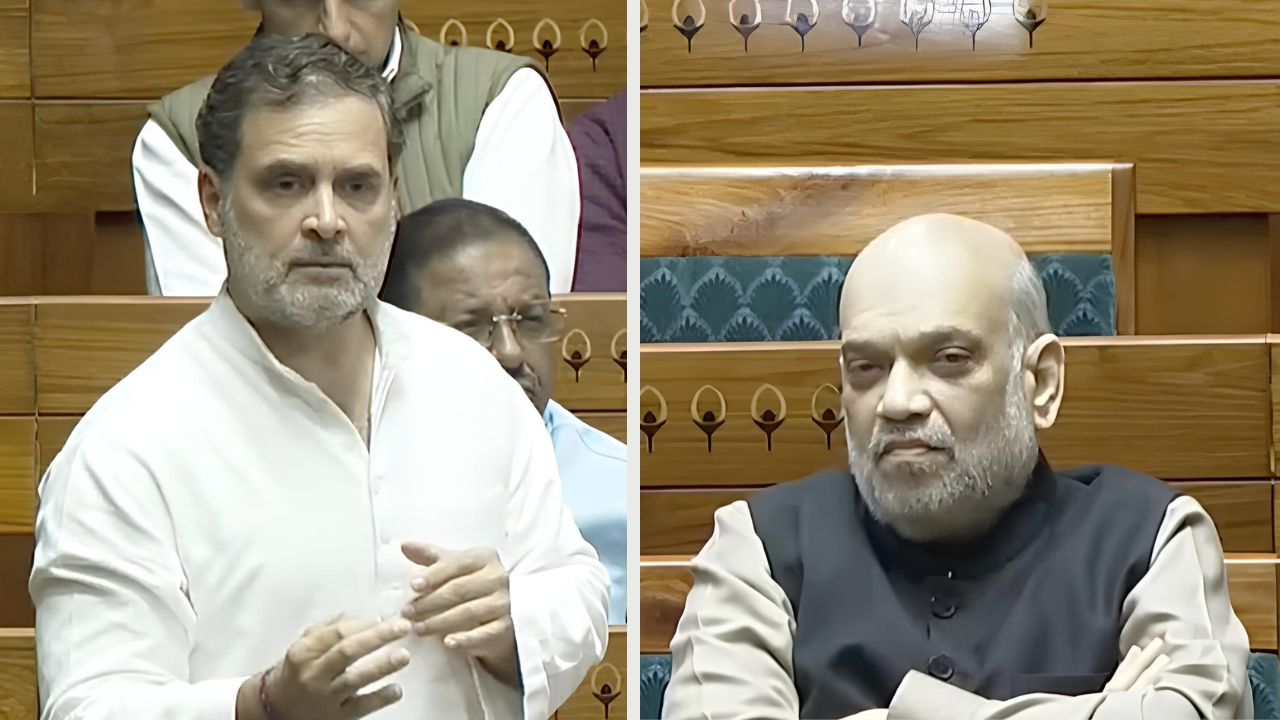
Gandhi issued a direct warning to the Election Commissioners, telling them that their current immunity would not mean they can get away with anything.
Synopsis: LoP Rahul Gandhi on Tuesday accused the BJP-led Union government and the Election Commission of colluding with the RSS to weaken India’s democratic institutions and manipulate the electoral process, calling their actions the “biggest anti-national act” possible. He pointed to the “institutional capture” of government agencies, universities and the ECI itself, cited examples of irregularities in voter rolls across several states, and criticised recent changes to the electoral process, including the blanket immunity “gifted” to Election Commissioners.
In a forceful opening to the Lok Sabha debate on election reforms during the Winter Session of Parliament on Tuesday, 9 December, Leader of the Opposition Rahul Gandhi accused the BJP-led Union government and the Election Commission of India (ECI) of acting at the behest of the Rashtriya Swayamsevak Sangh (RSS) to erode India’s democracy and equality through electoral fraud.
“Our nation is a fabric made up of 1.4 billion people, and the fabric is woven together by the vote. Everything that we see, in fact, this House where I am standing today, the Lok Sabha, the Rajya Sabha, the Vidhan Sabhas across the country, the panchayats across the country, none of them would exist if the vote did not exist,” he said.
“They [RSS] are happy to see the fabric, but they cannot stand the idea that every single person in the fabric of our country, regardless of what religion they come from, regardless of what community they come from, regardless of what language they speak, should be equal, because they fundamentally do not believe in equality. They believe in a hierarchy, and they believe that they should be on top of that hierarchy.”
Invoking the assassination of MK Gandhi by Nathuram Godse, the Congress leader alleged that the Sangh has long been engaged in a project to capture India’s institutions to realise its hierarchical worldview.
“So it is obvious that the RSS has to capture all the institutions that have emerged from the project after Gandhiji’s assassination. The next step of the project was the wholesale capture of India’s institutional framework,” he alleged.
LIVE: Discussion on Election Reforms | Parliament Winter Session https://t.co/sOuiOmuJBU
— Rahul Gandhi (@RahulGandhi) December 9, 2025
Gandhi said the claims he was making were “uncomfortable truths” but necessary to state in Parliament.
“My friends across the aisle do not like the connections I am making; they are disturbed by them,” he said.
“After the father of the nation was assassinated, his vision of an equal India, of an India where institutions belong to the people, had to be destroyed, and so the process started. The RSS attempted to capture one institution after the other.”
He cited the higher education system as his first example. “Everybody knows how Vice-Chancellors are placed on top of Indian universities today… it does not matter whether the professor has qualifications. It does not matter whether the professor has a scientific temperament. The only thing that matters is that the professor belongs to a particular organisation,” he said, prompting loud objections from the treasury benches.
Parliamentary Affairs Minister Kiren Rijiju objected to Gandhi’s comments and accused him of wasting the members’ time.
“We are sitting here to listen, but the Leader of the Opposition hasn’t said a word about election reforms,” Rijiju said. “We are ready to listen to the LoP’s suggestions on election reforms, but he’s telling stories in Parliament about an unrelated organisation. It is not prudent. Time is very valuable and it is not prudent for the LoP to waste everyone’s time.”
Gandhi protested that he was being repeatedly interrupted. “What is happening here is patently unfair. I am not being allowed to speak… I have done absolutely nothing wrong. I am talking about the subject,” he said, insisting that the link between institutions and elections was central to the debate.
“In order to capture the vote, you have to capture institutions. I am saying that the institutions of India are captured… the Election Commission is captured,” he said.
He went on to list what he described as successive stages of “institutional capture”. The second, he said, involved intelligence and investigative agencies. “The capture of the CBI, of the ED, of the Income Tax Department, and the systematic placement of bureaucrats who favour their ideology and attack the opposition and anybody who chooses to oppose them,” he said.
The third, he argued, was the most consequential for democracy: “the institution that directly controls the election system of our country, the Election Commission.”
Rahul Gandhi asserted that he had presented evidence to support his allegations time and again, only to receive no response from the Election Commission.
“I have put forth adequate proof about how the Election Commission is colluding, colluding with those in power, to shape the elections,” he told the House. “It is very clear that the BJP is directing and using the Election Commission to damage India’s democracy.”
He then put forth a series of questions to the ECI, the first concerning the change to the selection panel for Election Commissioners.
“Why is it that the CJI [Chief Justice of India] was removed from the selection panel of the Election Commissioner? What motivation could there be to remove the CJI? Do we not believe in the CJI?” he asked.
Gandhi said that while he sits on the panel as Leader of the Opposition, “I have no voice in that room… On one side, Prime Minister Narendra Modi and Home Minister Amit Shah; on the other side, the Leader of the Opposition. What they decide is what happens.”
He asked why Modi and Shah were “so keen on choosing exactly who the Election Commissioner is going to be.”
His next question targeted the government’s amendment to the law providing blanket immunity to Election Commissioners.
“In December 2023, this government changed the law… to make sure that no Election Commissioner could be punished for any action they take while they are in office,” he said.
“Why would the Prime Minister and the Home Minister give this gift of immunity to the Election Commissioner? Why would they need to give this tremendous gift that no Prime Minister has ever given before?” he asked.
“Amit Shah is looking into the ceiling; maybe he will answer this question when he speaks.”
The third question related to changes in the rules on the retention of CCTV footage from polling stations.
“Why was the law put in place that allows the Election Commission to destroy CCTV footage 45 days after the election? What is the need?” he asked, rejecting the government’s explanation. “It is not a question of data. It is a question of stealing the election.”
Gandhi argued that the consequence of such “institutional capture” was an electoral calendar adjusted to suit the ruling party.
“We have a set of election campaigns that are tailored for the Prime Minister. Three-month, four-month, five-month-long campaigns are taking place so that the Prime Minister’s schedule can be fitted in,” he said.
Gandhi then turned to what he described as concrete instances of electoral malpractice, beginning with alleged irregularities in Haryana’s voter rolls.
“We have a Brazilian woman who appears 22 times on the voter list of Haryana,” he said. When the Speaker objected to opposition members displaying the woman’s photograph in the House, Gandhi responded that the objection itself “is a reflection of our democratic structure. This is what is happening in our democracy, that you are not allowing us to show this.”
He repeated that “a Brazilian woman has appeared 22 times on the voter list in Haryana,” adding that there was “one woman whose name has appeared 200 times, more than 200 times, in one booth in Haryana.”
“The Election Commission has not told me why this lady’s picture has appeared on the polling list. They have not told me why lakhs and lakhs of duplicate voters exist. They have not told me why a BJP leader is coming from Uttar Pradesh to vote in Haryana,” he said, insisting that he had placed clear proof in front of the country but received no answer from the ECI.
He then turned to the contentious Special Intensive Revision (SIR) of electoral rolls in Bihar.
“Why is it that after the SIR, 1.2 lakh duplicate photos are existing in Bihar in the voting list? If you have cleaned up the voting list, why are there 1.2 lakh duplicates in Bihar?” Similar discrepancies, he said, had been flagged in Karnataka and Maharashtra.
“I am absolutely certain this is how you are winning elections in Madhya Pradesh, in Uttar Pradesh, in Bihar, across the country,” he alleged.
“So what I am putting on the table is: it is very clear that you have captured the institution. I have shown the mechanism of that capture. I am also showing you how the Election Commission is doing things that are completely out of line. I am not getting any answers.”
Gandhi then turned from his allegations to the steps that he said are needed to restore integrity to the electoral process. He listed four measures the Opposition has long demanded.
“Number one: give machine-readable voter lists to all political parties one month before the election. That is the first step,” he said.
“The second step is: take back the law that allows the destruction of CCTV footage. Very simple. Not difficult.”
Gandhi also pressed for full transparency regarding electronic voting machines.
“Tell us what is the architecture of the EVM. Give us access to the EVM. Let our experts go and see what is inside the EVM,” he said, noting that the Opposition has “not had access to the EVM” and is “not shown the architecture” or “physically allowed to go and see” the machines.
“Give us the architecture; give us access to the EVM,” he repeated.
His final demand concerned accountability within the Election Commission. “Please change the law that allows the Election Commissioner to get away with whatever he wants to do,” he said. “That is all the electoral reforms you need.”
Gandhi then issued a direct warning to the Election Commissioners, telling them that their current immunity would not mean they can get away with anything.
“They might be under the impression that this law lets them get away with it,” he said. “Let me remind them: do not worry. We are going to change the law, and we are going to change it retroactively, and we are going to come and find you.”
The Congress leader framed his speech on the alleged erosion of electoral integrity in the context of India’s democratic identity.
“Everybody says to us that India is the biggest democracy. Actually, we are not just the biggest democracy; we are the greatest democracy,” he said.
Describing India as the world’s most diverse democratic project, he added that “the democracy that weaves together the largest number of people, the largest diversity of people, the largest number of languages, the largest number of states, is ours.”
That democratic fabric, he argued, was now under attack. “Our most powerful asset, the thing that stitches together the entire concept of modern India… is being attacked by these people,” he said.
“They are destroying it. You know they are destroying it. I know they are destroying it. And they know they are destroying it.”
He then accused the ruling BJP and the ECI of engaging in the “biggest anti-national act” possible.
“Because when you destroy the vote, you destroy the fabric of this country. You destroy modern India. You destroy the idea of India,” he said. “Vote chori is an anti-national act, and those across the aisle are doing an anti-national act.”


