

Published Dec 07, 2025 | 8:00 AM ⚊ Updated Dec 07, 2025 | 8:29 AM

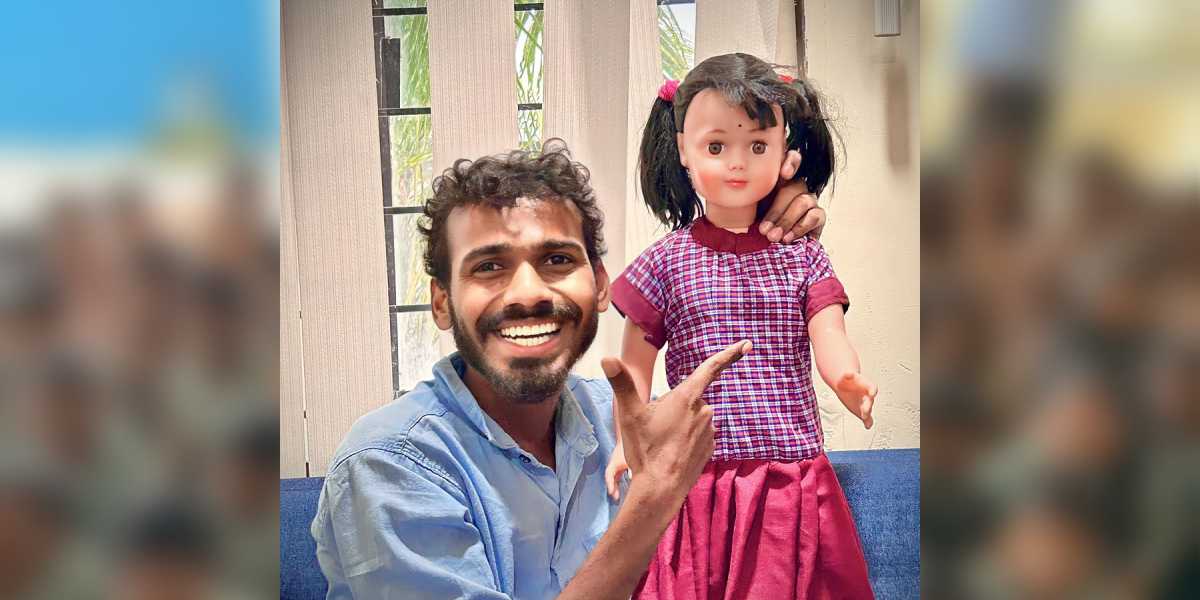
Ganesh with the doll(supplied).
Synopsis: For Ganesh Yakara, the idea for the Samskar doll was triggered during a trip between villages. He witnessed the problem firsthand: an older man offering chocolate to a young girl and then misbehaving with her. Though Yakara intervened immediately, the incident stayed with him.
“Really, hats off! I strongly believe in his ideas and because of this, lots of people will change. I’m really satisfied with this programme. Very thankful to Ganesh Yakara and team for such an interesting and motivated programme…”
These are the words of P Srinivas, Sub-Inspector of Inavolu Police Station in Warangal district of Telangana, spoken on 19 September 2025 after attending a child and woman safety awareness programme called Velugu Payanam. Standing among the team behind it, his reaction was not to a public speech or lecture, which such programmes usually involve, but to something else entirely: a doll.
Dubbed Samskar, this doll teaches children the difference between good touch and bad touch, a topic many parents still find uncomfortable to discuss.
Behind the doll is Ganesh Yakara, a 26-year-old innovator from the small village of Nandanam near Warangal. For him, technology and innovation are tools that can change the world if used well.
“It’s not about what the country gives me. It’s about what I give to the country,” Yakara tells South First.
His view is that there are only two ways an idea forms: one must either witness a problem or experience it. He laughs as he adds that if it is neither, it is certainly not original.
View this post on Instagram
For Yakara, the idea for the Samskar doll was triggered during a trip between villages. He witnessed the problem firsthand: an older man offering chocolate to a young girl and then misbehaving with her. Though Yakara intervened immediately, the incident stayed with him.
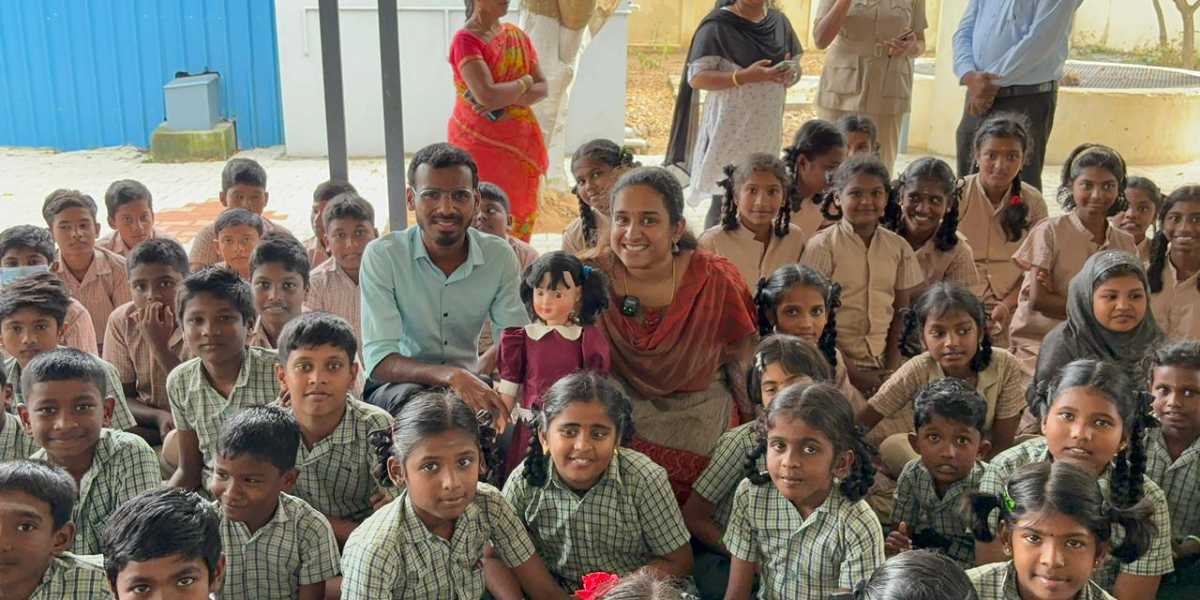
Ganesh in a school.
“It’s not just this one child; it’s so many girls who are in this situation,” he later reflected. “I had to do something.”
Yakara’s journey as an innovator began long before the Samskar doll. His life has not been easy. He grew up in poverty, with parents who worked as daily-wage labourers. “There were days we went to bed without eating,” he recalls.
Watching their struggle and toil in the scorching sun, the innovator in him began to take shape. At around 10 years old, he started scavenging for discarded electronics. From the scraps he found, he built a small fan for his mother.
“She felt happy using it,” he remembers. “I felt proud to be in a position to put forth a solution to a problem.”
The spark had been lit. From that moment, there was no going back for Ganesh Yakara.
At school, he remained mostly invisible. Teachers noticed his curiosity but offered little encouragement. Friendships were rare. He was instead surrounded by people who believed his experiments would get him nowhere.
“Until my 10th standard, nobody even knew who Ganesh Yakara was,” he says.
His first moment of recognition came when one of his projects was selected for the national Inspire Awards, where he met former President APJ Abdul Kalam. For the young boy who had spent years working alone, this national recognition became a turning point.
He went on to design more than thirty social-impact projects. During the pandemic, he made a sensor-based sanitiser dispenser. He created a hearing aid costing just ₹150 for a deaf boy in his village. He also built a glove for women’s safety, to help women travelling alone defend themselves. With one touch using the glove, the perpetrator would receive a strong electric shock, giving the woman time to call for help and share her location.
Recently, on 26 November 2025, Yakara became the bronze recipient of the Rex Karmaveer Chakra Award, presented by the International Confederation of NGOs and the United Nations, in recognition of his work towards social change.
“I already made a glove for women, so why a doll now?” Yakara knows the question, and he answers it. “It’s not reducing abuse and rape numbers. It’s people’s mindset that needs to change first.”
He realised that self-defence tools or alarm systems were not going to solve the problem. The issue had to be addressed not at its final stage but at the root.
“What I felt was the cause was that children don’t have awareness,” he said. “Even if someone misbehaves with them, children don’t know how to tell their parents.”
What disturbed him even more was the way the topic was being taught in schools.
“They call a child to the front, touch them, and ask, ‘what do you do now?’ That needs to change,” Yakara explains. “If you are touching while explaining, the children will also do the same thing.”
All these thoughts and observations led to the Samskar doll. Yakara set out to teach boundaries without exploiting them in the first place, letting children learn safely through play.
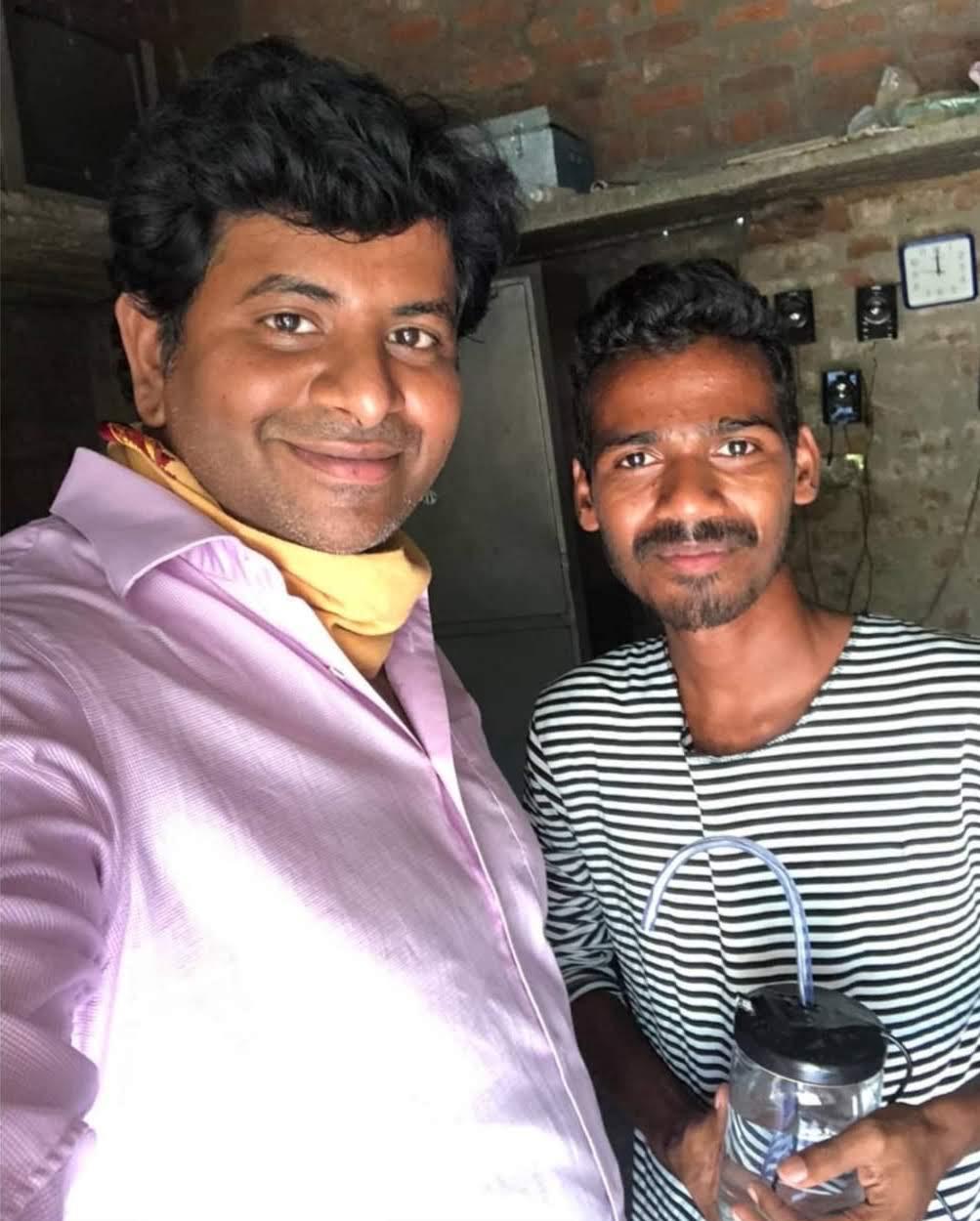
This is the first time Dr Nazeer met with Ganesh
He chose to make a doll because that is what children interact with most and enjoy engaging with. He equipped it with sensors that activate voice warnings when private parts are approached, without any touch. It supports multiple Indian languages: English, Telugu, Hindi, Tamil, Kannada, Malayalam and Konkani.
The quest for accessibility did not end there. During awareness sessions, Yakara was asked about blind and deaf children. He instantly developed versions for both, installing vibratory warnings and red and green lights.
Building the doll was far from easy. There were many different versions, according to Yakara. First, the clothes looked foreign. Then the hair and the eyes. There were complaints throughout the process, but he took them in stride.
“There were so many problems,” he said. “But I did it for the kids.”
Ganesh Yakara remained a steady force throughout the journey, but support was not entirely absent.
Dr Md Nazeer Shaik, who currently serves as an Assistant Professor at RVM Institute of Medical Sciences and Research Centre and is the CEO of Diya’s Medicolegal Consultancy in Hyderabad, first heard about the young innovator from the village sarpanch. It was during the pandemic, yet he visited Yakara’s home and spoke to him for hours.
“It’s a very small room, in which his parents, sister and all live,” Dr Nazeer recalled. “He has a small table with a lamp and he’s doing his innovations. Whatever he’s done, he did on his own. I did whatever small help I could. I’m happy for that kid.”
Others stepped in along the way. Brigadier (Retired) Pogula Ganesham, founder of Palle Srujana Organization, provided early guidance. Nodal Officer Sreeha Reddy, working with the government in the toys industry, helped with awareness sessions. Prakash Macharla, Director at Renspur Health Care Pvt Ltd, called Yakara to Hyderabad for the first time and gave him his first laptop.
There were many days when Yakara felt demotivated, almost ready to quit, but the support of these people, among many others, became his driving force.
“Nazeer sir always believed in me, always told me I could do it,” he says with a small smile.
Samskar Electronics Pvt Ltd was incubated at IIIT Hyderabad, where he initially faced scepticism. They questioned his education, and he said, “Give me two months.”
Ganesh Yakara, though he himself holds no degrees, now teaches engineering students at a college in Warangal and continues his innovation work.
His creative eyes are now turning towards suicide prevention, this time a problem he not only saw but also experienced.
Yakara is starting conversations about areas so clouded with stigma that they rarely see the light. He is beginning the kind of conversations that have been missing for the longest time, ones that society urgently needs.
For all the children who now have the words to protect themselves where silence once stood, Yakara has given them knowledge and taught them boundaries.
“You may look at it like a doll,” says Yakara. “I see the cause behind it.”


