

Published Jul 12, 2025 | 7:06 PM ⚊ Updated Jul 12, 2025 | 7:06 PM

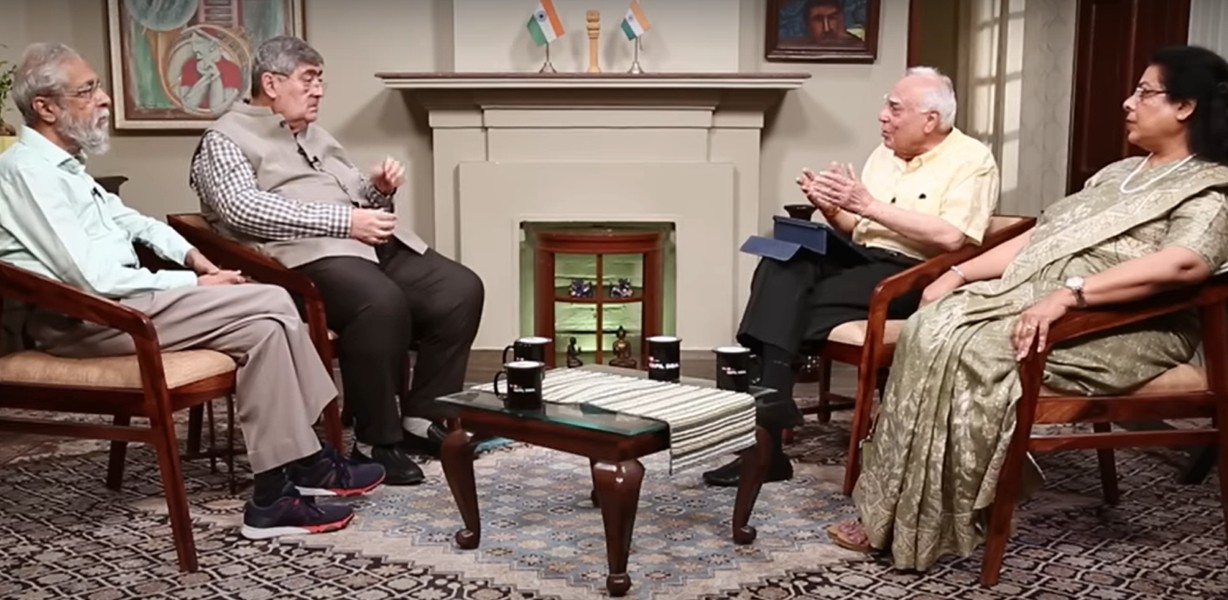
Kapil Sibal with Justices Lokur, Kaul and Gupta. (Screengrab)
Synopsis: In a discussion with former Justices Lokur, Kaul, and Gupta, Kapil Sibal raised concerns about the impeachment process against Justice Yashwant Varma. They questioned the legality of forwarding an in-house report to the government without proper investigation, warning it undermines judicial independence, lacks due process, and risks politicizing a constitutional mechanism meant to protect the integrity of the judiciary.
As Parliament prepares for its monsoon session on 21 July, where the impeachment of former Delhi High Court judge Yashwant Varma is expected to be addressed, advocate Kapil Sibal in a discussion held on his YouTube channel was joined former Justices Madan Lokur, Sanjay Kishan Kaul, and Mukta Gupta, where they discussed the constitutional and legal implications of the case.
The spoke about the facts, timeline of events, and implications of the Supreme Court’s in-house inquiry report being sent to the Prime Minister and the President. Together, they raised fundamental questions about due process, judicial independence, and the potential politicization of a process meant to remain strictly constitutional.
During the discussion, Kapil Sibal explained that under the Constitution, 100 members of Parliament can move an impeachment motion in the Lok Sabha, and 50 members can move the impeachment motion in the Rajya Sabha.
He stressed that this is a right given specifically to members of Parliament, and that the government has not been given any such right to move a motion for impeachment.
He questioned why an in-house procedure of the Supreme Court should send a report to the Prime Minister or the President of India when the government has no role to play in the impeachment motion.
Justice Madan Lokur responded that he was equally intrigued about why the report of the in-house inquiry was sent to the Prime Minister or the President. He explained that the in-house inquiry was called by the then Chief Justice of India, who wanted to know what had happened.
“The Chief Justice appointed the members of the committee, and they gave him a report. Having received the report, the Chief Justice had two options: to reject it, finding nothing in it, or to accept it and decide that some steps should be taken,” Justice Lokur added.
Justice Lokur further explained that the in-house inquiry report stated that cash was found at the residence of the judge, specifically in the outhouse, and recommended steps for his removal. The Chief Justice of India evidently accepted that report.
In Justice Lokur’s view, the next step should have been for the Secretary General of the Supreme Court to lodge an FIR. “There were two possibilities: to lodge an FIR against unknown persons—especially since the judge had said the money didn’t belong to him and that he didn’t find any money there—or, if the Chief Justice believed the money belonged to the judge or that he was aware of it, to lodge an FIR directly against the judge,” he added.
Justice Lokur noted that neither of these steps was taken. He said that to move an impeachment motion, there should be an investigation and a report concluding that the money belonged to the judge.
Kapil Sibal re-questioning the constitutionality of sending the government the report on Justice Yashwant Varma, argued that this step, undermines the constitutional mandate that excludes government involvement in judicial impeachment, thereby tainting the process and making the in-house mechanism appear inconsistent with constitutional principles.
Justice Lokur agreed, saying that by doing this, the process had effectively been made political, even though it was not supposed to be.
Meanwhile, Justice Sanjay Kishan Kaul explained that the in-house inquiry was a very preliminary one. “By the time the report comes, the Chief Justice will be about to demit office. The judge under scrutiny was given only two or three hours to respond—making any meaningful reply impossible.”
He added that this was not a proper investigation: “The committee merely weighed probabilities. They recorded statements from the police, fire department, and staff, concluding that the probability of one version being true was higher—especially noting that some of the staff came from the judge’s home state and might have had innate loyalty to him.”
He pointed out one of the biggest problems: “When the incident occurred, the judge was not present. Nothing was done to protect the premises of the outhouse. Questions remained about what happened to the notes, what these so-called burnt notes were, and the only evidence appeared to be a video clip showing some notes.”
Justice Kaul also criticized how the press went into hyperbole over the figures without any firm evidence.
He voiced concern that the process should not be about making an example out of the judge without first establishing whether he had actually done something wrong.
Justice Mukta Gupta opined that allegation against a judge or judicial officer has far-reaching consequences—not only for the judge’s own career and family, but also for the credibility of the entire judiciary and the faith of the people in the judicial system.
Due to which, she stressed that this makes it absolutely necessary to have concrete and proper facts before anybody is indicted.
She further pointed out that the fact-finding inquiry itself, whose full text is unavailable but has been partially reported in the media, shows conflicting accounts: “The Secretary describes the incident as arson while the judge says it was a short circuit. Typically, in any fire incident, the fire department provides an initial report identifying the cause, and unless that fundamental question is resolved, there is no proper basis for further conclusions.”
Justice Gupta noted that back gates are often not monitored by CCTV or by forces like the CRPF, and there is unregulated ingress and egress. It would be inaccurate, she argued, to say the judge had exclusive possession of the premises.
She highlighted that the report apparently draws the inference that since the premises were in the judge’s possession, he is responsible for explaining the cash. However, the legal principle is that such an inference can be drawn only if there is exclusive possession.
“The moment it is acknowledged that the premises were accessible to family members, servants, and many others, the inference collapses.” That is why, she said, it is so important to have an in-depth, proper investigation into how the money got there—if indeed it was there at all.
Justice Gupta further argued that understanding how the money reached the premises is only the first step, upon which any subsequent acts or inferences would rest.
Sibal further argued that only in anti-corruption or prevention of corruption cases, the burden of proof typically shifts on the accused— when a raid finds money in someone’s drawer or hand.
That test, he said, cannot be applied to this situation. “Yet the committee apparently applied that test anyway.”
Justice Lokur responding, asked pointedly: “Assuming money was there, where did it come from? And where did it go? Were the notes genuine or counterfeit? How did they get there? They said that far from answering these questions, the entire episode only raises more of them.”
He added that, due to lack of proper investigation, everyone are speculating.
Justice Kaul stressed that “Before condemning a judge—especially one who has never shown any lack of credibility—there must be serious reflection about the signal this sends to the judiciary and the public. It risks creating a situation where people argue that because the appointment process is controlled by the judiciary, this is what happens.”
Sibal reiterated that “The problem is that the institution itself is damaged. When the Chief Justice of India forwards such a report to the government, it carries enormous credibility. Who would disbelieve the Chief Justice? Yet if this happens without a proper investigation, it actually puts the entire institution in the dock.”
Justice Gupta added, “Even if you go by impeachment, it is a judicial inquiry. It’s not going to be an investigative process. This needs a proper scientific investigation. Without that, simply recording statements of some people and on the basis of two or three issues coming to a conclusion is not the answer.”
Further the panel opined that, “Assuming there was cash, someone from the staff would have known about it. Investigation at least for that would be required. Nobody knows from where this money has come. Somebody would have delivered it. Let us assume, even against the judge, that someone delivered the money. Then there are issues about that person as well. These are all matters that without investigation would be very difficult to resolve.”
“You cannot investigate this by just recording statements of people. You cannot. So therefore, if you record statements, come to a conclusion, the Chief Justice of India agrees with that conclusion, sends this to the government, and the minister says, ‘We’ll impeach him,’ what kind of process is this?,” they questioned.
Sibal further questioning about the CCTV’s said, “Another issue arises about CCTV cameras on the premises. Who controls them? The CRPF. It’s not under the control of the judge. None of you controlled it. So the question arises—what happened to the CCTV camera? Who investigated that? Nobody. The forensic report says the hard disk doesn’t contain anything. So when did it stop working? Until what time was it working? When did it stop working? Who complained? How did it stop working?”
Questioning the role of Delhi police, they asked, “The police from day one washed their hands of the whole issue.”
Justice Gupta, raising question on why not a single note was recovered, added, “From the number you can trace it back to the bank. Even if the notes had changed hands many times, at least when it was released from a particular bank you can find that out.”
“This basic investigation—if the money is there, whose money is it, how it came there—is a must to come to that conclusion that the money was actually there. I would go further: even if it was fake currency, that too is a serious matter. The first thing the police should have done was to cordon it off, secure that place, maintain sanctity. Do a panchnama.”
Questioning the report being made public, Justice Lokur said, “Also, who made the report public? That is another very serious issue. I am sure the Chief Justice would have given it in confidence to the Prime Minister and the President. So who made it public, and why? That’s another chilling aspect. It’s fuel for the media.”
Justice Kaul further posed questions to the probable committee that is expected to be set up as announced by parliamentary affairs minister: “What is the material on which they have relied? They are disputed facts. The report is based on probabilities, simply forwarded by the Chief Justice. That can’t be looked at as conclusive.”
Sibal added, “Now for the committee to form an opinion, you have to have a sitting Supreme Court judge under the Judges Inquiry Act, along with an eminent jurist and another Chief Justice. So this can’t be that committee anyway.”
Justice Kaul added, “How will the committee form an opinion if the fundamentals of investigation are missing?”
“If the in-house report lacks legal validity and no formal investigation has been conducted, how can 100 or 50 MPs move an impeachment motion? The Constitution requires solid evidence, not press reports or unverified claims. Without a legitimate basis, the motion has no ground,” Sibal added.


