


Published Dec 19, 2025 | 12:57 PM ⚊ Updated Dec 19, 2025 | 12:57 PM

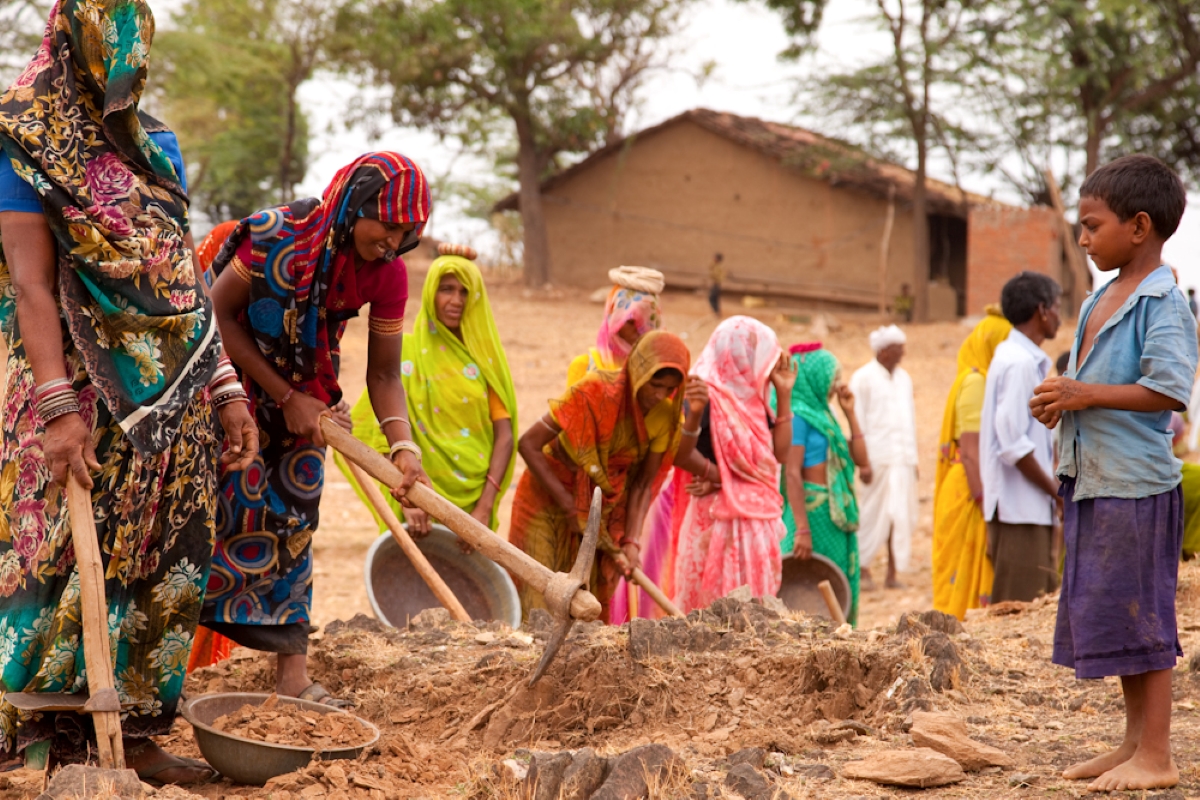
Women engaged in MGNREGA work. (Creative Commons)
Synopsis: A group of international academics wrote an open letter to express profound concern regarding the imminent repeal of the Mahatma Gandhi National Rural Employment Guarantee Act. The group urged a recommitment to the landmark legislation, which they said “stands as the world’s most significant policy operationalising a demand-driven, legal right to employment”.
A group of international scholars, policymakers, lawyers, and civic actors — who said are “all friends of India” — wrote an open letter to express profound concern regarding the imminent repeal of the Mahatma Gandhi National Rural Employment Guarantee Act (MGNREGA).
The group urged a recommitment to the landmark legislation, which they said “stands as the world’s most significant policy operationalising a demand-driven, legal right to employment”.
The letter was written in the wake of the passage of the Viksit Bharat Guarantee for Rozgar and Ajeevika Mission (Gramin) Bill, 2025 (VB G Ram G Bill) in the Lok Sabha amid Opposition protest. The Bill is intended to replace MGNREGA.
In its letter, the group said the current shift to devolve the scheme to states, without commensurate fiscal support, threatens its existence.
“States lack the central government’s financial capacity. The new funding pattern creates a catastrophic Catch-22: states bear legal liability for providing employment, while central financing is withdrawn. Previously contributing only 25% of material costs, states now face burdens of 40% to 100% of total costs, ensuring poorer states will curb project approvals, directly stifling work demand. This structural sabotage is compounded by discretionary “switch-off” powers, which allow the scheme to be suspended arbitrarily and render the guarantee meaningless,” the letter said.
They said MGNREGA transcends political lines, with its foundational principle that the national government must guarantee an employment safety net affirms economic dignity as a fundamental right. Empirical evidence underscores its impact.
“MGNREGA routinely generates over 2 billion person-days of work annually for some 50 million households, with transformative equity: more than half of all workers are women, and about 40% are from Scheduled Castes or Tribes. The early years of the Act coincided with unprecedented rural wage growth, and studies confirmed the program’s positive effects on economic output and efficiency, dispelling myths of unproductivity,” they said.
“However, chronic underfunding and payment delays have long hampered implementation,” they added.
They claimed that the unexplained defunding of West Bengal in the last three years exemplified political misuse. “The new framework institutionalises this risk, imposing unfunded mandates on states without consultation,” they said in the letter.
“MGNREGA’s demand-driven design not only provides wages but also builds vital rural assets such as wells, roads, and ponds, stimulating local economies. By making projects financially untenable for states, these multiplier effects are extinguished. MGNREGA has captured the world’s attention with its demonstrated accomplishments and innovative design,” they said.
They further said that dismantling it would be a historic error.
“It would abandon a proven instrument for poverty alleviation, social justice, and care for the environment. We call for its restoration through assured central funding, timely wages, and an unequivocal return to its foundational guarantee of the right to work,” they added.
The letter was signed by Olivier De Schutter, UN Special Rapporteur on extreme poverty and human rights; Isabelle Ferreras, Professor, University of Louvain, Belgium; James Galbraith, Professor, The University of Texas at Austin, USA; Darrick Hamilton, Professor, New School for Social Research, USA; Thomas Piketty, Professor, Paris School of Economics, France; Joseph E Stiglitz, University Professor and Nobel Laureate, Columbia University, USA; Mariana Mazzucato, Director, Institute of Public Purpose and Policy, University of London; Pavlina R Tcherneva, President, The Levy Economics Institute, USA; Imraan Valodia, Professor of Economics, University of Witwatersrand, South Africa; and Randall Wray, Senior Scholar, The Levy Economics Institute, USA.
(Edited by Muhammed Fazil.)


