


Published Mar 05, 2026 | 7:18 PM ⚊ Updated Mar 05, 2026 | 8:03 PM

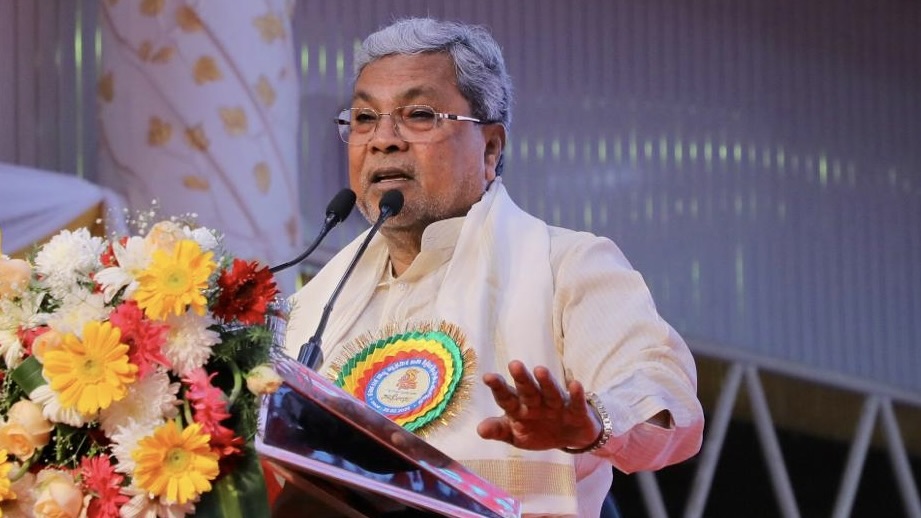
Karnataka Chief Minister Siddaramaiah.
Synopsis: Karnataka Chief Minister Siddaramaiah’s record 17th Budget, set to be tabled on 6 March, is expected to walk a tight fiscal tightrope amid pressure on his government from rising welfare spending, lower revenue due to GST rate rationalisation, and competing demands for development funding, including for Bengaluru and the Kalyana Karnataka region.
Karnataka Chief Minister Siddaramaiah is set to present his record 17th Budget on Friday, 6 March, a historic milestone in his political career.
But it comes amid mounting fiscal pressure on his government, hit by the impact of a mid-year GST rate rationalisation, the Centre’s retention of 41 percent vertical devolution, and the pressure of sustaining the party’s flagship guarantee schemes, making the budget a tightrope walk for the state.
A Mid-Year Review on State Finances 2025–26, tabled during the Legislative Assembly session in Belagavi, said the increase in committed expenditure, including spending on guarantees and various welfare schemes, has raised revenue expenditure.
“Simultaneously, the shortfall in revenue receipts on account of GST rate rationalisation has further constrained the state’s fiscal position,” it said.
In a statement to the media, Siddaramaiah recently said the state’s total liabilities by the end of March 2026 are projected at ₹7,64,655 crore, as per the 2025–26 Budget Estimates, which is 24.91 percent of the Gross State Domestic Product (GSDP).
In the 2025–26 Budget, the annual grant allocation for the development of Bengaluru rose from ₹3,000 crore to ₹7,000 crore. Funds were also allocated for projects such as the North–South and East–West corridor tunnel projects, the Peripheral Ring Road project, and railway tracks, among others.
Over the last year, the government has come under scrutiny for the poor condition of roads, pothole deaths, and garbage management.
With the Greater Bengaluru Authority (GBA) elections scheduled this year, more than a decade since the city last elected corporators, the state government is likely to grant a higher allocation for Bengaluru’s development.
Beyond Bengaluru, the state government faces pressure from leaders, including those from its own party, to pay greater attention to the demands of the Kalyana Karnataka region.
Kagwad MLA Raju Kage, who revived the demand for separate statehood for 15 districts of North Karnataka, said the region has faced injustice, discrimination, and neglect in every sector.
“If MLAs of the region also get ₹500 crore grants like those of Kalyana Karnataka, development will take place here also. Keeping the backwardness in view, I am in favour of statehood for the North Karnataka region,” he added.
In fact, a recent report by Karnataka Regional Imbalances Redressal Committee Chairman Govinda Rao identified Kalyana Karnataka as one of the most backward regions in the state, with six of its districts categorised as most backward.
A delegation of the Kalyana Karnataka Chamber of Commerce and Industry (KKCCI) reportedly met the Chief Minister recently to press for budgetary support for infrastructure development in the region.
It also remains to be seen whether the government will continue funding its flagship welfare schemes at the same scale or reduce allocations amid criticism from opposition leaders.
Deputy Chief Minister DK Shivakumar recently said the five guarantees were a “burden” on the state government but added there was no question of discontinuing them. In the 2025–26 Budget, the government earmarked ₹51,034 crore for the five guarantee schemes. A sixth guarantee of “land” was also announced recently.
Another challenge the government must address in the Budget is its stand on implementing the new VB-G RAM G.
While it recently became the third state to pass an Assembly resolution opposing the Act and demanding the reinstatement of MGNREGA, the state will have to make budgetary provisions for the old Act while also earmarking funds for the new scheme if it chooses to implement it.
If it opts out and introduces a fully state-funded scheme, it will have to forego support from the Central government.
The budget session, which will last until 27 March, is also expected to see the introduction and discussion of several bills.
The Karnataka Rohith Vemula (Prevention of Exclusion or Injustice) (Right to Education and Dignity) Bill, 2025, is one of them.
It seeks to prevent discrimination against students from Scheduled Castes (SC), Scheduled Tribes (ST), Other Backward Classes (OBC), and minority communities in higher educational institutions.
Penalties range from a written apology to one year in jail and a ₹10,000 fine for the first offence, and up to three years in jail and a ₹1 lakh fine for repeat offences. Courts may also order compensation of up to ₹1 lakh for victims.
An amendment to the BJP-era Karnataka Prevention of Slaughter and Preservation of Cattle Act, 2020, is also likely to be introduced.
In December 2025, the state Cabinet approved the amendment, which would allow vehicles seized for alleged illegal cattle transport to be released on furnishing an indemnity bond instead of a bank guarantee.
The government was expected to table the proposal during the winter session in Belagavi but decided against doing so after backlash from right-wing groups, including the Vishwa Hindu Parishad (VHP) and the Bajrang Dal, which held protests across the state after the amendment was announced.
The Karnataka Freedom of Choice in Marriage and Prevention and Prohibition of Crimes in the Name of Honour and Tradition Bill, 2026, also known as Iva Nammava, is also likely to be discussed during the session. The Bill was drafted after a spate of caste killings in the state.
In December 2025, a 20-year-old pregnant woman was killed by her family for marrying a Dalit man in Dharwad district. She was six months pregnant at the time of the murder. Following this incident, Siddaramaiah announced plans to draft a Bill to curb such crimes.
The Karnataka Crowd Control (Managing Crowd at Events and Place of Gathering) Bill, 2025, will also be discussed. Royal Challengers Bangalore (RCB) recently confirmed they would play five home games at the Chinnaswamy Stadium, months after a stampede killed 11 people outside the venue.
The confirmation came after the government gave the necessary clearances. The Bill would enforce crowd control by mandating punishment for violations related to mass gatherings, imprisonment of three to seven years and a penalty of up to ₹1 crore, or both, for those organising events without permission from the relevant authorities.
(Edited by Dese Gowda)


