

Published Dec 09, 2025 | 8:00 AM ⚊ Updated Dec 09, 2025 | 7:40 PM

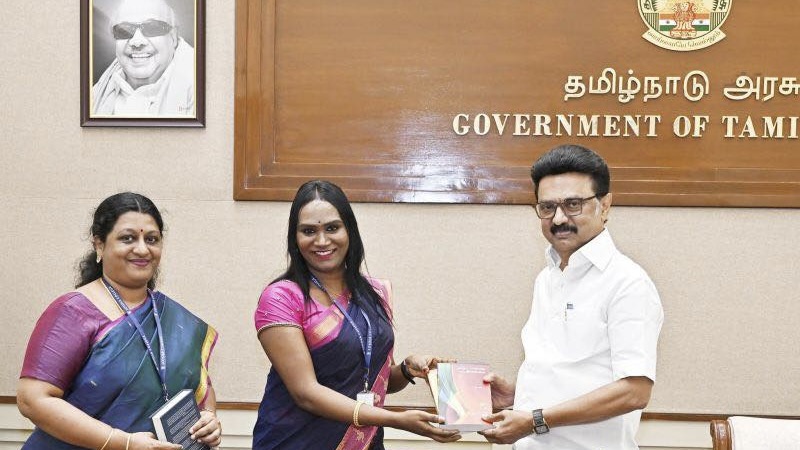
Dr N Jency with Chief Minister MK Stalin.
Synopsis: TRB examinations are not held regularly, with the last recruitment conducted almost 15 years ago. For transgender candidates like Dr N Jency, who have faced social, economic, psychological and physical oppression throughout their lives, missing such an opportunity is devastating.
In June, Dr N Jency, a transwoman, was appointed Assistant Professor in the Department of English at Chennai’s Loyola College, the first such appointment in Tamil Nadu.
Chief Minister MK Stalin had then invited Dr Jency to the Secretariat and personally congratulated her. Deputy Chief Minister Udhayanidhi Stalin, several political leaders and many public personalities also wished her well. In turn, Dr Jency had placed a simple request in front of all.
“I am currently working as a professor in a private college. I should be given a position as a government professor in a government institution,” she had said.
“And like me, many people from the transgender community should be given exclusive reservation in various government sectors so that they can advance in life.”
The demand was not new. Dalit and transgender activist Grace Banu, who has been fighting for transgender rights for many years, has also been consistently demanding exclusive reservations in education and employment for transgender persons.
But it has failed to yield any results. For the upcoming examination for 4,000 Assistant Professor posts on 20 December, the Tamil Nadu Teachers Recruitment Board (TRB) has not announced any exclusive reservation for trans persons.
The letter from Dr Jency to the department about the issue received a far from satisfactory response, leaving her and hundreds of others like her deeply disappointed.
The TRB is responsible for selecting professors for government arts and science colleges, teacher education colleges and engineering colleges.
In August 2019, the board issued a notification for recruiting 2,331 Assistant Professors for government arts and science colleges. But the exam remained unconducted for more than five years. By 2024, the vacancies had risen to 4,000, and a new notification was released in March that year.
That notification too was later cancelled. A fresh notification was issued on 6 October 2025, stating that all previous applicants must reapply. New applicants could apply until 10 November 2025.
Based on this, around 35,000 candidates are set to appear for the exam on 20 December. Candidates will be shortlisted for the next stage based on marks and reservation norms approved by the government.
According to the notification, 69 percent communal reservation will be applied vertically as per existing government rules and orders:
For horizontal reservation, 30 percent is reserved for women, priority is given to Tamil-medium candidates and 4 percent is set aside for persons with disabilities.
For transgender persons, the notification cites G.O.(Ms).No.90, dated 22 December 2017:
“Transgender candidates without community certificates may choose to be considered under the MBC category or under ‘Others’. Those belonging to SC / SC(A) / ST with proper certificates will be considered under their respective category. Those from other communities may choose to be considered either under their community or as MBC, whichever is beneficial, and this cannot be changed later.
“Regarding employment reservation, transgender persons identifying as female will be considered under both the 30 percent women’s quota and the 70 percent general category. Those identifying as male or transgender will be considered only under the 70 percent general category.”
But transgender applicants argue that placing them within male or female categories is unfair. They insist that only a separate transgender reservation category will allow them to secure their rightful place. Dr N Jency and several activists have strongly repeated this demand.
Women receive separate reservations because they are more vulnerable compared to men. Similarly, caste-based reservations exist because certain communities have been historically oppressed and pushed back in every social and educational sphere.
By the same logic, transgender persons, who face extreme discrimination socially, economically and educationally, can progress meaningfully only if they are provided exclusive reservation, argues Grace Banu.
“It is crucial who we are competing with,” she says. “I have no objection to existing gender- and caste-based reservations. But when transgender people are far more vulnerable and marginalised than both men and women, asking us to compete with them is simply unfair. Only exclusive reservation for transgender persons will ensure true advancement.”
In 2024, in a case filed by Banu and activist Rizwan Bharathi, the Madras High Court directed the Tamil Nadu government to explore the feasibility of providing 1 percent horizontal reservation for transgender persons in education and employment.
Likewise, in the 2018 case The Chairman, Tamil Nadu Uniformed Services Recruitment Board vs Aradhana, the Madras High Court referred to the Supreme Court’s landmark NALSA judgment, reproducing Paragraph 67:
“TGs have been systematically denied rights under Article 15(2)… not afforded special provisions under Article 15(4)… are SEBC and eligible for reservation… The state must take affirmative action… TGs are entitled to enjoy economic, social, cultural and political rights… and to reservation in public appointments under Article 16(4)… The government must uplift them so the injustice of centuries can be remedied.”
The Court further cited Paragraph 135(3): “We direct the Centre and State Governments to treat them as Socially and Educationally Backward Classes and extend all kinds of reservation in education and public appointments.”
The Court added that all concessions and relaxations granted to vulnerable groups must also apply to transgender persons, urging the state to “be the forerunner in placing those who have long been tread upon as the least among us, as the first among equals.”
In Rakshika Raj v State of Tamil Nadu (2024), the Court struck down the Tamil Nadu government’s GO that placed transgender persons under the 1 percent SEBC/MBC vertical reservation category. It held that treating transgender people as a separate backward class was unconstitutional.
However, the Court simultaneously directed the state to provide a 1 percent horizontal reservation for transgender persons across all categories in education and public employment, ensuring representation without misclassifying them under MBC.
TRB exams are not conducted regularly like other competitive exams. The last TRB recruitment for arts and science college professors was in 2010, almost 15 years ago. Missing this opportunity is difficult even for candidates with gender privilege.
For transgender candidates like Dr N Jency, who have faced social, economic, psychological and physical oppression throughout their lives—often abandoned by families, bullied at school and denied every form of support—a missed opportunity is devastating.
Many have fought against the odds to complete undergraduate, postgraduate and doctoral degrees. They cannot afford to wait another decade.
Dr Jency believes that a special reservation is the only path through which hundreds of transgender persons can follow in her footsteps.
“There were days I didn’t even have food to eat. I pushed through all that, completed my PhD and today I am a professor. But unless the government recognises us and gives us reservation in government jobs, my community cannot move forward,” she says.
“When you consider men and women, society has always given them some support system. But transgender children are often thrown out of their homes at a young age. We grow up entirely without any backing. Making us compete with men and women again and again is unfair,” say both Dr Jency and Grace Banu.
“Our struggle deserves at least some recognition. We fight against discrimination every day in every space. Only if the government acknowledges this and grants us reservation can we continue to move forward,” Dr Jency insists.
Activists urge Tamil Nadu to follow Karnataka’s example
While Tamil Nadu has been debating exclusive reservation for transgender persons for years, Karnataka took the historic step in 2021 by introducing 1 percent horizontal reservation for transgender persons in government jobs.
The Karnataka Civil Services (General Recruitment) Amendment Rules, 2021, added sub-rule (1D) to provide 1 percent reservation for transgender persons in posts filled through direct recruitment.
But it was Tamil Nadu that became the first state in India to establish a Transgender Welfare Board in 2008 under former Chief Minister M Karunanidhi.
The board issued ID cards, residence certificates and ration cards, and Karunanidhi insisted on addressing transgender persons respectfully as Thirunangai and Thirunambi.
More recently, the Tamil Nadu government released the draft Tamil Nadu State Policy for Transgender Persons, 2025. Yet, despite several welfare schemes, the long-standing demand for exclusive reservation remains unfulfilled.
Activists ask whether the reluctance stems from the fact that transgender persons constitute a small voter population. According to the electoral roll on 01 June 2025, Tamil Nadu has 9,120 transgender voters, between 10 and 150 per constituency.
According to the 2011 Census, Tamil Nadu has 22,364 transgender persons, which accounts for about 5 percent of the total transgender population in India. Of them, only 57 percent are literate.
Regardless of how many schemes exist, without exclusive reservation, the community will remain unable to access meaningful opportunities. Dr N Jency and Grace Banu reiterate that Tamil Nadu must immediately implement 1 percent horizontal reservation for transgender persons.
(Edited by Dese Gowda)


