

Published Dec 15, 2025 | 2:13 PM ⚊ Updated Dec 15, 2025 | 2:13 PM

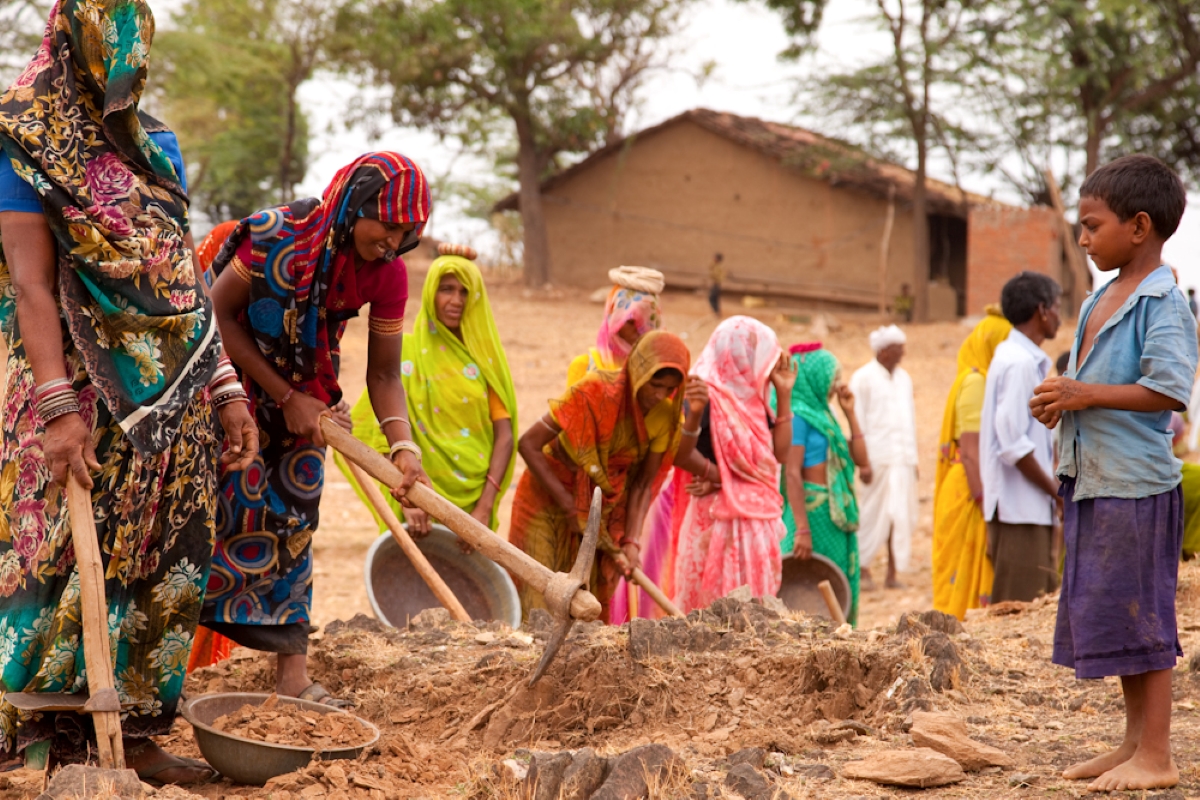
Women engaged in MGNREGA work. (Creative Commons)
Synopsis: Union Minister of Agriculture and Farmers Welfare Shivraj Singh Chouhan is expected to introduce the Viksit Bharat—Guarantee for Rozgar and Ajeevika Mission (Gramin) Bill, 2025 (VB–G Ram G Bill) in the Lok Sabha. The bill proposes to increase the number of employment days from 100 to 125, but it poses a higher financial burden on states with a 60:40 share of the fund allocation.
Union Minister of Agriculture and Farmers Welfare Shivraj Singh Chouhan is expected to introduce the Viksit Bharat—Guarantee for Rozgar and Ajeevika Mission (Gramin) Bill, 2025 (VB–G Ram G Bill) in the Lok Sabha on Monday, 15 December.
The Bill seeks to replace the Mahatma Gandhi National Rural Employment Guarantee Act (MGNREGA).
The bill proposes to increase the number of employment days from 100 to 125, but it poses a higher financial burden on states — except Northeastern states, Himalayan states and Union Territories — with a 60:40 share of the fund allocation.
Under the MGNREGA, the Union government bears the full cost of wages for unskilled manual work, up to three-fourths of material costs, and three-fourths of wages for skilled and semi-skilled workers.
Even after the Bill states that the Scheme implemented under this Act shall be a Centrally Sponsored Scheme, 40 percent of the financial burden falls on the states.
“For the purposes of this Act, the fund-sharing pattern between the Central Government and the State Governments shall be 90:10 for the North Eastern States, Himalayan States and Union territory (Uttarakhand, Himachal Pradesh and Jammu and Kashmir), and 60:40 for all other States and Union territories with legislature,” the Bill stated.
Adding to that, the Union government decides the state-wise normative allocation for each financial year, based on objective parameters prescribed by it. This provision will end the open-ended funding mechanism under MGNREGA.
“Any expenditure incurred by a State in excess of its normative allocation 35 shall be borne by the State Government in such manner and by such procedure as may be prescribed by the Central Government,” it added.
Further, the Union government will be identifying the rural areas in the states, and the state governments have to provide 125 days of guaranteed employment.
“Save as otherwise provided, the State Government shall, in such rural area in the State as may be notified by the Central Government, provide to every household whose adult members volunteer to do unskilled manual work, not less than one hundred and twenty-five days of guaranteed employment in a financial year in accordance with the Scheme made under this Act,” the Bill said.
The VB-G Ram G Bill also has the provision to pause the employment guarantee during peak agricultural seasons. The Union government said it is aimed at facilitating “adequate agricultural labour availability during peak agricultural seasons”.
“Notwithstanding anything contained in this Act or rules made thereunder, and to facilitate adequate availability of agricultural labour during peak agricultural seasons, no work shall be commenced or executed under this Act, during such peak seasons as may be notified under sub-section (2),” states Section 6(1) of the VB-G Ram G-Bill.
According to the Bill, the state governments have to notify in advance, a period of 60 days in a financial year, covering the peak agricultural seasons, during which works under this Act will not be undertaken.
According to the VB-G Ram G-Bill, payment of wages to workers shall be done every week, unlike MGNREGS, which has a 15-day limit.
“The disbursement of daily wages shall be made on a weekly basis or in any case not later than a fortnight after the date on which such work was done,” the Bill states.
However, it has retained the MGNREGA provision of compensation for payment delays.
“In case the payment of wages is not made within fifteen days from the date of closure of the muster roll, the wage seekers shall be entitled to receive payment of compensation for the delay, at the rate of 0.05% of the unpaid wages per day of delay beyond the sixteenth day of closure of muster roll,” says the MGNREGA.
The Bill states that from the day the notification regarding the VB–G Ram G Bill is released, the MGNREGA stands repealed.
“Save as provided in section 10, on and from such date as the Central Government may by notification appoint in this behalf (hereinafter referred to as the appointed date), the Mahatma Gandhi National Rural Employment Guarantee Act, 2005, together with all rules, notifications, Schemes, orders and guidelines made thereunder, shall stand repealed,” it said.
(Edited by Muhammed Fazil.)


