

Published Jan 11, 2026 | 10:15 PM ⚊ Updated Jan 11, 2026 | 10:15 PM

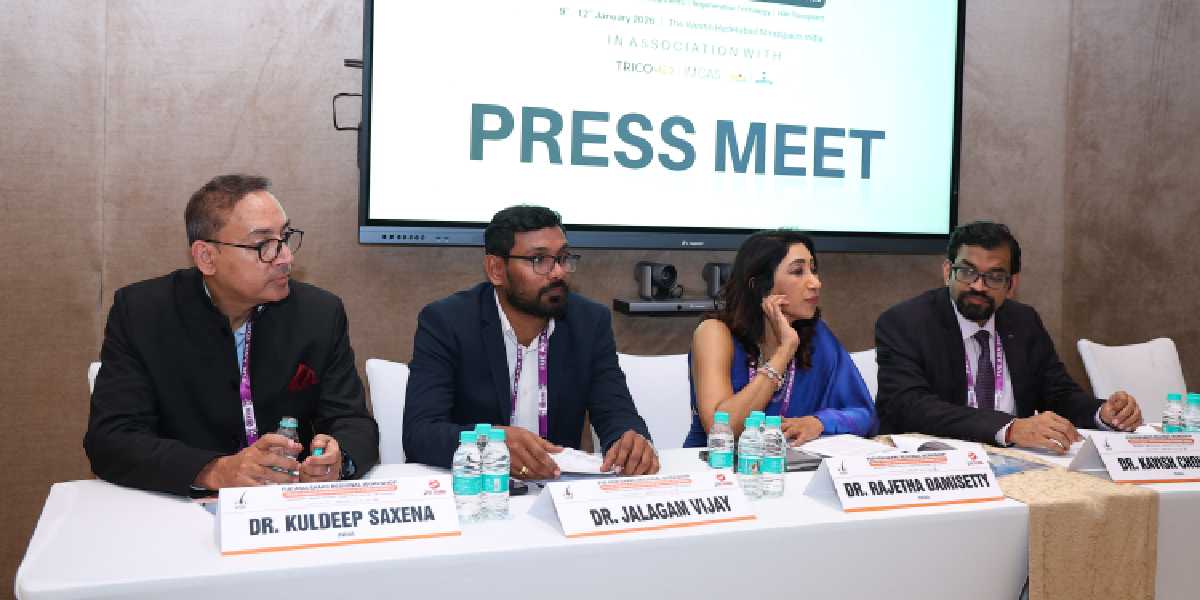
FUE Asia Regional Conference 2026 was held in Hyderabad. (Supplied)
Synopsis: Dermatologists in India are opposing the Union Health Ministry’s move allowing dentists with OMFS degrees to perform hair transplants, citing patient deaths, unlicensed clinics, and regulatory confusion. At the FUE Asia Conference 2026, experts warned of “ghost surgeries” and technician-led procedures. Legal challenges are underway, with dermatologists stressing that hair loss often signals systemic disease requiring specialist medical evaluation.
Dermatologists across India have pushed back against the Union Health Ministry’s position allowing dentists with postgraduate degrees in Oral and Maxillofacial Surgery (OMFS) to perform hair transplant procedures, warning that the move risks legitimising unsafe practices in a largely unregulated industry already linked to patient deaths.
The opposition was voiced sharply at the FUE Asia Regional Conference 2026 in Hyderabad, where senior dermatologists cited recent fatalities, regulatory confusion, and the proliferation of unlicensed clinics as evidence that hair transplantation must remain firmly within medical specialties trained to diagnose systemic disease.
Two engineers in their early 30s died after undergoing hair transplant procedures allegedly performed by a dentist in November 2024 and March 2025, incidents that have become central to dermatologists’ arguments against expanding the scope of dental practice.
“Patients today are not just losing hair. They are losing time, money, hair and hope,” said Dr Rajetha Damisetty, organising president of the conference. “In some cases, they are losing their lives. Hair transplantation is not a beauty service. It is a medical procedure with real risks.”
The dispute intensified after the Union Ministry of Health and Family Welfare clarified on 16 December that dentists holding OMFS degrees may perform aesthetic surgical procedures and selected hair restoration procedures, limited to the cranio maxillofacial region.
Minister of State for Health Anupriya Patel made the statement in response to questions raised in the Rajya Sabha by Vivek K Tankha, who sought clarity on whether the Dental Council of India’s permissions conflict with the National Medical Commission Act, 2019.
The ministry said OMFS specialists receive extensive surgical training under the Dental Council of India’s postgraduate curriculum and that the domains of the Dental Council of India and the National Medical Commission are complementary.
Dermatologists, however, argue that the clarification conflates reconstructive surgery with treatment of hair loss, which often reflects internal medical disorders.
Dr Kavish Chauhan, founder and secretary of FUE Asia, challenged the ministry’s reliance on the Dental Council’s interpretation.
“What the Union Health Minister quoted was the DCI circular,” Chauhan said. “But if you read that circular carefully, it talks about facial reconstructive surgery.”
He drew a clear distinction between reconstruction and elective hair loss treatment. “If someone has lost a moustache or hair due to burns, trauma, or surgery, something like Operation HOPE could arguably apply. But why should dentists start treating baldness? That is our contention.”
Hair loss, Chauhan said, is frequently a manifestation of hormonal disorders, metabolic disease, autoimmune conditions, or nutritional deficiencies.
“When health problems reflect in the hair, how will dentists know what they are looking at?” he asked.
The controversy traces back to a notification issued by the Dental Council of India on 6 December 2022, which stated that OMFS practitioners with adequate training could perform aesthetic and hair transplant surgeries, provided they were registered with State Dental Councils and had appropriate infrastructure.
That notification relied on a Gazette amendment dated 26 August 2019, which expanded the OMFS postgraduate curriculum to include facial aesthetic procedures, craniofacial trauma, skull base surgery, bone graft harvesting, and hair transplantation as a skill enhancement module.
Between 2021 and 2022, the DCI issued multiple communications reaffirming that position.
Medical regulators, however, disagreed.
After the Telangana Medical Council sought clarification in May, the National Medical Commission responded on 13 June stating that the DCI had issued its 2022 notification without consulting the Ethics and Medical Registration Board.
The NMC reiterated that hair transplant procedures should be performed by specialists with formal surgical training, such as MCh or DNB in Plastic Surgery or MD or DNB in Dermatology with appropriate surgical training.
On 26 June, the Telangana Medical Council issued a public notice stating that dentists, including OMFS specialists, lack the qualifications to perform aesthetic procedures or hair transplantation.
“Dentists and Oral and Maxillofacial Surgeons do not have these specialties as core subjects in their curriculum and therefore lack formal surgical knowledge and training to perform these procedures,” the notice said.
Two days later, the Telangana Dental Council countered, asserting that registered OMFS practitioners are authorised under DCI norms.
Dr Vijay Jalagam, co-opted member of the Telangana Medical Council, said enforcement remains the biggest challenge.
“If there are problems with doctors, doctors are the only ones who can solve them,” he said, outlining inspection drives across Hyderabad.
“We have inspected around 100 beauty centres. About 10 were found to be operating illegally,” Jalagam said. When dentists were found performing hair transplants, the council referred cases to the Dental Council. “We have written to about 20 to 30 practitioners, but we have not received any response so far.”
He painted a stark picture of regulatory failure. “In Madhapur alone, within 5 kilometres, you will find dozens of clinics either unlicensed or operating without proper infrastructure. I can show you 10 within minutes of this hotel.”
“Ghost surgeries” and technician-led transplants
Dr Chauhan warned of a growing phenomenon he described as “ghost surgery”.
“At many centres, a doctor books the procedure, but when the patient enters the operation theatre, technicians perform the entire surgery. The doctor is not present at all,” he said.
He stressed a basic rule of medical practice. “Any procedure where the skin is penetrated must be performed by a doctor. Technicians can assist, but they cannot extract grafts, implant grafts, or administer anaesthesia.”
Low-cost procedures advertised online, he said, almost always compromise safety.
Dr Damisetty said the DCI’s 6 December 2022 notice is currently under challenge in both Madras High Court and the Bombay High Court.
“Incidentally, the public notice that is most frequently cited was not signed by a doctor or a dentist, but by an accounts officer,” she said.
Dr Chauhan confirmed that dermatologists are seeking a stay and reversal of the permission granted to OMFS practitioners.
“We are also preparing a public interest litigation in the Supreme Court seeking comprehensive laws to regulate aesthetic skin and hair procedures,” he said.
Amid the legal and regulatory battle, dermatologists urged patients to exercise caution.
Dr Damisetty advised patients to verify medical degrees, state medical council registration, clinic licensing, operation theatre facilities, sterilisation standards, and the identity of the surgeon performing the procedure.
“Hair is an integral part of the body and often reflects internal health,” she said. “Evaluation of hair loss can uncover diabetes, PCOS, thyroid disease, nutritional deficiencies, and autoimmune disorders. Dermatologists are trained to see that. Hair transplants are not cosmetic commodities.”
While the Health Ministry says its December clarification resolves jurisdictional overlap by limiting OMFS practitioners to the cranio maxillofacial region, dermatologists argue that patient safety, not professional territory, lies at the heart of the dispute.
(Edited by Amit Vasudev)


