

Published Dec 12, 2025 | 10:03 AM ⚊ Updated Dec 12, 2025 | 10:03 AM


The 30th Edition of IFFK will begin on 12 December evening.
Synopsis: The 30th edition of the International Film Festival of Kerala begins on 12 December. From 12 to 19 December, Thiruvananthapuram is preparing for a week where cinema does not just entertain; it interrogates, remembers and resists. The festival opens not with glittering nostalgia, but with the bruised memory of Palestine 36 — a film that exhumes the 1936 revolt and echoes with the present-day anguish of Gaza.
At 30, the International Film Festival of Kerala (IFFK) refuses the comfort of celebration. Instead, it steps boldly into turmoil, opening with a Palestinian story of uprising and guided by the moral voice of an exiled Iranian filmmaker.
The festival opens not with glittering nostalgia, but with the bruised memory of Palestine 36 — a film that exhumes the 1936 revolt and echoes with the present-day anguish of Gaza.
Presiding over the jury is Mohammad Rasoulof, an Iranian filmmaker who has traded his homeland for artistic freedom, carrying into IFFK the weight of exile, censorship and unbroken dissent.
IFFK 2025 emerges not just as a film festival, but as a reminder that cinema — when unafraid — can challenge regimes, reclaim histories and demand empathy across borders.
With 206 films from 82 countries across 26 diverse categories, IFFK 2025 stands not merely as India’s most vibrant film festival but as its most politically conscious.
From 12 to 19 December, Thiruvananthapuram is preparing for a week where cinema does not just entertain; it interrogates, remembers and resists.

A still from Palestine 36
The 30th IFFK is set to open on an unmistakably political note, signalling its unwavering commitment to cinema that confronts power, history, and injustice.
This year’s opening film, Palestine 36 — Annemarie Jacir’s epic revisit of the 1936 Palestinian revolt against British rule and Zionist expansion — places the festival firmly within the urgent global conversation on Palestine.
By foregrounding Yusuf’s journey through a land on the brink of uprising, Jacir reclaims a chapter of resistance whose echoes resound sharply in today’s Gaza.
The film, which won Best Film at the Tokyo International Film Festival and was Palestine’s official submission to the 98th Academy Awards, sets a bold tone for the week ahead.
IFFK will also honour Jacir’s earlier work with the screening of Wajib, her 2017 Golden Crow Pheasant-winning film, as part of a special retrospective of early Suvarna Chakoram winners.
This curatorial stance gains further depth through IFFK’s dedicated Palestine package, a carefully chosen trio — All That’s Left of You, The Sea, and Once Upon a Time in Gaza — each reflecting the unbroken resilience of a people marked by displacement, trauma, and defiant hope.
At a moment of intense geopolitical polarisation, the festival’s programming becomes a cinematic act of solidarity.
Underscoring this political commitment is the appointment of exiled Iranian auteur Mohammad Rasoulof as Chair of the International Competition jury.
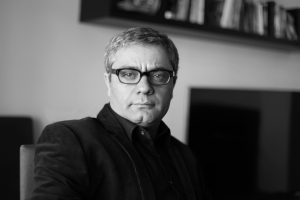
Mohammad Rasoulof
A filmmaker who has endured arrests, imprisonment, and censorship for speaking truth, Rasoulof’s presence at IFFK, said the organisers, transforms the jury chair into a declaration: that the festival stands with artists who risk everything for freedom.
Fresh from global accolades — including multiple Cannes wins for The Seed of the Sacred Fig and a place in TIME’s 100 Most Influential People — Rasoulof embodies the courage the festival seeks to champion.
Rasoulof has long faced censorship and punishment from the Iranian government for his independent filmmaking. Now living in exile in Germany, he has made five feature films — none permitted for release in Iran.
Arrested in 2010 while working with Jafar Panahi, he was sentenced to six years in prison. And last year, after The Seed of the Sacred Fig was selected for the Cannes Competition, he received another harsh sentence: eight years in jail, plus whipping and a fine.
Together, Palestine 36 and Rasoulof’s leadership shape IFFK 2025 as not just a celebration of cinema but a resolute political statement.
The film festival also brings together an extraordinary tapestry of global cinema shaped by resistance, memory, and artistic innovation.
The festival’s Country Focus spotlights Vietnam, commemorating the 50th anniversary of the Vietnam War through five acclaimed films — Glorious Ashes, The Tree House, Cu Li Never Cries, Don’t Cry Butterfly, and Once Upon a Love Story. Together, these works explore the nation’s cultural resilience, emotional landscapes, and the enduring scars of conflict.
The festival’s highest honour, the Lifetime Achievement Award, will be presented to Mauritanian maestro Abderrahmane Sissako, celebrated for films such as Life on Earth and the globally acclaimed Timbuktu.
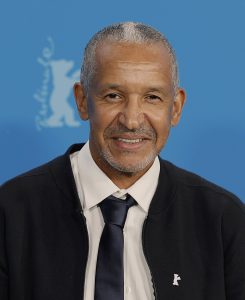
Abderrahmane Sissako
His body of work — rooted in themes of exile, identity, and everyday struggles — has played a crucial role in bringing African cinema to the world stage.
This year’s Spirit of Cinema Award — instituted at the 26th IFFK to honour courageous women filmmakers who use cinema as a tool of resistance — will be conferred on Canadian filmmaker Kelly Fyffe-Marshall, recognising her powerful storytelling.

Kelly Fyffe-Marshall
The award carries a cash prize of ₹5 lakh, a statuette, and a citation.
In the Retrospective section, IFFK revisits three landmark films by Saeed Akhtar Mirza — Naseem, Salim Langde Pe Mat Ro, and Arvind Desai Ki Ajeeb Dastaan — showcasing his pivotal contributions to Indian Parallel Cinema.
As part of the birth centenary tributes to Ritwik Ghatak, the festival will also screen restored versions of Meghe Dhaka Tara, Komal Gandhar, Subarnarekha, and Titash Ekti Nadir Naam, capturing the filmmaker’s searing reflections on Partition, displacement, and human endurance.
IFFK 2025 thus emerges as a vibrant convergence of political memory, artistic resistance, and cinematic heritage.
The film fest also unfolds as a vibrant celebration of world cinema, offering an extraordinary mix of genres, cultures, and creative visions.
This edition features an expansive World Cinema lineup of 57 films, including compelling queer narratives such as The Little Trouble Girls, Enzo, Mirrors No. 3, The Mysterious Gaze of the Flamingo, Amrum, and Cotton Queen.
The festival’s Special Screenings bring cinephiles a restored 4K version of Tarantino’s cult classic Pulp Fiction, while midnight screenings promise thrills with Spielberg’s Jaws and Hadrah Daeng Ratu’s The Book of Sigyn and Illiyn.
The Restored Classics section pays homage to cinema history with masterpieces like Kieślowski’s Blind Chance, Eisenstein’s Battleship Potemkin, Chaplin’s The Gold Rush, and the Malayalam gem Padatha Painkili.
Adding depth and diversity, IFFK turns its lens toward Latin American cinema, presenting a curated package featuring works by Laura Casabé, Cecilia Kang, Luciana Piantanida, Verónica Perrotta, and Francisco J Lombardi.
The Female Focus category elevates women’s voices and vision, showcasing powerful films by Kristen Stewart, Louise Hémon, Gaya Jiji, Paulene Loquès, and Shu Qi, exploring themes of identity, magical realism, and resilience.
Alongside the International Competition, Malayalam Cinema Now, and Indian Cinema Now sections, the festival also honours its legacy by spotlighting Golden Crow Pheasant award-winning films, including the pioneering Flowers of Shanghai (1998), the first to claim the top honour in 1999.
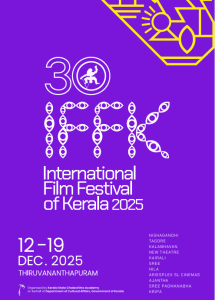
The curtain will rise on Friday. 12 December, in Thiruvananthapuram, for the 30th edition of the IFFK, a milestone moment for an event that has, over three decades, shaped Malayalis into global citizens through the beauty, politics, and poetry of world cinema.
Organised by the Kerala State Chalachitra Academy, the festival opens on Friday evening at 6 pm at the Nishagandhi auditorium, where Culture Minister Saji Cherian will officially inaugurate the landmark edition.
Chilean filmmaker Pablo Larraín will grace the inaugural ceremony as the chief guest.
Palestinian Ambassador Abdullah M Abu Shavesh and German Ambassador Dr Philip Ackerman will attend as special guests, adding to the festival’s international character.
This year’s festival brings an enriched set of experiences beyond screenings.
Three major exhibitions add depth to the celebrations: IFFK Experiencia, a curated walkthrough of the festival’s evolution over 30 years; a special exhibition commemorating the Ritwik Ghatak centenary in collaboration with West Bengal’s Department of Information and Cultural Affairs; and a showcase of artist–art director Namboothiri’s evocative location sketches, presented with the Kerala Lalithakala Akademi and the Artist Namboothiri Samman Trust.
As always, IFFK’s parallel events will keep conversations alive across the city, with Open Forum sessions, In Conversation series, Meet the Director events, the Aravindan Memorial Lecture, and cultural performances at Manaveeyam Veedhi.
Among the first to receive the delegate kit this year was actor Lijo Mol Jose, who recalled her early memories of IFFK and expressed hope that the festival would remain a space for dialogue, discovery, and new cinematic encounters.
Following the inauguration, Anne Marie Jasir’s Palestine 36 will be the opening film screened at Nishagandhi.
As IFFK turns 30, it also looks back on a remarkable journey.
Thirty years on, the International Film Festival of Kerala stands as one of India’s most beloved cultural spaces — where cinema provokes, comforts, provokes debate, and strengthens solidarity.
As the lights come on at Nishagandhi this evening, IFFK begins a new chapter in that storied legacy.
(Edited by Muhammed Fazil.)


