

Published Nov 15, 2026 | 10:29 AM ⚊ Updated Nov 15, 2026 | 10:30 AM

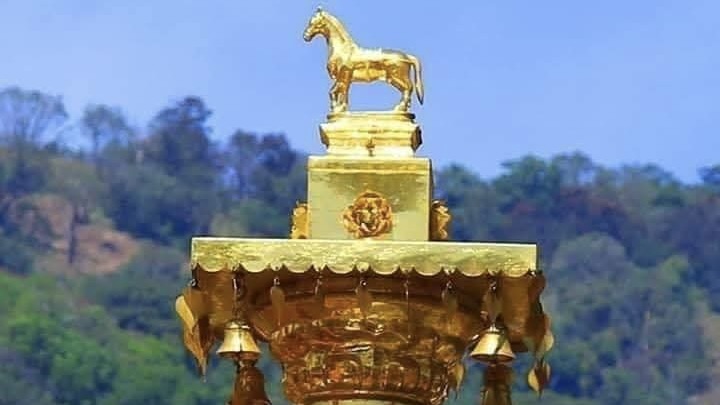
Sabarimala's gold-coated 'Vaji Vahanam', the 11-kg Panchaloha horse-shaped structure that once stood atop the shrine's old flag mast.

Synopsis: The Kerala High Court has held that a Tantri’s (head priest) authority to conduct religious rituals does not give him ownership rights over temple valuables or allow him to take them away as personal property. The Division Bench made the observation while dismissing a petition challenging a 2012 Travancore Devaswom Board circular, which requires old temple articles, including structures mounted atop flag masts, to remain Devaswom property even after replacement.
The Kerala HC has held that a Tantri’s (head priest) authority to conduct religious rituals in a temple does not give him ownership rights over the temple’s valuables or allow him to take them away as personal property.
A Division Bench of Justices KV Jayakumar and Raja Vijayaraghavan V made the observation while dismissing a petition challenging a Travancore Devaswom Board circular issued in 2012. The circular requires old temple articles, including metal structures mounted atop flag masts, to remain the property of the Devaswom even after they are replaced.
The court said that religious duties and the management of temple assets are two separate matters.
Once property is dedicated to a deity, it belongs to the deity and must be preserved and maintained as a Devaswom asset.
The ruling is significant in the context of the controversy surrounding Sabarimala‘s gold-coated ‘Vaji Vahanam’, the 11-kg Panchaloha horse-shaped structure that once stood atop the shrine’s old flag mast.
The artefact was handed over to Tantri Kandararu Rajeevaru in February 2017, when the old flag mast was replaced.
It came under renewed scrutiny in January 2026, when the SIT, probing the Sabarimala gold misappropriation case, seized it from the Tantri’s residence in Chengannur. It was later produced before the Kollam Vigilance Court on 13 January.
Also Read: Contractor arrested for allegedly diverting 11,040 kg of ghee meant for Sabarimala to two TN firms
The petition centred on whether the Tantri could retain the Vaji Vahanam as a customary offering or whether it should have remained with the TDB.
The petitioners, MS Sreerajkrishnan Potti and N Vishnu Namboothiri, chairman and vice-chairman of the Akhila Thantri Pracharak Sabha, argued that Tantris were traditionally entitled to receive such metal structures as Dhaanam (offering) under Verse 34 of the Shilpa Bhagam in the traditional text Tantra Samuchayam.
They contended that when an old flag mast is replaced, the metal structure mounted on it, depicting an eagle, bull, tiger or horse, should be handed over to the Tantri or melted down and given to him.
They also claimed that the practice had continued for generations and was protected under Article 25 of the Constitution.
The HC rejected this argument and said a Tantri’s ritual authority cannot automatically give him ownership of property belonging to a deity. Any separate customary right over such assets must be independently established under the law and cannot be presumed merely on the basis of a religious prescription.
The court also referred to the Devaswom Manual, which requires valuables such as flagstaffs, bells and articles made of gold, silver and Panchaloha to be entered in official registers.
The Bench clarified that its judgment did not examine the circumstances or legality of the 2017 transfer of the Sabarimala Vaji Vahanam or determine ownership of the artefact seized by the SIT.
(Edited by Dese Gowda with inputs from Sreelakshmi Soman)



