

Published Oct 14, 2026 | 7:00 AM ⚊ Updated Oct 14, 2026 | 7:00 AM

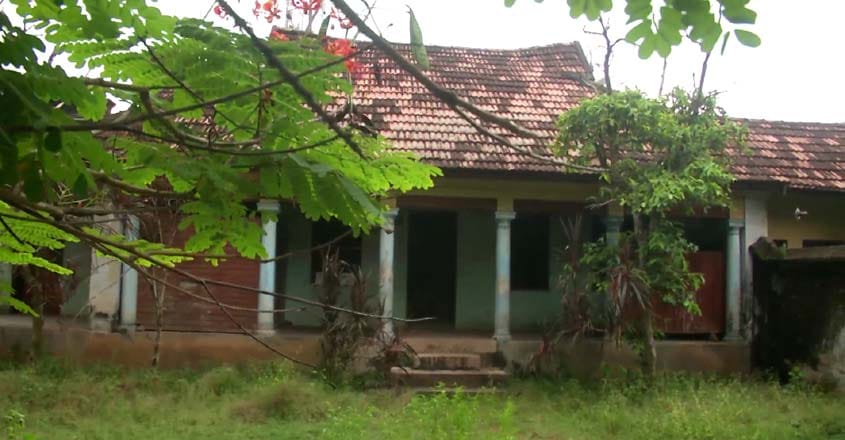
Uma Mandiram, the ancestral home of Koodathil family where seven mystery deaths happened over 26 years

Synopsis: Seven deaths over 26 years, a disputed will and the ancestral property allegedly passed into the hands of the family’s caretaker lie at the heart of the Koodathil family mystery in Thiruvananthapuram. The arrest of Raveendran Nair in connection with the 2017 death of Jayamadhavan, believed to be the family’s last heir, has brought renewed focus to a case marked by conflicting accounts, questions over suspicious deaths and allegations of foul play. After years of investigation, the arrest raises a larger question: was Jayamadhavan’s death an isolated case, or could it shed light on the fate of other members of the family?
Seven deaths, a disputed ancestral property and years of unanswered questions form the backdrop to the arrest of Raveendran Nair, caretaker of the Koodathil family at Karamana in Thiruvananthapuram, on Tuesday, 13 October.
The family’s run of deaths began in 1991 and continued over the next 26 years, ending with Jayamadhavan’s death in April 2017.
Raveendran had been under suspicion since Jayamadhavan’s death and was questioned by investigators at various stages, but his arrest came only on Tuesday in connection with the final death.
The case had gained fresh attention after a forensic report in 2021 pointed to the possibility of murder.
Allegations that the caretaker took control of the family’s ancestral property after the deaths of its last surviving members added another layer to the mystery.
The District Crime Branch is now investigating the case, though it remains unclear whether the arrest will lead investigators to revisit the other deaths in the family.
Also Read: Kerala’s shocking serial killings
It is the series of deaths within the once-affluent Koodathil family’s ancestral home, Uma Mandiram, several under mysterious circumstances, that continues to raise questions.
Gopinathan Nair, his wife Sumukhiyamma and their children Jayashree, Jayabalakrishnan and Jayaprakash are among those who died.
Jayamadhavan and Unnikrishnan Nair, sons of Gopinathan Nair’s elder brothers Narayana Pillai and Velu Pillai, also died.
The deaths of Jayamadhavan in 2017, Jayaprakash in 2012 and Jayabalakrishnan in 2002 have drawn particular attention, as all three were unmarried.
Questions surrounding the family’s fortunes intensified after Jayamadhavan, regarded as the last heir to its assets, died in April 2017.
Police had then told the media that he had mental health issues.
However, the post-mortem and internal organ examination reports pointed to a head injury as the cause of death.
Blood had clotted on his face, and forensic tests were conducted to establish how he sustained the injuries.
Investigators also recovered items from the scene, including a blood-stained piece of wood. Jayaprakash’s death, reportedly after he vomited blood, had not been followed by a post-mortem examination.
Though it was reported that both Jayaprakash and Jayamadhavan had mental health issues, substantiating medical records were missing, which in turn became another mystery.
Raveendran Nair, the family’s estate caretaker, had told investigators then that he reached Uma Mandiram on 2 April 2017, and found Jayamadhavan lying on the floor after apparently falling from his cot.
He said he then took him to the Government Medical College Hospital, Thiruvananthapuram, in an autorickshaw.
The circumstances later invited scrutiny, particularly over why neighbours were not alerted when Jayamadhavan was found seriously injured, while a domestic worker who lived some distance away was informed.
Property trail, conflicting accounts led to murder probe
The arrest of Raveendran Nair in connection with the death of Jayamadhavan Nair follows years of suspicion over the circumstances of the death and the transfer of the family’s properties to the caretaker and his son.
What began with a complaint to Chief Minister Pinarayi Vijayan in 2018 eventually led to a Crime Branch investigation, which uncovered conflicting accounts of the events surrounding Jayamadhavan’s death on 2 April, 2017.
A forensic examination later raised the possibility of homicide, prompting investigators to add murder charges to the case.
Also Read: Thiruvananthapuram man kills five, including family members
Jayamadhavan was reportedly found on the floor after falling from his bed at the family home and was taken to hospital by Raveendran and domestic worker Leela. He was declared dead.
Later, the family’s properties were found to have been transferred to Raveendran and his son under a will dated 15 February 2016, which the complainants suspected was fabricated.
The case came under scrutiny after Anil Kumar, a family neighbour, petitioned the Chief Minister in 2018. He argued that, without an heir, the property should rightfully go to the government and alleged that Raveendran and his associates had taken control of the estate.
Kumar, who reportedly witnessed the transfer of the properties, grew suspicious when Raveendran began using the family bungalow as his own. He said the two families had shared close ties, but contact faded after the caretakers took charge of the premises.
The Chief Minister forwarded the petition to then State Police Chief Loknath Behera, who ordered a probe by the District Crime Branch.
Prasannakumari, another complainant and a relative of the family, also raised questions about the deaths. She alleged that Raveendran was present when Jayaprakash, another member of the family, collapsed at home. Raveendran had taken him to a hospital in an autorickshaw without informing relatives.
She further alleged that records relating to the mental health treatment of Jayaprakash and Jayamadhavan had been found charred at the residence, and that Raveendran had threatened her after she approached the police. The family suspected foul play in both deaths.
Also Read: Of experiments with astral projection and massacres
The Crime Branch investigation into Jayamadhavan’s death gathered momentum after a forensic study indicated that the death could have been a homicide.
In 2021, investigators added Section 302 of the Indian Penal Code, relating to murder, to the FIR and brought the matter before the Chief Judicial Magistrate Court.
Investigators found discrepancies in the accounts given by Raveendran, Leela and the autorickshaw driver about what happened after Jayamadhavan was found injured.
Raveendran had told investigators that he found Jayamadhavan lying on the floor after a fall from his cot and took him to the Medical College Hospital with Leela. He said the two later went to the Karamana police station, where he gave a statement, while Leela returned to the family home.
Leela, however, reportedly gave a different account.
She said they did not go to the police station and that Raveendran had asked her to return home by autorickshaw because the body had to undergo a post-mortem examination. The contradictions became a focus of the subsequent investigation.
The autorickshaw driver also changed his account.
Though he initially said he transported Jayamadhavan to the hospital, he later claimed the journey did not take place as described. He alleged he gave the earlier version after Raveendran promised him ₹5 lakh. The first investigation team reportedly did not examine the revised statement, which had been recorded on video.
Prasannakumari also questioned why an autorickshaw, arranged with the help of another caretaker, Sahadevan, was used to take Jayamadhavan to the hospital instead of the vehicle usually associated with the household.
Also Read: How superstition, black magic reveal the other side of Kerala
The transfer of the estate became another major strand of the investigation.
According to the Crime Branch report, the will, reportedly drawn up in February 2016, was not registered but submitted through a notary. Subsequent attempts were made to transfer the land through the Manakkad village office.
The report cited the transfer of around 1.5 acres — valued at approximately ₹6.5 lakh a cent — to Raveendran. Another parcel, valued at around ₹4 lakh a cent, was allegedly transferred to an aide. The report also said Raveendran received 35 cents, worth about ₹5 crore, under the disputed will.
Investigators also examined reports that Raveendran handed over ₹25 lakh and ₹5 lakh to two individuals soon after Jayamadhavan’s death.
The property transactions, disputed will and conflicting statements formed part of the circumstances that prompted investigators to examine whether Jayamadhavan’s death was a case of homicide.
Thus, Raveendran’s arrest marks a significant development in a case that has remained under scrutiny for years.
It’s learnt that he was arrested following questioning at the Thiruvananthapuram City Police Commissioner’s office.
Police reportedly used brain mapping, a forensic investigative technique, as part of the probe before making the arrest.
The technique, also known as Brain Electrical Oscillation Signature Profiling (BEOS), records brainwave responses when a person is exposed to crime-related information. Investigators use these responses to assess whether the person appears to recognise details associated with the incident.
The case had drawn comparisons with the Koodathayi serial murder case in Kozhikode, in which a woman, Jolly Joseph, was accused of killing six members of her family spanning 14 years. The crime documentary, Curry & Cyanide: The Jolly Joseph Case, was based on the series of deaths.
(Edited by Majnu Babu).



