

Published Oct 04, 2026 | 12:00 PM ⚊ Updated Oct 04, 2026 | 12:01 PM

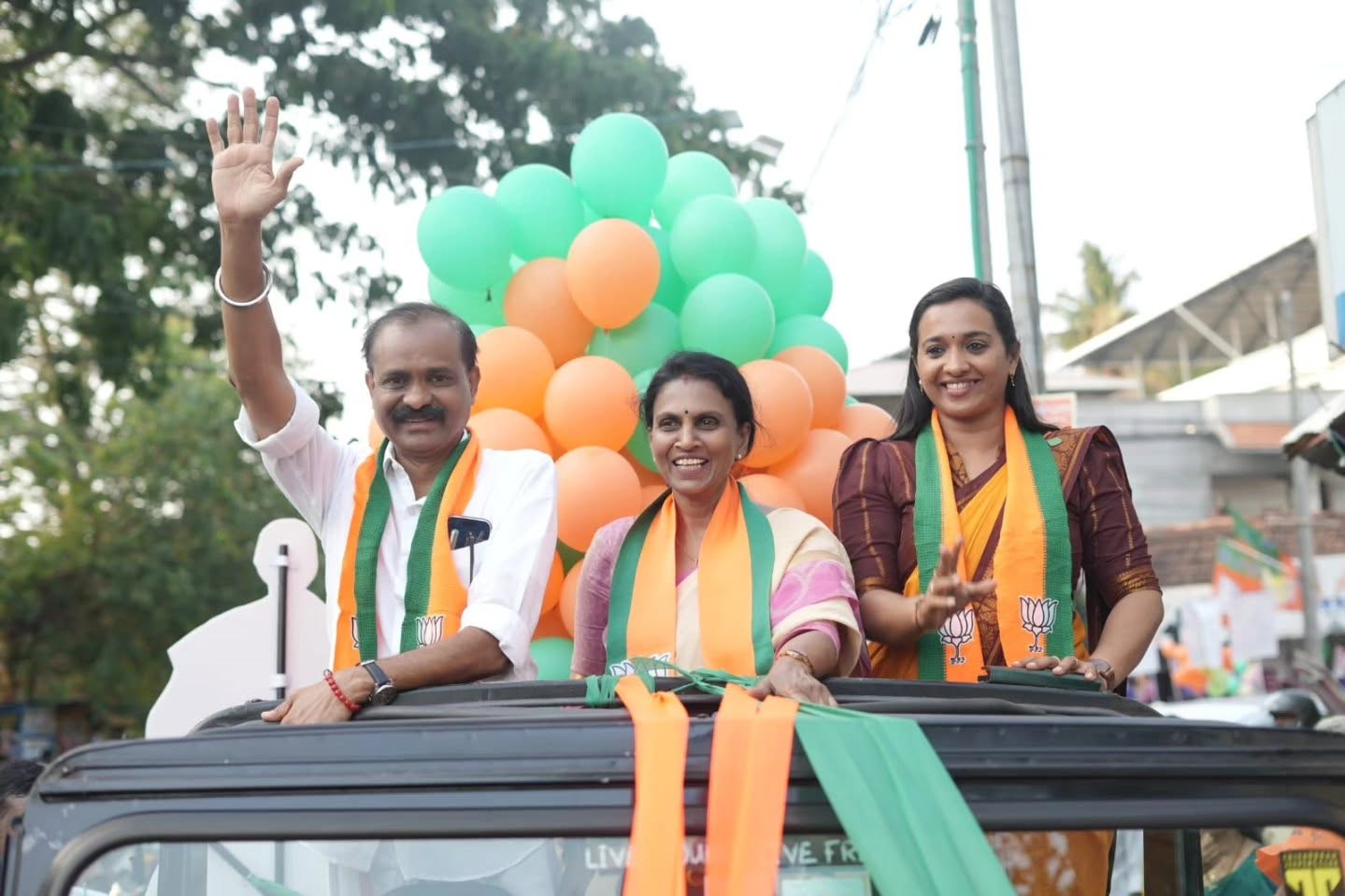
R Sreelekha flanked by Mayor VV Rajesh and Deputy Mayor Asha Nath GS

Synopsis: The BJP’s historic capture of Thiruvananthapuram Corporation is suddenly on shaky ground as party councillor and former DGP R Sreelekha moves to quit, putting its wafer-thin majority at risk. With the party’s one-seat majority hanging by a thread, Sreelekha makes her move, and the BJP counts its pieces.
In December 2025, Prime Minister Narendra Modi had called the BJP’s capture of the Thiruvananthapuram Corporation a “watershed moment” in Keralam politics. Ten months later, that watershed victory is facing a serious test — and the trouble is from within.
R. Sreelekha, the former DGP who was brought into the BJP with considerable political expectations and projected as one of its most recognisable faces in the capital, has announced her resignation as a councillor. If she stands firm on quitting, her exit comes at a particularly awkward moment for the BJP, which governs the 101-member Corporation with a one-seat cushion.
Her resignation threat has once again exposed just how fragile the arithmetic behind the BJP’s historic victory remains. The party has 50 councillors and depends on independent Pattoor Radhakrishnan to reach the 51-member mark needed to retain control. With Sreelekha’s resignation, the BJP’s tally could fall to 49, leaving the NDA camp with 50 members.
That makes the Sasthamangalam ward more than just another vacancy. A by-election there could determine whether the BJP can hold on to the Corporation it fought for decades to capture.
For the BJP, the political irony is hard to miss. Sreelekha was inducted into the party in October 2024, elevated as a state vice-president. There was even an expectation that she could emerge as the party’s mayoral face after winning Sasthamangalam. Instead, VV Rajesh took the mayor’s post, while Asha Nath GS became the Deputy Mayor, leaving Sreelekha as just another councillor in the council she had been expected to lead.
Her resignation announcement, therefore, comes less than a year after the BJP celebrated its biggest municipal breakthrough in Keralam. What began as the rise of a high-profile recruit now threatens to become an internal test of the party’s hold over the capital corporation.
The question now is not merely why Sreelekha walked out. It is whether the BJP can absorb her exit, if it indeed happens, without allowing the narrow arithmetic that brought it to power in Thiruvananthapuram to unravel.
Also Read: BJP’s civic majority in Thiruvananthapuram jolted as Sreelekha submits resignation to Mayor
Sreelekha may have announced her resignation, but technically she continues to hold office, with the resignation yet to be submitted in the manner prescribed under the Kerala Municipality Act 1994.
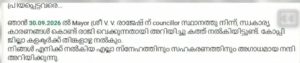
Sreelekha’s WhatsApp message announcing her resignation
Sreelekha announced in a WhatsApp group formed for the Sasthamangalam ward that she had decided to resign for “personal reasons” and had handed over her resignation letter to Mayor Rajesh on 30 September. She said a copy would be submitted to the District Collector on 5 October.
However, the Mayor and Corporation officials maintained that no formal resignation had reached the Corporation Secretary, the competent authority under the law to receive a councillor’s resignation.
Rajesh sought to play down the development, saying Sreelekha had handed him a letter detailing certain personal difficulties. He stopped short of confirming that it was a resignation letter, pointing out that a councillor has to submit the resignation to the Corporation Secretary.
Corporation Secretary J Muhammed Shafi also said no such communication had been received.
Under Section 40 of the Kerala Municipality Act, 1994, a councillor has to tender the resignation to the Secretary in the prescribed form. The resignation takes effect from the date the Secretary receives it, following which the fact has to be reported to the council and the State Election Commission.
A Corporation official said Sreelekha had “announced” her resignation, but had not initiated the formal process.
“The councillor may submit the resignation directly to the Secretary or send it by registered post, with the prescribed attestation where required. The Secretary has to acknowledge its receipt. None of that has happened in this case,” the official said.
The BJP leadership, meanwhile, is understood to be in touch with Sreelekha in an effort to address her grievances. Party sources said the fact that the letter was handed over to the Mayor and not the Corporation Secretary had left room for discussions and efforts to persuade her to reconsider.
Rajesh said the party was examining the concerns raised by Sreelekha and trying to find a way forward.
“On the basis of the letter I got and the information shared with me, I’m trying to take things forward smoothly and address them in the way possible,” he said.
For now, therefore, Sreelekha has announced her resignation, but has not formally resigned from the Corporation.
Also Read: BJP councilor R Sreelekha opts out of PM-hosted Delhi visit
The BJP’s historic capture of the Thiruvananthapuram Corporation could soon enter a more uncertain phase, with Sreelekha’s resignation threatening to strip the ruling NDA of its wafer-thin majority.
Sreelekha’s decision to quit as councillor from Sasthamangalam has changed the arithmetic of the 101-member council.
If the resignation is formally moved, the BJP’s strength will come down to 49.
With the support of independent councillor Pattoor Radhakrishnan, who represents Kannammoola, the NDA will have 50 members — one short of the majority mark.
That leaves the BJP with a difficult stretch ahead.
The party’s biggest gain in the 2025 local-body elections was winning 50 of the corporation’s 101 wards, emerging as the single largest party. But 50 was not enough to form the council on its own. Radhakrishnan’s decision to support the BJP-led NDA provided the crucial 51st vote and paved the way for the BJP to take control of the corporation for the first time.
Sreelekha’s exit threatens to undo that arithmetic.
For the moment, the BJP’s immediate task is to prevent the resignation from becoming final.
If she remains firm, the party will have to keep the council functioning without a majority and, at the same time, prepare for the Sasthamangalam by-election.
That election could become the BJP’s most important political battle in the corporation.
A BJP victory would restore its strength to 50 and, with the independent’s support, take the NDA back to the 51 needed for a majority. A defeat, on the other hand, could prolong the uncertainty and give the opposition an opening to test the stability of the Rajesh-led administration.
The BJP is already dealing with another vacancy-like situation.
Its councillor from Vazhottukonam, R Sugathan, is in jail in connection with a case under the Kerala Anti-Social Activities (Prevention) Act (KAAPA). His absence has complicated the ruling front’s position in council proceedings. He has been granted six months’ leave to avoid disqualification arising from prolonged absence from council meetings.
The opposition had already tested the waters earlier this year.
The UDF had planned to move a no-confidence motion against the BJP-led council in June. But with only 20 councillors, it needed the LDF’s support to take the move forward. The LDF, which has 29 members, did not agree to back the initiative, forcing the UDF to drop the plan.
Sreelekha’s resignation now brings the question back into focus.
The LDF and UDF together have 49 councillors — exactly the strength the BJP would have after Sreelekha’s resignation.
Whether that arithmetic can translate into a change of administration, however, will depend entirely on whether the two fronts are willing to work together.
That is far from settled.
After the 2025 election, both the LDF and UDF chose to remain in opposition rather than join hands to prevent the BJP from taking control. Their positions have remained sharply divided on several political issues, and the LDF’s refusal to support the UDF’s earlier no-confidence initiative showed the difficulty of stitching together an anti-BJP arrangement at the corporation level.
The resignation could nevertheless force both fronts to reconsider their approach.
A no-confidence motion, if brought, would require the prescribed number of councillors to move it, while its success would depend on the numbers at the council. With the NDA reduced to 50, the BJP can no longer rely on the comfortable arithmetic it had at the beginning of its term.
The independent councillor’s position could also assume greater significance.
For the BJP, therefore, the immediate strategy is likely to be two-fold: retain the support that keeps the administration afloat and fight the Sasthamangalam by-election with the aim of restoring the lost seat.
For the LDF and UDF, the dilemma is different. They now have an opportunity to challenge the BJP’s hold, but doing so would require an understanding between two fronts that have so far remained unwilling to share the same political platform in the corporation.
The numbers have changed. Whether the political equations change with them remains the bigger question.
Also Read: BJP’s R Sreelekha criticises party for backing out of its promise
The BJP was well aware of Sreelekha’s displeasure, but it apparently did not see this move coming.
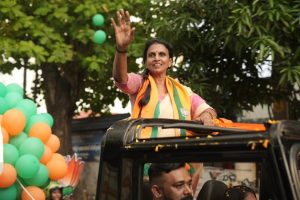
R Sreelekha
The immediate challenge before the leadership is to prevent an internal disagreement from turning into a larger political embarrassment.
Sreelekha had entered the Corporation election with the expectation that a BJP victory would put her in contention for the Mayor’s post. The party, however, settled on Rajesh for the position after emerging as the single largest bloc by a narrow margin. The decision did not go down well with Sreelekha, who made her dissatisfaction known within the party as well as in public.
The leadership subsequently appeared to have explored the possibility of accommodating her with a position at the national level. A berth in the National Commission for Women was understood to be among the possibilities discussed.
That, too, did not materialise.
The recent appointment of Nivedita Subramanian, who had contested the Guruvayur Assembly constituency in 2016, to the National Commission for Women has added another layer to the episode.
The party is now scrambling to contain the fallout.
State BJP president Rajeev Chandrasekhar is expected to hold a direct discussion with Sreelekha in an effort to persuade her to withdraw the resignation.
The differences themselves were hardly a secret within the BJP.
What appears to have caught the leadership off guard was Sreelekha’s decision to take the dispute out of the party forum and announce an exit.
For the BJP, it is an awkward move on a political chessboard where every piece matters.
What began as a disagreement over the Mayor’s chair has now left the party having to work out its next move in the Corporation.
(Edited by Majnu Babu).



