

Published Nov 26, 2026 | 8:54 AM ⚊ Updated Nov 26, 2026 | 9:03 AM

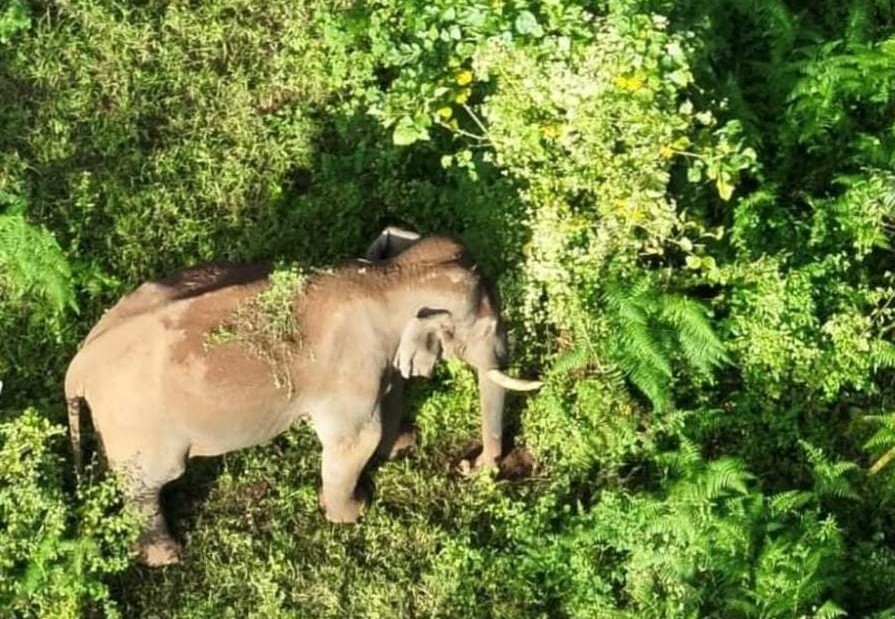
Chakkakomban basking in the evening sun on Wednesday, 26 November. (Supplied)

Synopsis: More than 100 forest department officials are tracking Chinnakanal’s Chakkakomban, a jackfruit-loving wild elephant, a day after thick, tall grass prevented a tranquiliser dart from penetrating the animal’s skin. The decision to radio-collar the majestic jumbo followed its repeated incursions into human settlements and growing public safety concerns.
The operation to tranquilise, radio-collar, and release wild elephant Chakkakomban at Chinnakanal in Keralam’s Idukki district resumed at 4 am on Thursday, 26 November, a day after a failed attempt.
A 140-member Forest Department team is tracking the wild tusker, last spotted near the Kudi settlement. Rapid Response Team, elephant squads and two kumki elephants, Vikram and Bharat, brought from Muthanga, are assisting the operation.
On Wednesday, 25 November, a tranquiliser dart fired around 3.45 pm in the Omanakkuzhi area failed to penetrate the elephant’s skin fully after hitting thick grass, High Range Chief Conservator of Forest DK Vinod Kumar said.
Officials said the tranquiliser dart would be fired only after Chakkakomban moves to a safe location, as the tusker is currently staying close to human settlements.
When the team made another attempt, Chakkakomban charged at the personnel before retreating towards the Anayirangal dam area. Heavy rain and thick fog that enveloped the area further disrupted the operation, while the elephant eventually disappeared into the dense forest.
The department aims to tranquilise the elephant and fit it with a GPS-enabled radio collar for continuous monitoring, rather than translocating it, as it did with another tusker, Arikomban, three years ago.
Prohibitory orders restricting public movement and unauthorised drone and camera use remain in force in the operation zone.
Also Read: Mission Chakkakomban faces minor setback
On Wednesday, officials had expected Chakkakomban to sleep until after midday. Waking up earlier than expected, it lumbered around the Anayirankal Dam reservoir on the Panniyar River in Chinnakanal.
Chakkakomban foraging by the Anayirankal Dam on the Panniyar River on Wednesday.
The animal then moved through Ponnuswamy Estate, near the 80-Acre Colony, before reaching the reservoir. The task force monitored its movements from a boat as it swam towards an islet. Officials waited for it to move into a safe, accessible area of the forest before attempting to tranquillise it.
Attempts to drive the tusker towards the forest by bursting crackers failed. Officials had ruled out darting the elephant near the water body, fearing it could drown if it collapsed into the water after being tranquillised.
The decision to radio-collar the majestic jumbo followed its repeated incursions into human settlements and growing concerns over public safety.
Residents of the area named the elephant Chakkakomban — a portmanteau of the Malayalam words chakka (jackfruit) and komban (tusker) — in reference to its penchant for the fruit.
The initial plan was to guide the tusker to an open, safe area, away from water bodies and steep slopes, before tranquillising it. After fitting the radio collar and completing medical examinations, the team would release the animal in the same forest area, despite calls to translocate it.
The operation revived memories of the 2023 mission to capture Arikomban, a rice-loving wild elephant that had repeatedly raided settlements and ration shops in the Chinnakanal region. Ari means rice in Malayalam.
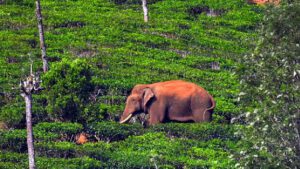
Arikomban roams around a tea estate in Munnar before its capture. (Supplied)
In that operation, a 150-member Rapid Response Team, led by Dr Arun Zachariah and assisted by four kumki elephants, tranquillised and captured Arikomban near Cement Palam after a 12-hour operation on 29 April 2023.
The team subsequently relocated the elephant to the Kalakkad-Mundanthurai Tiger Reserve in Tirunelveli district, Tamil Nadu, where it continues to be monitored in the wild.
Safety concerns had prompted the District Collector to issue prohibitory orders in wards 1, 2, 9, 10, 11 and 12 of the Chinnakanal grama panchayat. The District Collector declared a holiday for all educational institutions, including anganwadis, professional colleges, and tuition centres, and suspended all tourism-related activities in the area.
As the wild elephant issue once again became live, a strongly worded intervention by former Indian Forest Service officer Prakriti Srivastava in 2023 has refocused attention on the roots of the crisis.
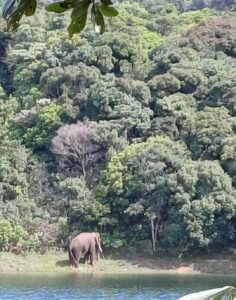
A June 2023 photograph of Arikomban in Tamil Nadu. (Supriya Sahu/X)
Srivastava, who served as Divisional Forest Officer (DFO) of Munnar between 2002 and 2004, had then offered a rare insider account of how administrative decisions ignored repeated warnings about settling people inside a known elephant corridor.
In her detailed statement issued at the height of the Arikomban controversy, the former officer categorically stated that the conflict now gripping Chinnakanal was not sudden, but the outcome of decisions taken despite objections raised by the Forest Department.
She clarified that public discourse had often wrongly merged the issue of Mathikettan encroachments with the later rehabilitation of landless tribal families in Chinnakanal.
A suggestion she had once made to relocate Mathikettan encroachers to Chinnakanal was merely an informal recommendation made in desperation to protect Mathikettan forests and had no legal or administrative sanction.
Srivastava pointed out that Mathikettan was eventually cleared of encroachments and later notified as a National Park, and it remains a thriving wildlife habitat today.
However, the larger crisis unfolded elsewhere.
She revealed that in 2003, a Cabinet decision assigned nearly 276 hectares in Chinnakanal to 559 landless tribal families.
As DFO, she had objected to the move, warning authorities that the land fell within a traditional elephant corridor and that human-wildlife conflict was inevitable if settlements were permitted there.
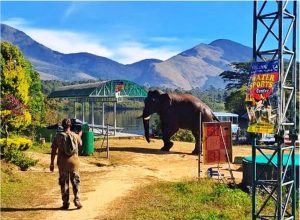
A file picture of Chakkakomban near the Anayirankal dam.
Those warnings, she noted, went unheeded.
“Within a year of settlement, conflict escalated,” she had stated, adding that the mushrooming of resorts in the region further blocked elephant movement and worsened the situation.
In one of the statement’s most striking observations, Srivastava remarked that wildlife often ends up paying the price for human errors.
“It is ironic that we humans commit the misdeeds and the hapless wildlife have to pay the price while also being villainised by being called ‘rogue’, ‘thief’ and other such anthropomorphic adjectives,” she said.
The former officer also highlighted a structural flaw in governance, alleging that the Revenue Department routinely assigned land without consulting the Forest Department, creating long-term ecological and social consequences.
She further disclosed that several high-level discussions had taken place over the years, including in 2006 and 2009, but no lasting solution was implemented.
A comprehensive draft mitigation plan prepared in 2017, she said, had identified the problem in detail and proposed long-term measures. But the proposal never moved beyond the draft stage, reportedly because of the scale of financial and structural changes required.
Throwing weight behind the arguments, an official with the Divisional Forest Office, Munnar, said, “Relocating elephants may offer temporary relief, but it cannot resolve the deeper ecological crisis unfolding in Chinnakanal.”
“The real issue is the steady fragmentation of traditional migratory corridors and mounting human pressure inside elephant habitats. Unless long-term habitat restoration and scientific land-use planning are pursued together, Chinnakanal will remain a conflict zone for both people and wildlife,” the official added.
Alongside the IFS officer’s observations came the findings and recommendations of a five-member expert committee.
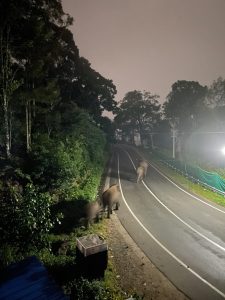
A herd of wild elephants hurrying across a road at Chikkakanal on Wednesday.
The Kerala High Court appointed it in 2023 to address the escalating human-wild elephant conflict in the Chinnakanal and Santhanpara regions.
In its report submitted to the court in 2024, the panel painted a grim picture of an elephant population trapped within fragmented habitats and increasingly forced into human settlements.
The committee warned that unless traditional movement routes were restored and ecological pressures reduced, the conflict would continue to intensify.
At the centre of the recommendations was the reopening of the historic elephant corridor linking Anayirankal and Old Devikulam in Munnar.
The panel stressed that securing the 60-acre shola forest corridor was critical to reconnect the isolated elephant population in Chinnakanal with the larger Munnar landscape, which spans nearly 4,500 square kilometres.
Restoring the corridor would allow elephants to move freely through their traditional migratory paths, reducing repeated encounters with humans and easing pressure on both wildlife and local communities, the report said.
The committee also recommended the voluntary relocation of the conflict-prone 301-Acre and 80-Acre colonies in Chinnakanal, with priority to be given to the 301-Acre settlement.
It further suggested exploring the possibility of declaring the region a conservation reserve to curb encroachments and illegal activities that threaten wildlife habitats.
The report also raised concerns over the growing disturbance caused by off-road jeep safaris in the Kolukkumala area near Suryanelli.
With more than 180 safari jeeps operating in sensitive habitats, the panel called for a scientific study to assess whether restrictions or even a complete ban on jeep operations were necessary.
Yet, despite the detailed recommendations, the conflict continues unabated.
“People here live with constant anxiety. But nobody can honestly say the elephants are invading our land. We entered forests that were once part of their route. The problem is that now both humans and elephants are trapped in the same space,” Maruthan of Chinnakanal said.
For the people of Chinnakanal, every stretch of mist-covered road and every fall of darkness carries the fear that a wild elephant could emerge without warning.
But for the elephants, these hills are not unfamiliar territory. Long before settlements, roads and tourism arrived, these forests formed part of ancient migratory paths travelled for generations.
(Edited by Majnu Babu).



