

Published Sep 27, 2026 | 7:00 AM ⚊ Updated Sep 27, 2026 | 7:00 AM

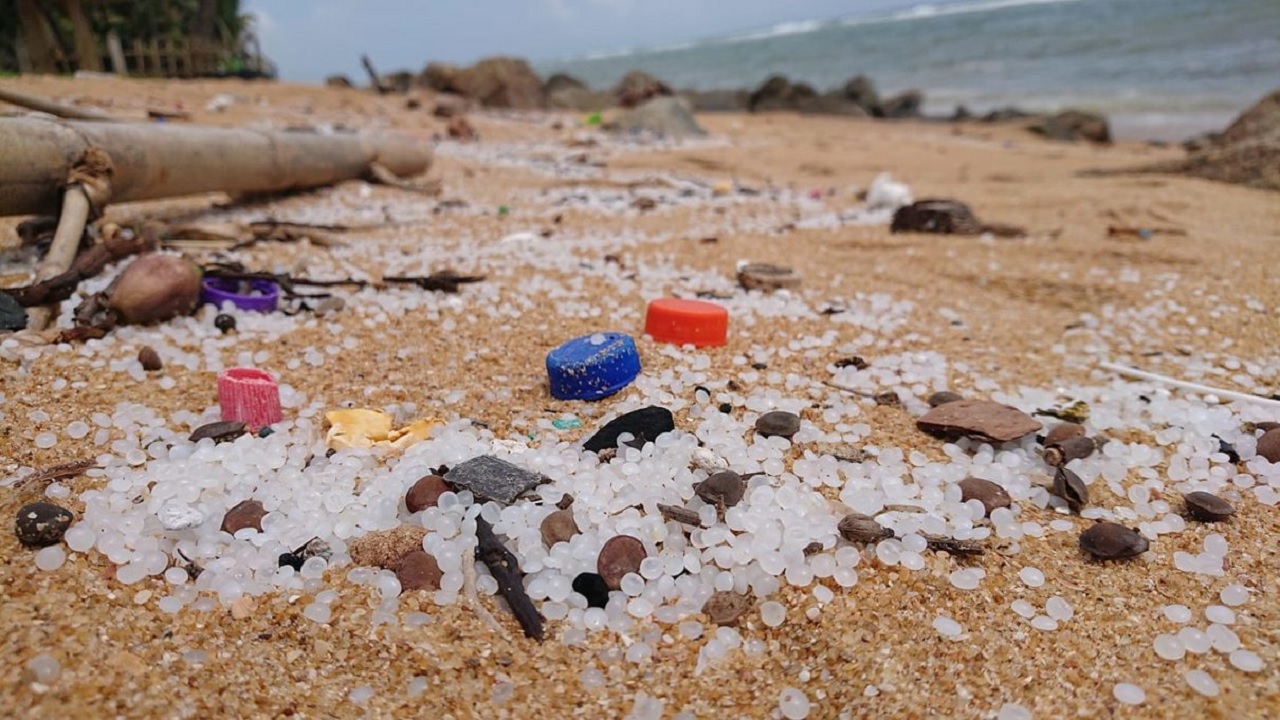
Researchers recorded nurdle concentrations as high as 31,230 pellets per square metre at some shoreline locations soon after the spill.

Synopsis: More than a year after the MSC Elsa-3 sank off Kerala, new research shows the impact continues to be felt along the coast. A KUFOS-SDMRI study found plastic pellets from the ship on the shores of Kerala and Tamil Nadu, some buried up to 20 cm beneath the sand and carrying harmful chemicals. As courts assess the disaster’s financial losses, the study raises a broader question: how do we measure damage to the sea and the coast?
A shipwreck is haunting the coastline of Keralam, Kanniyakumari and beyond even after a year.
The Liberia-flagged container MSC Elsa-3 sank off the Kochi coast after developing a severe list while sailing from Vizhinjam to Kochi on 25 May 2025. The vessel had suffered flooding and a mechanical failure in its ballast system, eventually tilting nearly 26 degrees to starboard.
Efforts to tow and salvage it failed, and the ship sank roughly 14 to 38 nautical miles off the Kochi coast. The Indian Navy and Coast Guard rescued all 24 crew members and brought them ashore.
However, the story didn’t end there. It was, in fact, the beginning.
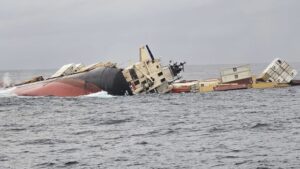
The MSC Elsa 3 sank on the morning of 25 May 2025.
The ship was ferrying around 640 containers, including hazardous material such as calcium carbide, along with large quantities of diesel and furnace oil. They all fell and spread over the sea.
What followed was a different kind of threat—one far smaller, almost invisible from a distance, but capable of travelling hundreds of kilometres along the coast.
Plastic resin pellets, commonly known as nurdles, started washing ashore.
More than a year after the sinking, a new study by the Kerala University of Fisheries and Ocean Studies (KUFOS) and the Suganthi Devadason Marine Research Institute (SDMRI), Tuticorin, has raised fresh concerns over what happened to those tiny pellets.
The study, titled ”Environmental Transformation and Ecological Interactions of Spill-derived Plastic Resin Nurdles Following the MSC ELSA-3 Spill, India”, tracked the pellets for a year across 93 coastal sites in Keralam, Kanniyakumari and the Gulf of Mannar.
The Gulf of Mannar, between India’s southeastern tip and Sri Lanka’s west coast, is a large, shallow bay with a chain of low islands and reefs. It is home to more than 3,6000 species of flora and fauna.
Related: MSC ELSA 3 sinks off Kochi coast
The researchers recorded nurdle concentrations as high as 31,230 pellets per square metre at some shoreline locations soon after the spill.
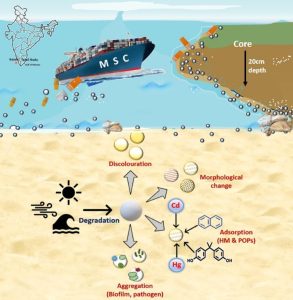
The MSC ELSA 3 wreck
Although densities at the initially affected sites fell by more than 80% within three months, the pellets did not vanish. Instead, new hotspots emerged.
By October 2025, concentrations reached 10,875 pellets per square metre on the mainland shores of the Gulf of Mannar and 2,960 pellets per square metre on islands. By May 2026, researchers were still finding spill-derived nurdles, including pellets buried as deep as 20 centimetres in beach sediments.
This buried plastic is significant because a clean-looking beach does not necessarily mean the contamination has disappeared.
The researchers also examined what happened to the pellets as they remained in the marine environment. Exposure to sunlight, waves, abrasion and other environmental processes altered their surfaces. Weathering increased polymer oxidation and surface roughness, creating conditions for contaminants and microorganisms to accumulate.
The study recorded polycyclic aromatic hydrocarbons (PAHs) of up to 0.239 mg per kg and bisphenol A (BPA) of up to 0.82 mg per kg on weathered nurdles. Sediment total petroleum hydrocarbons (TPH) reached 112.83 mg per kg at some locations.
In other words, the pellets were not merely pieces of plastic lying on a beach. Over time, they could become surfaces on which other substances accumulate and microbial communities develop.
The researchers described this as the development of a ”plastisphere” — a human-made ecosystem consisting of organisms able to live on plastic waste.
Related: Kerala government releases cargo manifest of MSC ELSA 3
Researchers examined biological interactions and found differences between organisms exposed to relatively fresh pellets and those interacting with weathered, contaminant-enriched nurdles.
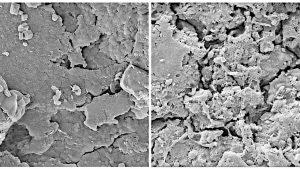
Plastisphere
While relatively fresh nurdles were associated with minimal physiological disturbance, weathered, contaminant-enriched pellets were associated with elevated oxidative stress and histopathological alterations in the marine organisms examined.
Oxidative stress occurs when harmful reactive molecules overwhelm an organism’s ability to neutralise them. Histopathological alterations refer to changes in tissue structure that can be identified under microscopic examination.
The significance is not that every fish or marine organism exposed to a nurdle will necessarily suffer the same effects. Rather, the findings indicated that environmental ageing can change the nature of the pellets and their biological interactions.
That makes the long-term behaviour of the spill important.
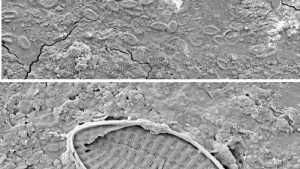
A plastisphere is a human-made ecosystem of organisms that can live on plastic waste.
The research team—K. Immaculate Jeyasanta, M. Jayanthi, R.L. Laju and Biju Kumar combined shoreline surveys, sediment coring, polymer and surface analysis, contaminant testing, microbial assessment and examination of fish.
The monitoring covered 93 locations between May 2025 and May 2026- five sites along the Keralam coast, 30 along Kanniyakumari and 39 mainland locations in the Gulf of Mannar, besides sites on the Gulf of Mannar islands.
KUFOS Vice-Chancellor Biju Kumar told South First that this was the first time such a study had been conducted at this scale following the incident.
”This is the first time such research is conducted. The findings are very important, especially for Keralam and Tamil Nadu, where the coasts are important, ” he said.
Related: Toxic bloom, oxygen crash, 357 tonnes nurdles
The scientific findings came at a time when the legal and administrative response to the MSC Elsa-3 incident is still unfolding.
The Directorate General of Maritime Administration (DGMA) has informed the Kerala High Court that C-Track Surveys and Fugro Survey India Pvt. Ltd. have been identified to carry out an independent underwater survey of the wreck.
The agencies are expected to conduct multibeam and side-scan sonar surveys.
The DGMA also told the court that the vessel owner, Mediterranean Shipping Company (MSC), must bear the survey costs and responsibilities related to wreck removal.
Meanwhile, the Supreme Court issued notice on 21 September to Elsa 3 Maritime Inc. in connection with disputes relating to cargo liability. The High Court has adjourned the ongoing public interest litigation to 6 October.
The legal proceedings will need to address questions of liability, cargo, and financial loss.
But the research raised another, harder question: how do you calculate the loss caused by something as small as a plastic pellet?
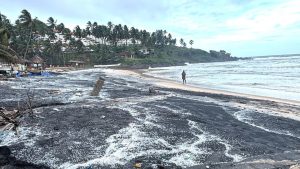
Plastic pellets washed ashore on Keralam coast
A nurdle can be measured in milligrams or counted by the thousands per square metre. Its monetary value may be negligible. But the cost of finding pellets buried 20 centimetres below a beach, monitoring them over years, assessing their effects on marine organisms, cleaning affected shores and understanding their movement through coastal ecosystems is a different matter.
And then there are losses that do not readily appear on an invoice — ecological changes, contamination of habitats, risks to marine organisms and the possibility of continued redistribution along interconnected coastlines.
The study itself did not put a rupee value on these losses. Instead, it provided evidence that the spill’s environmental footprint cannot be assessed simply by measuring what was visible immediately after the ship sank.
Related: Not a drop of oil, but a sea of damage
The movement of the nurdles also underlined the interconnected nature of Keralam and Tamil Nadu’s coastal ecosystems. The researchers found that the pellets were redistributed after the initial spill, with new concentrations appearing away from the earliest impact areas.
Monsoon winds, waves and coastal currents could influence the movement of buoyant pellets, allowing them to travel and wash ashore at different locations over time.
That makes a one-time clean-up an incomplete measure of the problem.
The MSC Elsa-3 incident provided an important long-term field example of how spilt resin pellets physically, chemically and biologically transform after entering a tropical coastal environment. The researchers call for continued monitoring and stronger spill-management strategies.
For Keralam and Tamil Nadu, the question is therefore no longer simply how many plastic pellets reached the shore after the MSC Elsa-3 sank.
It is where those pellets are now, what they have accumulated, what has grown on them, what has interacted with them and how long they may remain part of the coastal environment.
The courts may eventually have to determine financial liability for the wreck, cargo and other documented losses.
But the joint research by KUFOS and SDMRI opened up a much wider set of questions for the sea and the shores: can the full ecological cost of a spill ever be calculated? Who pays for monitoring a contaminant that remains after the headlines fade? And when a tiny plastic pellet disappears beneath the sand, has the loss really disappeared with it?
(Edited by Majnu Babu).



