

Published Oct 02, 2026 | 11:00 AM ⚊ Updated Oct 02, 2026 | 12:28 PM

Waqf board

Synopsis: Kerala government’s move to reconstitute the State Waqf Board has raised legal and representation concerns. While the government has told the High Court it will complete the process within two weeks, questions remain over members’ eligibility, the extent of reconstitution and representation of Muslim communities beyond Sunnis.
The Keralam government’s move to reconstitute the State Waqf Board has brought fresh attention to the legal and administrative complications involved in its formation, particularly over the representation of different Muslim denominations.
While the government has initiated steps to address questions concerning the eligibility of certain members and representation mandated under the law, the process is yet to reach its final stage.
The issue has also raised questions about the representation of Muslim communities other than Sunnis in the board, with concerns that the existing power structure does not adequately reflect the diversity within the Muslim community in Keralam.
On September 30, the State government informed the High Court that the process to determine the representation of Shia and Sunni members on the board would be completed within two weeks.
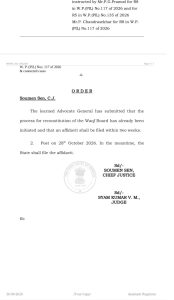
Copy of court order
Advocate General K. Jaju Babu informed the Division Bench comprising Chief Justice Soumen Sen and Justice V.M. Syam Kumar that the government had taken the necessary steps to determine the number of Shia and Sunni members on the board, along with the value of the Shia and Sunni waqf administered by it.
The exercise is intended to ensure representation in accordance with the controversial United Waqf Management, Empowerment, Efficiency and Development (UMEED) Act, 2025.
The court was considering petitions filed by BJP leader Shone George, the Assembly of Christian Trust Services (ACTS), Sajid Hussain Khatai, president of the Aal-E-Rasool Foundation, and Indian Air Force junior warrant officer V.M. Stalin Devan.
George has challenged the failure to include non-Muslim members on the board, arguing that their representation is mandated under the UMEED Act. The ACTS challenged the uploading of 404 acres of coastal land at Munambam on the UMEED portal and also pointed out the absence of representation for Shia, Bohra and Aghakhani communities.
Khatai’s petition concerns the representation of the Ithna Ashari Shia community.
Stalin has challenged the appointment of CPI(M) politician and former MLA K.P. Kunhammed Kutty, alleging that only two months remained in his tenure and that the appointment was contrary to the law.
The government is also examining the eligibility of four existing board members, including Samastha leader Umar Faizi Mukkam, after obtaining permission from the High Court to address the related issues.
The nine-member board was constituted on February 4, and K.S. Hamza was appointed chairperson in March. Although the board has a five-year tenure, the government is considering its reconstitution with nearly four-and-a-half years remaining.
The question before the government is whether to remove members found ineligible or reconstitute the entire board. The legal implications of both options are being examined, particularly in view of the cases pending before the High Court and the Supreme Court.
Speaking to South First, advocate Lakshmi Sreedhar, counsel for one of the petitioners, said the government had sought time to complete the determination and reconstitution process.
”Inducting members will take time. The State may need time to determine how many Waqf properties belong to each denomination, including Sunni, Shia, Hanafi and Shafi’i communities. In court, I felt that reconstitution was just a word being used, as the State may need time. There is political pressure too.” she said.
Beyond the legal proceedings, the composition of the Waqf Board has brought the issue of representation within the Muslim community into focus. Concerns have been raised over whether the existing arrangement provides adequate space for different denominations and schools of thought in the administration of Waqf affairs.
Stalin Devan one of the petitioners, has criticised the existing arrangement by calling it a “Sunni Waqf Board”, raising questions about the representation of other Muslim communities.
Ameen Mohammed, a member of the Hanafi Muslim community from Kottayam, told South First that the imbalance in representation within positions of power among Muslims had not received enough public discussion.
”The discrimination in power positions among Muslims is still not discussed widely. In Keralam, it is always Sunnis who get more voice in politics and policies. Everyone on the current board is Sunni, and more leaders are Sunnis. So, the representation of other communities is limited. Even among Muslim members, the State has to ensure that every section has a voice.” he said.
The government’s exercise to determine the representation of Shia and Sunni members is part of the legal process currently under way. However, the concerns raised by petitioners and members of other communities also bring attention to the broader question of how the board’s composition can accommodate the different groups involved in Waqf administration.
The proposed reconstitution comes amid differences within the existing board and questions over its functioning. Differences between the chairperson and the government over certain policy matters have also contributed to the strained relationship between the board and the Waqf department.
The government is examining whether changes to the board are necessary, but Waqf Minister N. Samsudheen has maintained that no decision has been taken to dissolve it.
On Monday the minister said the government would examine all aspects, including legal issues pending before the courts, before deciding on reconstitution. He also referred to an existing observation by the High Court that the government could reconstitute the board if necessary.
However, Hamza has opposed the proposed dissolution, maintaining that such a move would be illegal. In a Facebook post, he described the move as “organised plunder” and questioned whether it could be carried out in a country governed by the rule of law.
With the government informing the High Court that the process to determine representation would be completed within two weeks, the next steps will depend on the outcome of that exercise and the legal considerations involved.
The government is yet to announce a final decision on whether it will remove individual members or reconstitute the board as a whole.
(Edited by Fayisa CA)



