

Published Sep 23, 2026 | 9:15 AM ⚊ Updated Sep 23, 2026 | 9:15 AM



Synopsis: The Kerala State Electricity Board has imposed partial load shedding and other restrictions during the peak period between 6 pm and midnight across the State amid record electricity demand and limited available supply. The restrictions are disrupting daily life, disproportionately affecting students, remote workers and small businesses. The government is seeking additional power from other States and generators while preparing new long-term power agreements and an electricity policy to ensure long-term supply as demand is projected to double by 2030.
For families across Keralam, evenings now revolve around rearranging life around when the power might be available.
The Kerala State Electricity Board (KSEB) has imposed partial load shedding and other power restrictions during the peak period from 6 pm to midnight.
The board says the curbs have become unavoidable as electricity demand has surged to record levels while hydel storage and power availability from outside the State have fallen. The resulting deficit during the evening peak is estimated at 800–900 MW.
The official period for the announced restrictions is 6 pm to midnight, though residents in some areas say they have experienced outages before or after this period.
Chief Minister VD Satheesan has said the government is working on immediate power purchases to ease the shortage. It is also drawing up a longer-term plan involving fresh power agreements, battery storage and pumped-storage projects to meet the sharp rise in electricity demand expected in the coming years.
Also Read: ₹80 lakh a month to keep it flying: The chopper, the file and a bit of turbulence in Keralam
For residents, however, the immediate problem is the loss of evening hours when household chores, study and peak business activity tend to take place.
“Just as our daughter sits down to study, the power goes off. Without a fan, the heat makes it difficult for her to concentrate, and by the time electricity returns it is already late,” said Reshma, a parent from Amboori in rural Thiruvananthapuram.
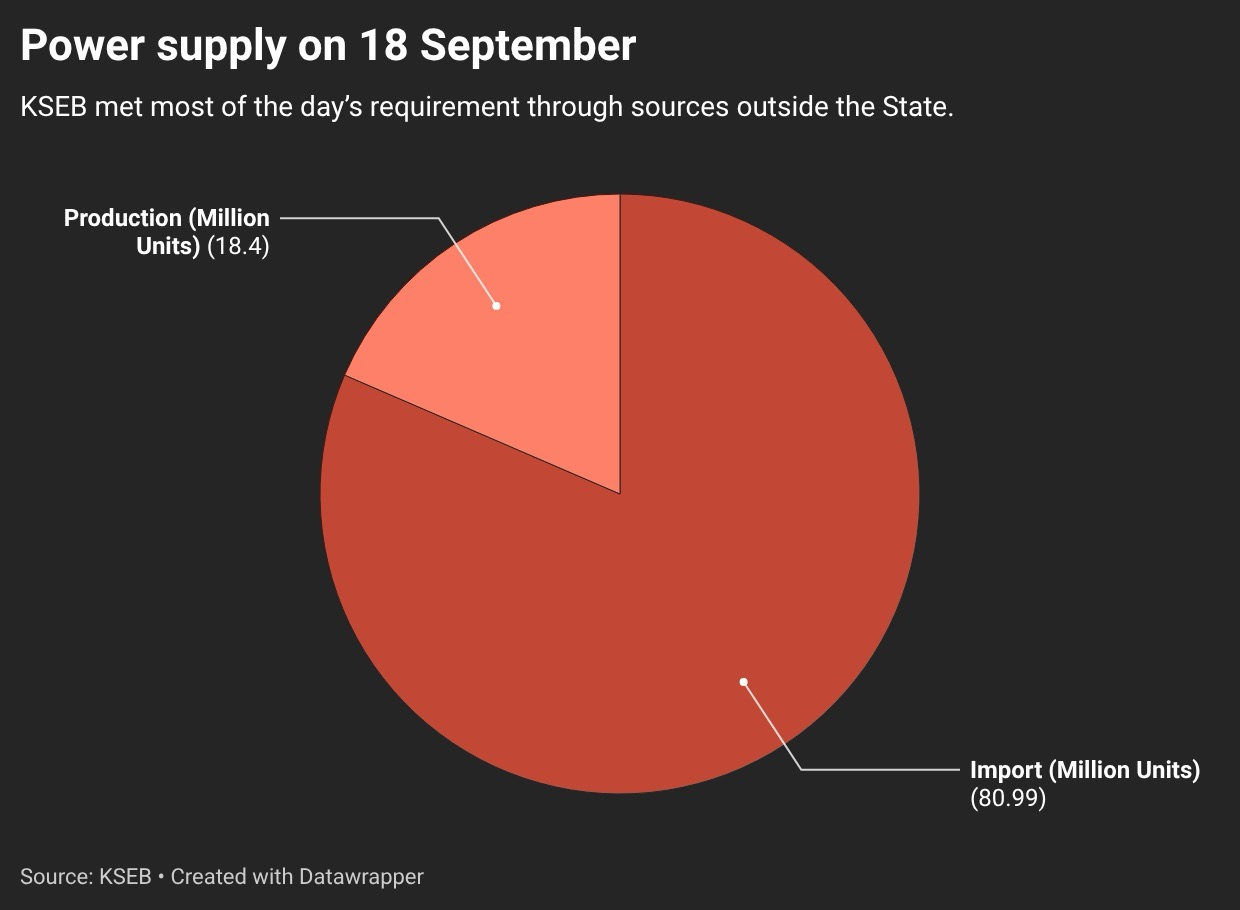
Kerala still relies heavily on power import.
Cooking, washing, ironing school uniforms and preparing children for the next day depend on electricity-powered appliances.
“I reach home around 6 pm. If the power goes off soon after, everything from cooking to getting the children ready for bed gets pushed back,” said a schoolteacher from Kottiyam in Kollam.
For employees working from home, particularly those dealing with overseas clients, the timing of the restrictions has created problems during working hours.
“Working from home does not mean I can work at any time I want. My colleagues and clients are in different time zones, so the evening is often my busiest period. The timing is the biggest problem. If the power goes at 7 or 8 pm, that is exactly when I have meetings. You cannot keep telling a client that there is a power cut in Keralam every time the connection drops,” said Sreerag, an employee with a private firm at Infopark, Kochi.
Hot and humid nights without electricity can make conditions uncomfortable, particularly for the elderly, for whom moving around a dark house increases the risk of falls. Families caring for people who depend on electrical medical equipment are forced to keep backup power available.
The restrictions are also affecting shops, eateries and neighbourhood businesses that depend on evening sales. Poor lighting and ventilation can drive customers away, while refrigerators and freezers storing milk products, ice cream and other perishables cannot remain without power for extended periods.
“The evening is our main business period. When the power goes, customers leave and running a generator for several hours is expensive,” said Rajan, who owns a wayside street food corner at Kazhakootam, Thiruvananthapuram.
To compensate, businesses have been forced to use generators, increasing operating costs. The restrictions are also forcing households to reconsider when they use induction cookers, washing machines and electric vehicle chargers.
Also Read: Keralam: UDF moves to withdraw LDF’s private universities Bill, plans fresh legislation
The Kerala State Electricity Board (KSEB) has attributed the evening power restrictions to a widening gap between electricity demand and availability, particularly between 6 pm and midnight, when the system faces a deficit of 800–900 MW.
The board said the shortage has been aggravated by lower water storage in its reservoirs, reduced inflows and a decline in the availability of electricity from outside Keralam. With little spare supply during the evening peak, KSEB said there is limited scope to avoid regulation.
Electricity demand has reached record levels for September. Peak demand has been between 4,900 MW and 5,100 MW, while daily consumption has reached 93–95 million units. Demand has increased by up to 15 percent from September last year, with consumption rising sharply after 6 pm.
At the same time, water storage in KSEB’s reservoirs has fallen. Total storage, which was 80.29 percent during the corresponding period last year, is now 63.75 percent. Storage in Idukki and Sabarigiri, the two major reservoirs, is at 63.18 percent and 67.03 percent, respectively.
KSEB has attributed part of the fall in inflows to lower rainfall associated with the El Niño phenomenon and higher atmospheric temperatures. Lower reservoir levels have reduced the scope for hydel generation precisely when electricity demand is at its highest.
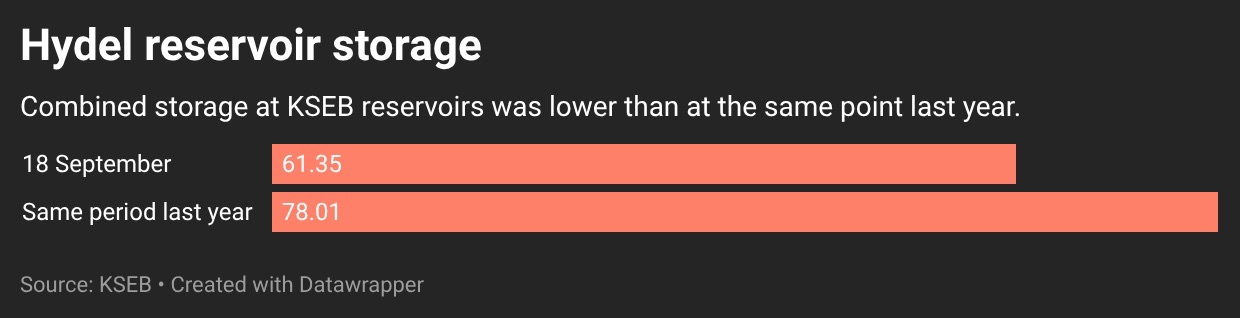
Supply has decreased compared to last year.
The supply shortage becomes most critical during the evening peak. When demand exceeds available supply, grid frequency begins to fall below the normal 50 Hz. A further fall could threaten the stability of the wider power system, including inter-State transmission lines, KSEB said.
To prevent this, the board is temporarily switching off heavily loaded feeders, causing power interruptions in selected areas.
The State had an installed generation capacity of 4,412.14 MW as of 31 March 2025. Hydel projects accounted for 2,284.42 MW, or 51.8 percent, followed by solar with 1,519.66 MW (34.4 percent), thermal with 536.54 MW (12.2 percent) and wind with 71.53 MW (1.6 percent).
KSEB said its thermal capacity is not normally used to meet daily requirements because of the high cost of generation. Its generation wing operates 61 dams, 41 large and small hydel stations, two thermal stations and a wind farm.
The shortage is not confined to Keralam, according to KSEB. Electricity availability in the national market has also fallen, with lower generation from thermal, hydel and wind sources.
The board said lower coal stocks at thermal power plants, along with high moisture content in the available coal, have affected thermal generation. Unexpected shutdowns of some thermal plants in southern India have further reduced the electricity available to Keralam.
Keralam depends heavily on electricity procured from outside the State. Its own generation accounts for less than 20 percent of total requirements. The balance comes from central generating stations, long- and short-term power agreements, renewable power arrangements with other States, and purchases through power exchanges and the DEEP (Discovery of Efficient Electricity Price) portal.
About 4,000–4,100 MW is being sourced every day through these arrangements.
KSEB also has to return power borrowed from other States in March and April under exchange agreements with Uttar Pradesh Power Corporation Ltd. (UPPCL) and BSES Yamuna Power Ltd. (BYPL). The obligation has added to the pressure on available supply.
Chief Minister VD Satheesan, speaking to the media on 16 September, Satheesan said the government was exploring every available source of power to reduce the restrictions and was working to ensure adequate supply from 1 October.
The immediate focus is on procurement. Keralam has already purchased 150 MW from Odisha and another 150 MW from the Nuclear Power Corporation.
Talks are under way with NTPC, NCPL and the governments of Himachal Pradesh, Rajasthan and Karnataka, besides other sources. The government has held discussions with eight States on power procurement.
Satheesan said the present crisis could not be attributed to deficient rainfall alone. Rising consumption, limited generation capacity and a sharp increase in night-time demand had compounded the problem. Electricity consumption in September was already 925 MW higher than in the same month last year.
A major weakness, he said, was the lack of adequate storage capacity. Keralam now has about 2,500 MW of renewable and solar generation, but much of this power is available during the day. Without storage, it cannot be deployed when demand peaks at night.
The government is therefore examining battery storage and pumped-storage projects to bridge the gap between daytime generation and night-time demand.
Also Read: Keralam documentary film fest: Union I&B Ministry denies screening permission for 31 films
The government is also seriously considering fresh long-term power purchase agreements. Satheesan pointed out that a previous 25-year agreement, under which Keralam had secured power at ₹4.29 per unit, had been cancelled without a replacement arrangement being put in place.
He said the immediate situation was expected to come under control within a week. The larger challenge, however, is the projected growth in electricity demand.
Current demand is around 5,000 MW and is projected to reach 10,000 MW by 2030. The expansion of semiconductor, artificial intelligence and other electricity-intensive industries is expected to add substantially to the requirement.
The government is preparing a comprehensive electricity policy based on these demand projections. A separate plan is also being prepared for the period from 1 October to the next monsoon, when higher temperatures and changing weather conditions could push consumption up further.
(Edited by Dese Gowda)



