

Published Nov 28, 2026 | 7:00 AM ⚊ Updated Nov 28, 2026 | 7:00 AM

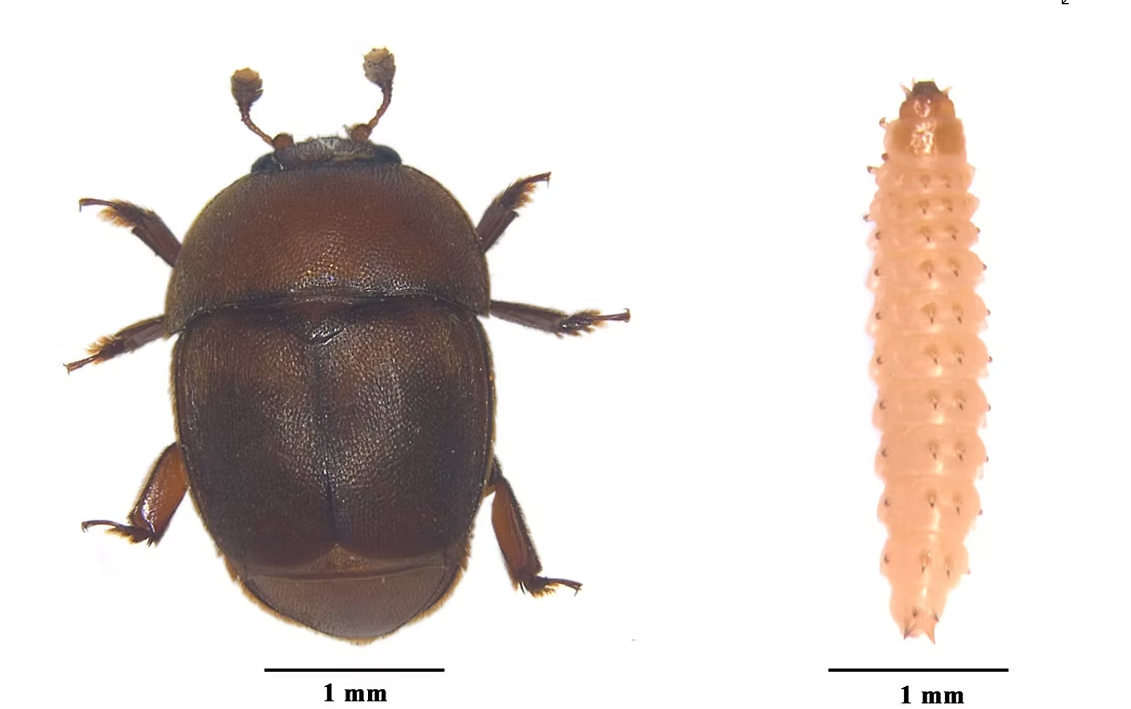
Adult small hive beetle (left) and larva. ( ICAR-IARI-NPC)

Synopsis: A tiny but highly destructive invasive pest, the small hive beetle (Aethina tumida Murray), is emerging as a serious threat to Keralam’s beekeeping sector, leaving apiarists worried about the survival of their colonies and the future of their livelihoods. Barely a few millimetres long, the beetle attacks entire beehives, with both adults and larvae feeding on honey, pollen, bee brood and dead bees. In severe cases, the bees abandon their colonies, resulting in substantial losses for beekeepers, some of whom have reportedly lost as many as 150 colonies. Kannur, Kasaragod, Wayanad and Thrissur are among the districts reporting serious infestations.
Keralam’s beekeepers are facing a threat from an unlikely quarter. Barely a few millimetres long, the small hive beetle (Aethina tumida Murray) can destroy an entire bee colony, turning honeycombs into a foul-smelling mass and wiping out months of hard work.
With infestations causing heavy losses in several districts, apiarists are increasingly worried about the future of their livelihood.
The scale of the damage is alarming. Some beekeepers have reportedly lost as many as 150 colonies. At the same time, Kannur, Kasaragod, Wayanad and Thrissur have emerged as the worst-affected districts, according to a scientific assessment by Kerala Agricultural University (KAU).
The beetle is particularly destructive because it attacks the entire hive, not individual bees.
Both adult beetles and their larvae feed on honey, pollen, bee larvae and even dead bees. The grubs tunnel through honey pots, pollen stores and brood cells, damaging the hive from within. Their feeding and waste cause honey to ferment and discolour, eventually reducing the hive’s contents to an indistinguishable, light-brown mass.
In severely infested colonies, the damage becomes irreversible, forcing bees to abandon their hives. For beekeepers, this means losing not just the honey harvest but the colonies themselves, which take considerable time and effort to establish.
Also Read: ‘Garden thug’ makes Kerala rue importing it
The threat is not confined to Keralam. The small hive beetle, native to sub-Saharan Africa, has spread to more than 30 countries over the past three decades and has become a major concern for the global apiculture sector.
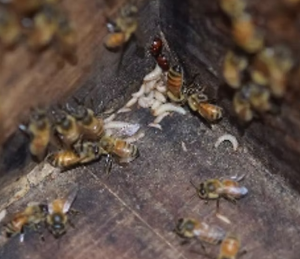
Small hive beetle infestation in a honey bee colony.
While it generally causes limited damage to weak or stressed colonies in its native habitat, its impact has been considerably more severe in regions it has invaded.
In India, the pest was first reported in 2022 in honeybee colonies in West Bengal’s North 24 Parganas district. Its ability to spread through the movement of bee colonies and products, coupled with its capacity to fly considerable distances, makes containment particularly difficult.
A study by researchers from the Division of Entomology at the ICAR-Indian Agricultural Research Institute examined the pest’s genetic diversity and population structure in India against a global backdrop.
The findings are significant because they offer insights into the pest’s possible invasion pathways and could help develop more effective control strategies.
The genetic analysis found that Indian populations belonged to a single sub-clade, indicating no genetic variation among the samples studied. The researchers also found that both adult beetles and grubs significantly weakened colonies by reducing bee populations.
The study identified July to November as the period of particularly severe infestation.
Migratory beekeeping emerged as a major factor in the pest’s spread, with the seasonal movement of colonies across Bihar and neighbouring states helping it reach new areas.
Beekeepers have been experimenting with different control measures, including sulphur, thymol and boric acid, alongside regular hive cleaning and other cultural practices. While these methods helped reduce beetle numbers, none was found to eliminate the pest.
The researchers have called for systematic monitoring and better regulation of migratory beekeeping, as well as the development of integrated pest-management strategies.
Also Read: A jumbo-sized solution to invasive weeds
The beetle’s ability to remain hidden during the early stages of infestation makes the problem even harder to control. Its high reproductive capacity and ability to disperse through the movement of colonies, wax and other bee products allow it to establish itself in new locations before the damage becomes evident.
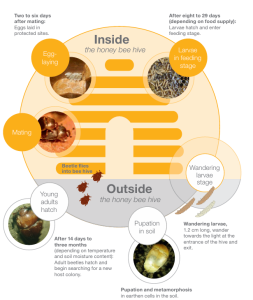
How does the small hive beetle reach a beehive?
Migratory beekeeping, trade in wax and bee-related equipment, and the insect’s own flying ability — estimated at 10 to 13 km a week — have all contributed to its spread across regions.
Keralam has had an earlier encounter with a related threat in its apiculture sector.
In 2017, Kerala Agricultural University identified Epuraea latissima Erichson as a small hive beetle infesting stingless bee colonies in the state.
The present concern over Aethina tumida Murray, however, brings a wider invasive-pest challenge into focus.
“Small-scale beekeepers cannot afford to keep losing colonies and replacing them. We invest a lot of time and money in building up colonies. The biggest problem is that the damage happens inside the hive, Peter, an apiarist in Wayanad, said.
“By the time we realise what is happening, the honeycombs may already be damaged, and the bees may have started leaving. When the bees abandon a hive, we lose the colony as well as the honey we expected to harvest. Starting afresh is not easy,” he added.
Taking note of the threat, Agriculture Minister T Siddique has directed the Agriculture Department to launch urgent preventive measures and strengthen surveillance across the state. The minister’s intervention follows findings from the KAU study, which pointed to substantial losses for beekeepers.
District-level Agriculture Department officials have been instructed to conduct immediate inspections of apiaries and assess the extent of the infestation.
The minister has also directed officials to make available KAU-recommended low-cost traps and organise training programmes and demonstrations through local Krishi Bhavans to familiarise beekeepers with their preparation and use. Steps will also be taken to assess the losses accurately and extend necessary assistance to affected beekeepers.
“The department will intensify awareness programmes on maintaining hive hygiene, conducting weekly inspections and sealing gaps in hive structures,” an official with the KAU’s Department of Agricultural Entomology said.
He also advised weekly inspections of colonies and keeping hives in places that receive adequate sunlight and are free from water stagnation. If beekeepers detect beetles or fermented honey cells, they should install traps immediately. Beekeepers have also been asked to approach their nearest Krishi Bhavan for technical assistance.
For Keralam’s beekeepers, the immediate concern is how to protect their remaining colonies.
With conventional control measures offering only partial relief and the pest proving difficult to eradicate once established, regular surveillance, early detection and coordinated intervention will be crucial.
For apiarists, the battle is no longer just about producing honey; it is about keeping their bees alive.
(Edited by Majnu Babu).



