

Published Nov 17, 2026 | 10:27 AM ⚊ Updated Nov 17, 2026 | 10:27 AM

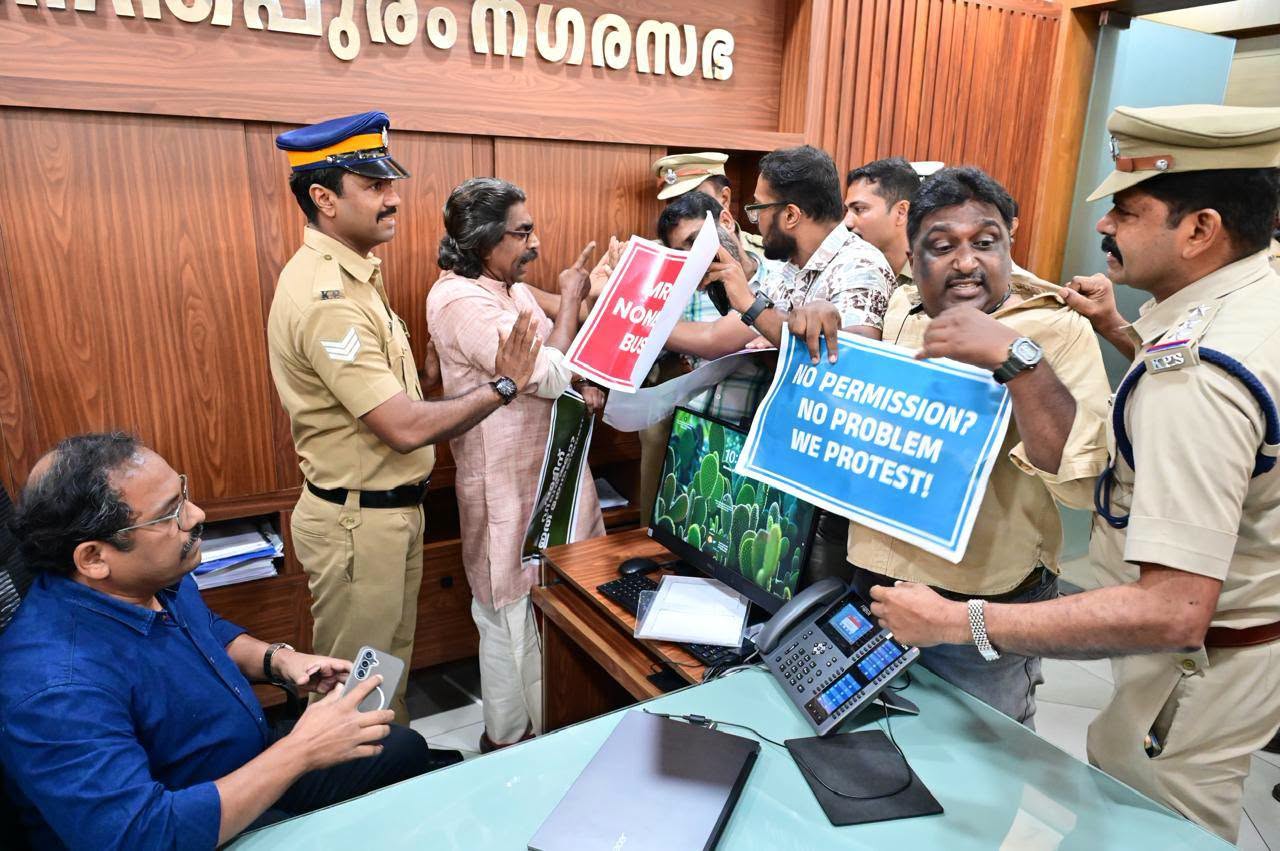
Cultural activists protesting in front of Thiruvananthapuram Corporation Secretary over Manaveeyam Veedhi issue on 16 November

Synopsis: Manaveeyam Veedhi, once a vibrant open space for art, music, theatre and social expression, is facing growing restrictions under the BJP-led Thiruvananthapuram Corporation. The denial of permission for singer Pushpavathy’s concert has intensified allegations that the civic body is attempting to curb artistic freedom and change the character of the 25-year-old cultural corridor.
For nearly a quarter of a century, Manaveeyam Veedhi (Manaveeyam Road) has been more than a 180m short stretch in the heart of the state’s capital city, Thiruvananthapuram. It has been a meeting point for artists, writers, musicians, theatre practitioners, social activists and ordinary people who found in the street a platform to express themselves without the restrictions of a conventional auditorium.
The sounds of street theatre, poetry, music and public discussions have long been part of its character. So have conversations on social justice, gender, identity and issues that rarely found an easy place in mainstream public spaces.
Over the years, the street acquired an identity of its own, becoming one of Thiruvananthapuram’s most recognisable cultural landmarks.
That identity is now being tested.
A series of restrictions and permission-related disputes involving the BJP-led Thiruvananthapuram Corporation has brought Manaveeyam Veedhi into the middle of a widening controversy.
What began as a disagreement over permissions for public programmes has developed into a larger argument about artistic freedom, the right to dissent, the management of public spaces and the authority of an elected civic body over a street originally conceived as a cultural corridor.
The latest flashpoint came with the Corporation’s refusal to grant permission for a music concert by singer Pushpavathy Poypadathu, scheduled as part of the silver jubilee celebrations of Manaveeyam Veedhi.
Beneath the disagreement over a single concert lies a more fundamental question: can a public space created to encourage free cultural expression be subjected to restrictions that, according to its long-time users, undermine the very purpose for which it was established?
Also Read: Anti-SIR rage blunts BJP-ruled T’puram Corporation move to nip Manaveeyam protest
The origins of Manaveeyam Veedhi go back to the mid-1990s, when the idea of creating a dedicated cultural street in Thiruvananthapuram began taking shape.
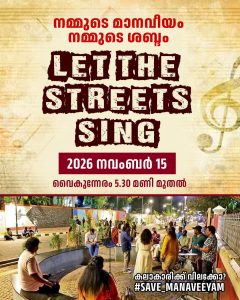
A programme organized by artists on 15 November against the denial of permission for Pushpavathy
Raghuthaman D, associated with the Abhinaya theatre group, was among those who championed the concept. Inspired by pedestrian cultural streets in European cities such as Paris, Berlin and Amsterdam, he envisioned a place where artistic performances and everyday public life could exist together.
The proposal was to take culture out of enclosed auditoriums and bring it directly to the people.
A street, rather than a conventional performance venue, would become the setting for theatre, music, literature, exhibitions and public interaction.
The idea subsequently became part of the state government’s Manaveeyam project, conceived around the themes of humanism and social progress.
In 2001, the stretch was formally named and inaugurated as Manaveeyam Veedhi, with then Assembly Speaker M Vijayakumar associated with its launch.
Abhinaya and other theatre groups organised performances, including productions associated with the works of theatre personality G Sankara Pillai. Writers, poets, filmmakers and artists began using the street as a space for interaction with the public.
The presence and contributions of cultural figures such as ONV Kurup, Adoor Gopalakrishnan, Sugathakumari and artist Namboothiri helped establish its standing in the state’s cultural landscape. Namboothiri also contributed wall art to the space.
Over time, the street’s activities moved well beyond conventional performances. It became a venue for discussions on social issues, literary gatherings, exhibitions, public meetings and experimental cultural programmes.
An informal network of artists and cultural activists, associated with initiatives such as Manaveeyam Theruvorakkoottam and later cultural collectives, helped sustain the activities. The Sunday programmes became a regular feature, bringing together people from different artistic and social backgrounds.
A dedicated space at Manaveeyam Veedhi for holding discussions
The street library added another dimension to the initiative.
Women’s forums such as Idam created opportunities for discussions and literary activities.
The Panchami Pennidam initiative, associated with a neermathalam (three-leaved caper) tree planted in memory of Kamala Surayya, became another part of its cultural identity.
Transgender festivals, Queer Pride-related activities and discussions on subjects often considered uncomfortable or taboo in mainstream society also found a place there.
For its supporters, this was precisely what made Manaveeyam different.
They say it was not intended to be a venue reserved for established artists or organised cultural institutions. Its appeal lay in its openness to different voices, including those that did not always find acceptance elsewhere.
Also Read: Collective vows to continue fight for justice in 2017 actress assault case
The street’s evolution, however, was not without difficulties.
Questions about its physical infrastructure, safety, late-night activities and management surfaced repeatedly, particularly as its popularity grew.
Cultural activists protesting in front of Thiruvananthapuram Corporation Mayor’s Office over Manaveeyam Veedhi issue on 16 November
By the late 2010s, Manaveeyam Veedhi had become part of the Smart City Mission works in Thiruvananthapuram. The proposed renovation was intended to give the cultural corridor better facilities, including seating, lighting, toilets, green rooms, accessible walkways, kiosks and a street library. Early plans also envisaged a dedicated performance stage.
The project, initially estimated at around ₹3 crore, underwent delays, redesigns and changes in scope. The proposed permanent covered stage was eventually dropped, with traffic movement cited as a major concern.
The completed project placed greater emphasis on road improvements, underground utilities, decorative lighting, kiosks and surveillance facilities than on the dedicated performance infrastructure sought by some of the original proponents.
The street was reopened to traffic around August 2023 following the major renovation works.
Two-way traffic continued, limiting the scope for treating the entire stretch as a pedestrian-only cultural venue.
The changes also revived an old disagreement about what Manaveeyam should ultimately become.
While some wanted it to retain its identity as an open-air cultural space, others favoured a more organised arrangement, with better facilities, commercial activity and tighter control over public gatherings.
Safety was another recurring concern.
Incidents of altercations – sometimes violent ones, complaints about late-night noise and allegations of drug-related activity occasionally brought the street under police scrutiny. Videos of clashes following its reopening also prompted calls for tighter monitoring.
Suggestions included restricting programmes beyond midnight, allowing only one event at a time, strengthening registration procedures and improving surveillance. Cultural groups, while disputing attempts to portray the entire venue as a trouble spot, have acknowledged the need for reasonable safety arrangements and better management.
Also Read: VV Rajesh named mayoral face, R Sreelekha misses even deputy role
The question of jurisdiction is also complicated.
The road falls under the Public Works Department (PWD), while its identity as a cultural corridor originated with the state’s Cultural Affairs Department and the Manaveeyam project.
The Smart City renovation was undertaken through Thiruvananthapuram Smart City Ltd, with funding drawn from the Centre, state and local contributions.
Following the completion of the project, maintenance responsibilities shifted towards the Corporation.
The civic body has subsequently explored private participation in the upkeep of Manaveeyam Veedhi and certain public parks.
The BJP-led Corporation argues that the responsibility entrusted to it after the renovation also gives it the authority to regulate activities at the venue.
Mayor VV Rajesh has maintained that programmes require the Corporation’s permission and that organisers must follow the prescribed procedures, including payment of applicable fees.
However, critics question whether the transfer of maintenance responsibilities amounts to a transfer of exclusive authority over the street and its cultural activities.
Former Mayor and CPI(M) leader V Sivankutty has argued that the previous council did not formally transfer complete management rights to the Corporation. The PWD’s ownership of the road and its original cultural designation by the state, he maintained, cannot be overlooked.
The state government has also indicated that it will examine the relevant documents to establish how management and maintenance responsibilities were transferred following the Smart City works.
The absence of clarity over the respective roles of the Corporation, PWD and Cultural Affairs Department has provided the backdrop for the present confrontation.
The Mayor’s office has indicated that the Corporation is considering a bylaw after consultations with stakeholders to regulate activities at the venue. Whether such a framework will accommodate the street’s traditional openness or impose a more restrictive system remains to be seen.
The dispute has acquired an additional political dimension following the BJP’s historic entry into power at the Thiruvananthapuram Corporation.
In the December 2025 local body elections, the BJP-led NDA won 50 of the Corporation’s 101 wards, ending the LDF’s decades-long dominance of the civic body. BJP leader Rajesh was elected Mayor with 51 votes, becoming the first BJP Mayor of Thiruvananthapuram Corporation and the first BJP Mayor of a municipal corporation in Keralam.
The new administration’s approach to Manaveeyam Veedhi, however, has brought it into direct confrontation with sections of the city’s cultural community.
The first major public confrontation in the present phase emerged on 16 October, during an anti-Special Intensive Revision (SIR) protest organised by the Collective for Democracy. The programme, which was attended by actor and activist Prakash Raj, demanded the resignation of Chief Election Commissioner Gyanesh Kumar.
Organisers alleged that Museum Police personnel attempted to take possession of the microphone before the programme, citing the absence of Corporation permission. The protest eventually went ahead amid a confrontation.
An FIR was subsequently registered against the organisers on allegations of obstructing traffic and the footpath and using microphones without the required sanction.
The Mayor insisted that the issue was one of procedure rather than politics. He maintained that the Corporation had informed the police about the need for permission and that unauthorised use of public property could not be allowed.
The organisers, however, alleged that applications for programmes had either been rejected on questionable grounds or that the permission process had become difficult to navigate, particularly for events planned at short notice.
The Corporation subsequently made clear that it wanted Manaveeyam Veedhi to remain primarily a cultural venue and not become a regular protest location. Rajesh argued that the street was developed as a cultural space and was not intended to function as a Jantar Mantar-style protest site, suggesting that demonstrations could instead be held near the Secretariat.
That position has drawn objections from cultural groups, who argue that the distinction between culture and politics is being used to exclude expressions of dissent.
The dispute reached another flashpoint in November when the Corporation refused permission for a concert by singer Pushpavathy, scheduled as part of the 25th anniversary celebrations of Manaveeyam Veedhi.
The organisers alleged that they had followed the prescribed procedures and submitted applications to both the police and civic authorities. Despite this, permission was denied without a satisfactory explanation, they claimed. They also alleged that the civic body and police had recently been imposing restrictions on programmes at the venue, making it increasingly difficult to organise cultural events.
Cultural Affairs Minister PC Vishnunadh, speaking to the media on 14 November, urged the Corporation to reconsider its decision. Describing Pushpavathy as one of the most gifted singers in Malayalam, he pointed out that she had also served as vice-chairperson of the Kerala Sangeetha Nataka Akademi.
He said Manaveeyam Veedhi was established as a space for creative expression and that denying artists opportunities to perform there was undesirable.
“The Corporation should reconsider its decision,” he said, calling for an approach that would encourage rather than restrict artistic activities.
The Mayor’s response added another layer to the controversy. Rajesh said he had not heard of Pushpavathy and questioned whether the committee formed to coordinate the silver jubilee celebrations had formally informed the Corporation about its activities.
He also reiterated that the state government had entrusted the Corporation with the maintenance of Manaveeyam Veedhi following its renovation under the Smart City Mission.
“If such a committee exists, there should be someone from the Corporation responsible for maintaining Manaveeyam Veedhi who is part of it. However, the Corporation was unaware of any such body organising an event at the venue,” he said.
The organisers, meanwhile, indicated that the anniversary celebrations would go ahead despite the denial of permission.
The controversy also attracted criticism from Congress MP Shashi Tharoor, who questioned attempts to restrict cultural expression while acknowledging that reasonable regulations were necessary to ensure public safety.
LDF and UDF councillors announced joint protests, rallying around the argument that Manaveeyam Veedhi belonged to the people and should remain accessible to those who wished to use it for legitimate cultural and public activities.
For the Corporation, the issue is about establishing an administrative framework for a public asset. It maintains that a designated cultural venue cannot function without rules governing permissions, fees, traffic movement, noise and public safety.
For the street’s cultural community, Manaveeyam was never conceived as a conventional auditorium where a handful of authorities decide who gets to perform and what subjects can be discussed.
(Edited by Majnu Babu).



