


Published Mar 16, 2026 | 12:00 PM ⚊ Updated Mar 16, 2026 | 12:00 PM

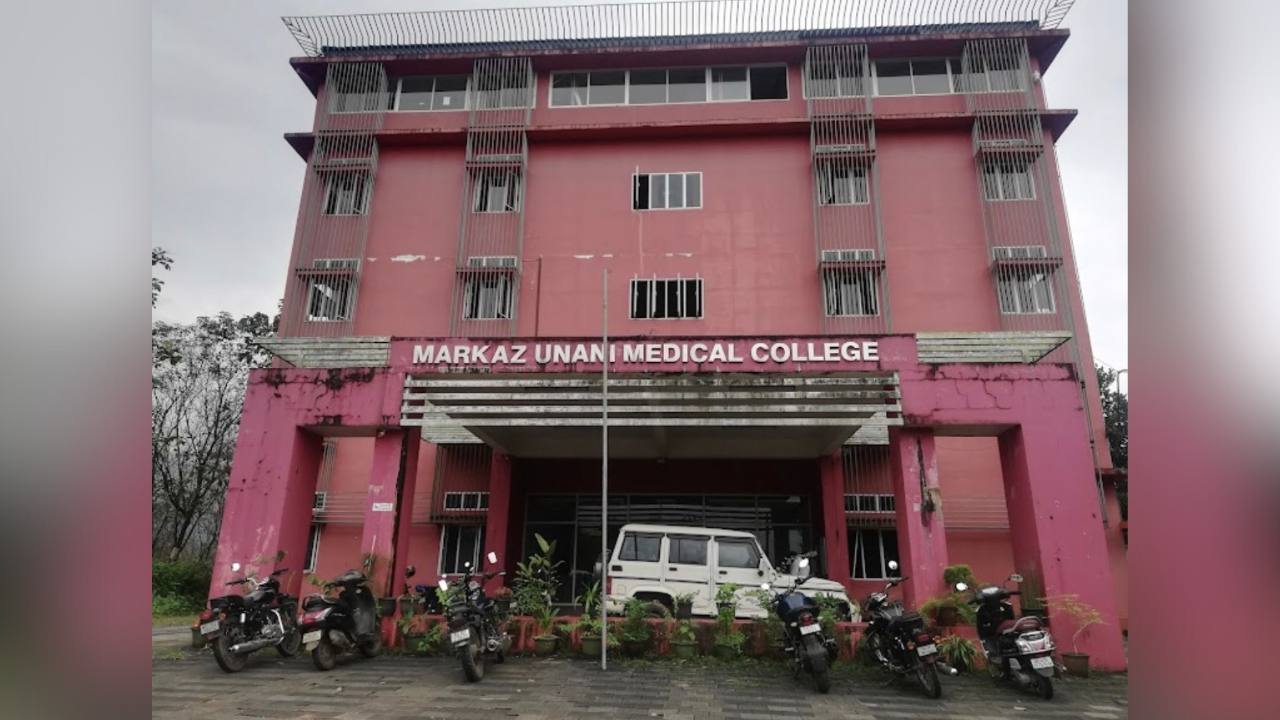
Markaz Unani Medical College.
Synopsis: The Kerala government’s recent decision to grant aided status to the only Unani medical college in the state has drawn widespread criticism. Critics said the decision at the eve of the Assembly elections is aimed at appeasing the Muslim community as the institution is owned by the AP faction of the Samastha.
With the 2026 Assembly elections drawing closer, the Kerala Cabinet’s decision on 5 March to grant aided status to the Markaz Unani Medical College in Kozhikode has raised political eyebrows.
On the face of it, the move was justified as a step to support the state’s only Unani medical college and expand access to the system of medicine.
However, the timing of the move — seen by many as part of the CPI(M)-led LDF’s efforts to broaden its appeal among Muslim voters — has drawn particular attention, especially since the institution is part of the wider Markaz network associated with Sunni scholar Kanthapuram AP Aboobacker Musliar.
Coming after years of bureaucratic delay but cleared by the cabinet in a matter of hours, the decision has raised questions about whether the move is driven purely by policy considerations — or by electoral arithmetic ahead of the poll.
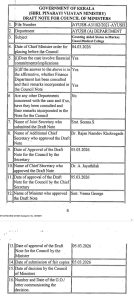
The Cabinet note on 5 March
Government records show that the proposal to grant aided status to the college resurfaced suddenly at the beginning of March.
The file notes indicate that Chief Minister, Pinarayi Vijayan, directed on 4 March to place the issue before the Cabinet.
Within a day, the Chief Secretary prepared a draft proposal.
Health Minister Veena George approved the proposal the same day, and the Cabinet cleared it on 5 March.
For a matter that had been under consideration for years, the turnaround was remarkably swift.
The decision effectively converts the institution — which has been functioning as a self-financing college — into an aided one, meaning the government will bear salary and related expenses under a direct payment system similar to the arrangement followed in institutions like Vaidyaratnam Ayurveda College in Ollur and Vaidyaratnam Ayurveda College in Kottakkal.
The speed of the Cabinet approval contrasts sharply with the long administrative history of the proposal.
The chairman of Markaz Unani Medical College had first approached the government seeking aided status on 20 December 2020.
A second representation followed on 10 September 2021.
Between 2021 and 2025, the Directorate of Ayurveda Medical Education repeatedly flagged the matter to the Health Department.
Official communications were sent on: 23 July 2021; 12 October 2021; 8 December 2021; 5 May 2022; and 12 August 2025.
Despite these repeated reminders, the proposal did not move forward.
The key hurdle came from the Finance Department.
When the proposal was examined, the department clearly recorded its objection, stating: “AD (Administrative Department) is informed that the proposal is declined at this point in time.”
Officials in the Finance Department said such proposals rarely move forward once fiscal objections are recorded, primarily because granting aided status creates a permanent financial commitment for the government.
Salaries of teaching and non-teaching staff, along with other operational expenses, would eventually have to be borne by the state under the direct payment system.
“Considering the present fiscal position of the state, such additional commitments could further strain the exchequer. That was the primary reason why the proposal was declined at that point,” a senior official familiar with the file told South First.
However, the trajectory of the file changed later.
The Health Minister, Veena George, subsequently sought a reconsideration of the Finance Department’s earlier position and forwarded the matter again for review.
When the proposal came up before Finance Minister KN Balagopal, he agreed to revisit the department’s stand.
In a departure from the earlier note of rejection, the minister eventually endorsed the proposal, observing that the institution was the only Unani medical college in the state and therefore merited government support.
With the finance minister recording his concurrence, the file was forwarded to Chief Minister Pinarayi Vijayan, who ordered that the matter be placed before the cabinet. The proposal was subsequently taken up and approved without delay.
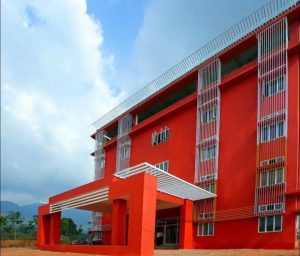
Markaz Unani Medical College and Hospital
In its justification, the Health Department emphasised that Markaz Unani Medical College — located in Kozhikode district — is the only institution in Kerala offering the Bachelor of Unani Medicine and Surgery (BUMS) programme.
Established within the Markaz Knowledge City complex, the college began functioning in 2015 after receiving approval from the Union government.
It operates a 60-bed hospital alongside the academic facility.
According to the file:
The government note argued that granting aided status would make Unani education more affordable and strengthen the availability of the treatment system in Kerala.
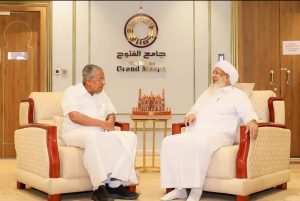
Pinarayi Vijayan and Kanthapuram AP Aboobacker Musliyar
While the administrative reasoning focused on the promotion of Unani medicine, the timing and speed of the decision have drawn attention to the political backdrop.
The college is part of the larger institutional network associated with the Markaz complex, linked to the religious and educational initiatives of Kanthapuram AP Aboobacker Musliar, a prominent Sunni scholar and leader of the AP faction of the Samastha Kerala Jem-iyyathul Ulama — widely known as Samastha.
Over the past decade, the CPI(M)-led government under Pinarayi Vijayan has maintained sustained engagement with the AP Sunni leadership, which commands influence across parts of northern Kerala, particularly in Kozhikode, Malappuram and Kannur districts.
This outreach includes policy consultations, public events and institutional interactions involving organisations aligned with the AP Sunni faction.
Political observers have frequently interpreted this engagement as part of the Left’s broader effort to widen its appeal among Muslim voters — a constituency that traditionally leaned toward the Indian Union Muslim League (IUML) within the Congress-led UDF.
Kerala’s Muslim population accounts for roughly a quarter of the state’s electorate, with significant concentrations in Malabar.
For the CPI(M), building relationships with influential Sunni organisations has long been seen as a way to weaken the IUML’s monopoly within the community.
The Markaz network — which includes educational institutions, charitable activities and religious bodies — represents a significant social ecosystem within this landscape.
Against that backdrop, the Cabinet decision to extend aided status to an institution within the Markaz system inevitably carries political implications beyond the immediate policy rationale.
Supporters of the move argue that the government merely corrected an anomaly by supporting the state’s only Unani medical college.
Critics, however, point to the sudden acceleration of the file after years of dormancy, the reversal of the Finance Department’s earlier rejection and the timing of the cabinet approval.
A senior CPI(M) leader from Malappuram defended the cabinet decision, saying attempts to portray it as political appeasement were misplaced.
“This decision should be seen in the context of healthcare and educational expansion, not through the narrow lens of politics. Unani medicine has a strong following in Malabar, and Kerala has only one institution offering formal education in the system. Supporting such an institution is a logical step if the government wants to strengthen alternative systems of medicine,” the leader told South First.
He also rejected the narrative that the move was aimed at winning favour with religious leaders.
“The Left does not approach communities through appeasement. Our engagement has always been through institutions, education and social development. The reality is that Kerala’s Muslim population has a strong presence in the Malabar region, and their educational needs cannot be ignored. Historically, the Indian Union Muslim League tried to maintain a monopoly over Muslim political representation. Over the years, many sections of the community have realised that the Communist Party of India (Marxist) engages with them on development issues rather than identity politics.”
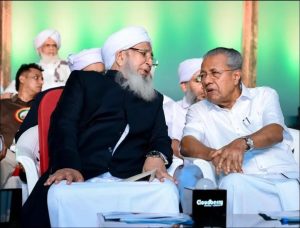
Kanthapuram AP Aboobacker Musliyar with Pinarayi Vijayan
The leader also pointed to broader political changes in the state.
“Kerala politics has evolved. The Sunni community is not a monolith, and different sections have begun engaging with progressive politics. Our government has consistently maintained dialogue with social and religious organisations across communities. Decisions like this are part of that wider approach to ensure that education and healthcare institutions serving the public are strengthened.”
However, a senior IUML leader said the ruling front was attempting a “last-minute cosmetic exercise” to influence sections of the Muslim community.
“Everyone can see the timing. This file was lying in government offices for years, and suddenly it moved from one table to another and landed in the Cabinet within 24 hours. Such last-minute gestures will not fool the people of Kerala,” the leader told South First.
He argued that the move reflects the ruling front’s anxiety ahead of the elections.
“The LDF knows that public sentiment is turning against it. Administrative decisions taken in haste cannot erase years of governance failures. The people of Kerala will not be swayed by political eyewash.”
The IUML leader added that the electoral verdict was already becoming clear.
“You can try to create headlines with sudden announcements, but that will not change the ground reality. The defeat of the LDF in the coming election is inevitable, and no amount of symbolic decisions will help them escape that verdict,” he stated.
(Edited by Muhammed Fazil.)


