

Published Jun 23, 2025 | 8:00 AM ⚊ Updated Jun 23, 2025 | 8:00 AM

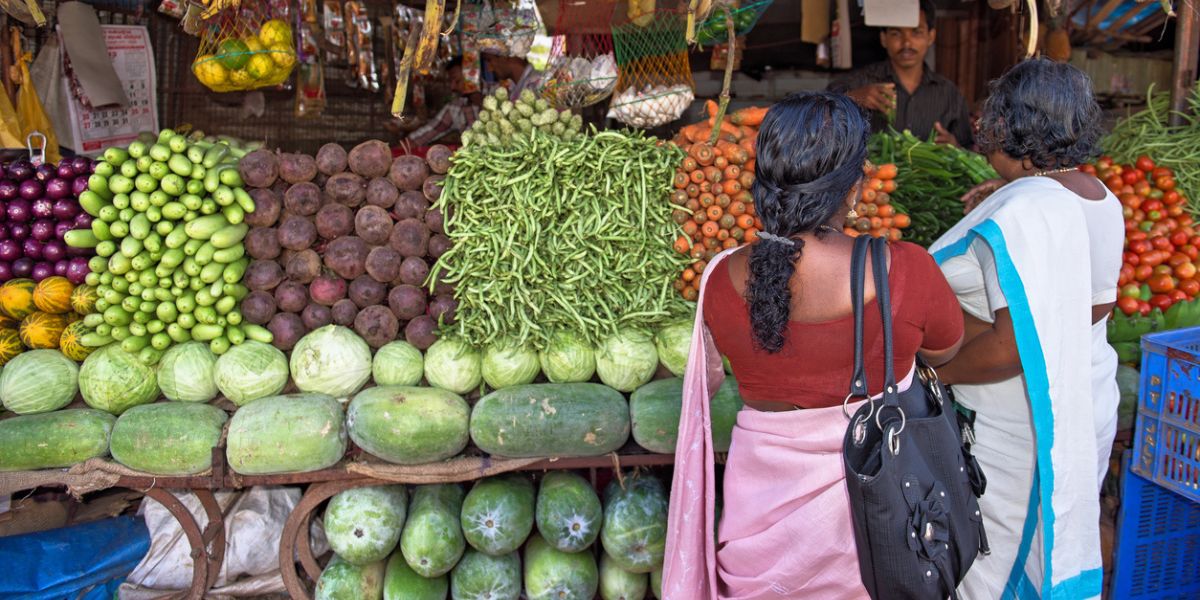
A vegetable stall in Kerala. (iStock)

Synopsis: Despite achieving self-sufficiency in vegetable production being a flagship aim of the LDF government in Kerala since 2016, the target has been pushed back time and again. In a renewed bid to turn this ambition into reality, the government has set its sights on 2033, launching a fresh initiative.
Kerala’s long-cherished dream of achieving self-sufficiency in vegetable production continues to remain elusive. Despite being a flagship aim of the LDF government since 2016, the target has been pushed back time and again.
Now, in a renewed bid to turn this ambition into reality, the government has set its sights on 2033, launching a fresh initiative titled the Comprehensive Vegetable Production Campaign (Samagra Pachakari Udpadana Yajnam), aimed at transforming the state’s farming landscape under its ambitious Vision 2033 programme.
Whether this latest effort can finally bridge the state’s enduring gap between promise and performance remains to be seen.
Since 2016, Kerala has been chasing the dream of achieving self-sufficiency in vegetable production, but the target has remained a moving one. When the first Pinarayi Vijayan-led government assumed office, the chief minister announced an ambitious plan to make the state self-reliant in vegetables.
Onam markets were to be filled with locally grown produce, supported by homestead farming and a strengthened supply chain, he envisioned then.
In February 2020, the then-agriculture minister, VS Sunil Kumar, declared in the Assembly that Kerala would achieve vegetable self-sufficiency within 470 days, increasing production from 6 lakh to 12.75 lakh tonnes. However, the Covid-19 pandemic soon tested the state’s resolve.
In April 2020, the government launched the ₹3,000-crore Subhiksha Keralam project, targeting 12,500 hectares of new cultivation, wasteland conversion, and kitchen gardens to avert possible supply disruptions. The promises didn’t stop there.
In 2021, the then-Governor Arif Mohammad Khan announced a fresh five-year deadline, while the chief minister unveiled Subhiksham Surakshitam, aiming for 84,000 hectares of organic farming.
In 2022, intending to instil agricultural culture in all families in Kerala and make Kerala food self-sufficient, a new programme ‘Njangalum Krishiyilekku’ (we are also into farming) was launched.
Urban areas entered the equation in 2023, with the government pushing for vertical vegetable gardens to address space constraints.
Now, in December 2024, Agriculture Minister P Prasad announced New Agriculture Wealth Opportunities – Driving Horticulture Agribusiness Networking (NAWO-DHAN), a new project targeting 50,000 hectares of fallow land using modern techniques and hybrid seeds — once again setting a five-year timeline for self-sufficiency.
Nine years on, Kerala’s quest for homegrown vegetables remains a shifting goalpost, reinvented with each passing government promise.
Despite some remarkable achievements in vegetable production — as one figure puts that, the state nearly tripled its output from 6.28 lakh tonnes in 2015-16 to 17.21 lakh tonnes by 2023-24 — the dream of attaining self-sufficiency remains just a dream.
The state continues to depend on neighbouring Tamil Nadu and Karnataka for vital produce like onions, tomatoes, and potatoes. In 2023-24, against a demand of 20-21 lakh tonnes, the state produced 17.21 lakh tonnes, leaving a deficit of around five lakh tonnes.
The momentum stalled due to multiple factors. A key issue is the steady shift of farmlands to cash crops like rubber and spices, as well as construction.
Traditional paddy fields, once hubs for side-cropping vegetables, have shrunk alarmingly. Even though the government identified over one lakh hectares of wasteland for cultivation, much of it remains underutilised.
Climate change hasn’t helped either. Unpredictable floods and droughts disrupt farming schedules, while infrastructure bottlenecks — such as the shortage of cold storage and modern market linkages — cripple the farm-to-market supply chain. Middlemen still dictate prices, limiting farmers’ profits and keeping retail rates high despite increased production.
Labour shortages and uneven adoption of mechanised farming equipment across Kerala’s diverse terrain add to the woes. Schemes to promote polyhouses and vertical farming in urban areas have made slow progress.
While seasonal campaigns like Onathinu Orumuram Pachakkari (one basket of vegetables for Onam) have reduced imports during festive periods, achieving year-round vegetable self-sufficiency demands bolder, sustained policy action. For now, Kerala’s dependence on truckloads from other states continues.
“There’s no proper support for marketing or storage. Even when we manage a good harvest, half of it goes to waste or gets sold to middlemen at throwaway rates,” said Rajan, a vegetable farmer from Palakkad. “If the government really wants self-sufficiency, it must fix this first,” he added.
At the same time, Sudha Kumari, a female farmer from Thiruvananthapuram, said, “We work hard, but when prices drop suddenly or natural disasters/crop diseases ruin the crop, there’s nobody to compensate us. She added, “Schemes come and go, but what we need is steady support and fair prices for what we grow.”
At the same time, it turns out that the state’s Agriculture Department is charting a bold course for the state’s farming future with its short-term Vision 2026 nearing completion and long-term Vision 2033 gaining momentum.
At the heart of this ambitious roadmap are three key initiatives — Krishi Samriddhi, Samagra Pachakari Udpadana Yajnam, and NAWO-DHAN.
The flagship Krishi Samriddhi project aims to empower farmers’ groups under Krishi Bhavans and local self-government bodies, addressing technical, financial, and social challenges in a participatory model.
Rolled out in 107 local bodies in its first phase, the project will expand to 393 more by 2025-26, integrating resources from agriculture and allied departments to strengthen Kerala’s diverse agro-ecological sectors.
Meanwhile, the chief minister’s special scheme, Samagra Pachakari Udpadana Yajnam, envisions making Kerala self-sufficient in vegetable production. The initiative promotes high-quality, pesticide-free vegetables to ensure healthy food for the public while boosting farmers’ incomes.
Recognising vegetables as a vital component in crop diversification and nutrition, the government plans a statewide vegetable farming campaign, building on the implementation of existing schemes like Onathinu Oru Muram Pachakari and Jeevani.
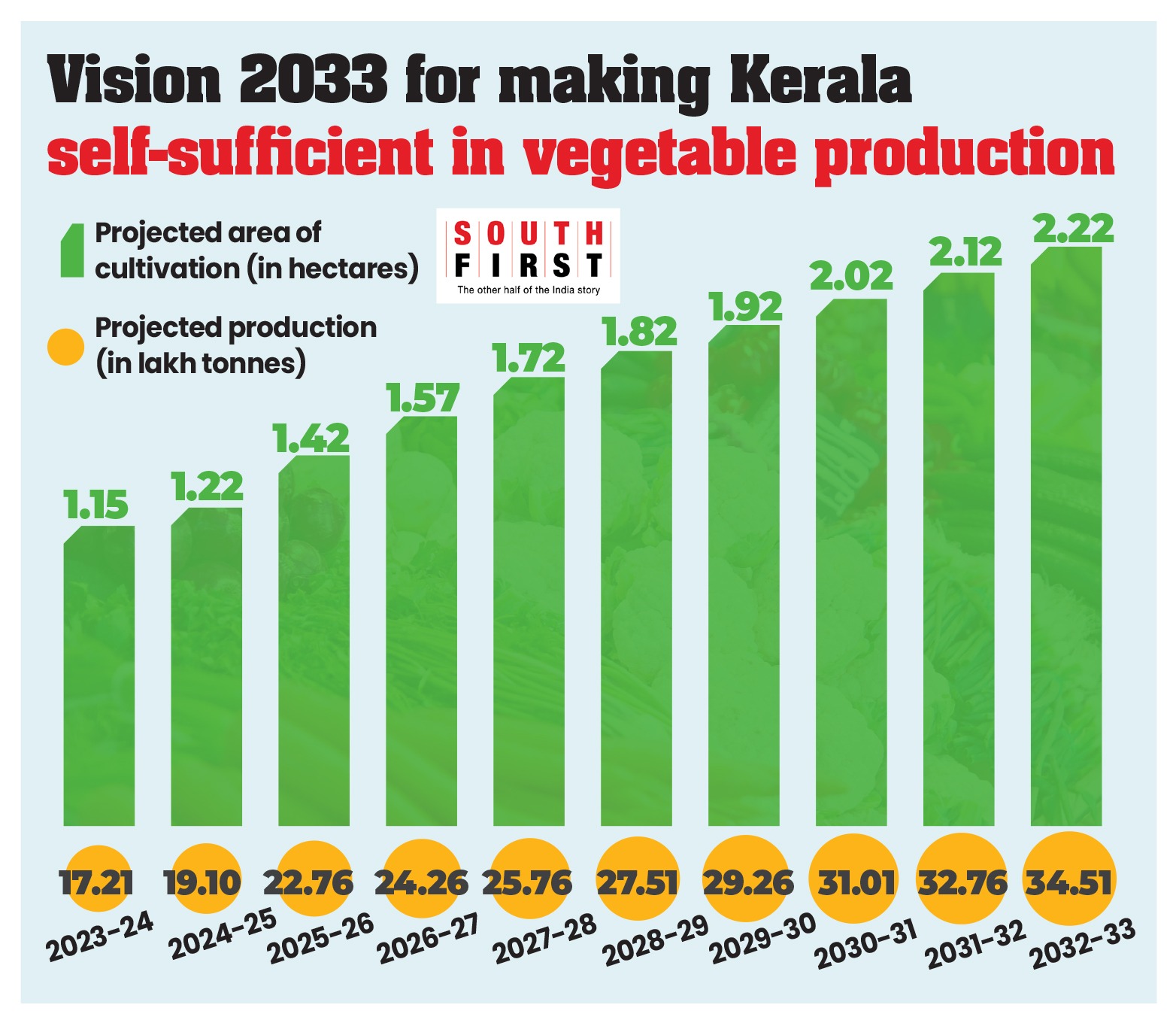
The projected area and production of vegetables in Kerala under Vision 2033.
The state produced 17.217 lakh tonnes of vegetables from 1.1525 lakh hectares of land in the financial year 2023-24, said the Agriculture Department.
However, this falls far short of the estimated 45 lakh tonnes needed annually to meet the nutritional requirements of the state’s 3.5 crore population, as recommended by the Indian Council of Medical Research (ICMR).
According to the State Planning Board’s 2022 Working Group Report, the demand is projected to touch 32 lakh tonnes by 2030, requiring a daily production of 9,726 tonnes.
In a bid to bridge this gap, the state is considering a phased expansion of vegetable cultivation — adding 20,000 hectares in 2025-26, 15,000 hectares over the next two years, and 10,000 hectares annually thereafter.
This strategy aims to boost production by 1.5 lakh to two lakh tonnes every year, gradually moving closer to self-sufficiency in vegetable production.
At the same time, the Agriculture Department is of the assessment that the ‘Samagra Pachakari Udpadana Yajnam‘ will act as a major push for local economic development and agricultural self-sufficiency.
“Moving beyond traditional crop-based systems, the initiative promotes commercial vegetable cultivation with an export-oriented approach while ensuring health and nutrition for the public,” reads an excerpt from the guideline on the programme.
Over 23,000 farm groups have already been established under the initiative, covering production, service, and marketing sectors. The campaign encourages active participation from women, youth, and traditional farmers, creating fresh employment opportunities and increasing household incomes.
Emphasising Good Agricultural Practices (GAP) and organic farming methods, the project aims to ensure safe, high-quality produce that meets international standards.
The guideline says that weekly markets, eco-shops, and aggregation centres at the panchayat level — along with Agro Hubs at block levels — will help farmers secure better markets and prices. Value-added farming groups and service sector collectives will also play a pivotal role in processing and marketing surplus produce.
Ultimately, the initiative envisions making Kerala a self-reliant, health-conscious, and export-competitive vegetable producer while addressing lifestyle diseases through improved public nutrition. Yet, as history has shown, Kerala’s road to vegetable self-sufficiency is littered with good intentions and unmet deadlines.
The new campaigns and ambitious roadmaps are promising on paper, but their real test lies in lasting execution, market reform, and sustained farmer support.
Unless the state finally fixes the cracks in its farm-to-market chain and ensures fair, assured returns for its growers, this too risks becoming yet another chapter in the state’s long, elusive quest for homegrown abundance. Whether Vision 2033 will harvest results or remain a rerun of past promises is a question only time will answer.
(Edited by Muhammed Fazil.)



