


Published Jul 11, 2026 | 8:00 AM ⚊ Updated Jul 11, 2026 | 8:00 AM


A teacher guiding students in class. (iStock)

Synopsis: The special K-TET examination has become a high-stakes test for thousands of in-service teachers in Kerala after Supreme Court rulings made the qualification mandatory for many serving educators, setting off a debate that pits classroom experience and service rights against the push for uniform teaching standards.
With the special Kerala Teacher Eligibility Test (K-TET) scheduled for 8 and 9 August, anxiety is mounting among a section of in-service teachers in government and aided schools across Kerala.
For many of them, the examination is no longer about securing a qualification for career advancement. It has become a test linked to the continuation of service itself, following a series of Supreme Court rulings that have made Teacher Eligibility Test (TET) qualification mandatory for a large section of serving teachers.
The examination is being conducted based on a special notification issued by the state government in February this year, primarily to provide another opportunity for teachers appointed up to the 2025-26 academic year and eligible non-teaching staff awaiting by-transfer promotion to acquire the mandatory K-TET qualification.
While the state government says the special examination is intended to help employees comply with judicial directions, several teachers’ organisations continue to maintain that compelling experienced teachers to clear an eligibility test decades after their appointment is both unfair and impractical.
Also Read: Public entry to disaster-hit area in Wayanad prohibited as search continues
The Teacher Eligibility Test (TET) was introduced following the Right of Children to Free and Compulsory Education (RTE) Act, 2009, under which the National Council for Teacher Education (NCTE) prescribed TET as the minimum qualification for teachers handling Classes I to VIII.
In Kerala, the state expanded the requirement up to the high school level and introduced the K-TET through government orders issued in 2012.
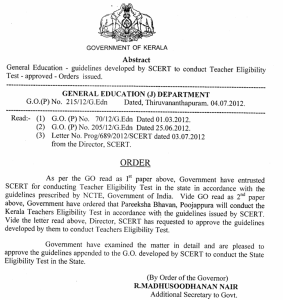
K-TET order of 2012
Conducted by Kerala Pareeksha Bhavan under norms framed by the State Council for Educational Research and Training (SCERT), the examination is held in four categories: Lower Primary, Upper Primary, High School, and language teachers, physical education teachers, and specialist teachers.
The objective was to ensure uniform standards in teacher recruitment, improve the quality of teacher education and assure parents that qualified teachers staff classrooms.
However, for years, many teachers who had entered government and aided schools before K-TET came into existence continued in service based on the recruitment rules prevailing at the time. Many possessed qualifications such as B.Ed., SET, NET, M.Ed. or even doctoral degrees, and several enjoyed exemptions because the eligibility test did not exist when they were appointed.
That position changed after a series of Supreme Court judgments culminating in a landmark verdict delivered on 1 September 2025.
The apex court held that TET is not merely a recruitment qualification but a mandatory statutory requirement flowing from the RTE Act.
It ruled that teachers appointed before the implementation of the Act, but who still have more than five years of service remaining, must qualify the examination within the stipulated period. Those with less than five years left before retirement were exempted from the examination for continuation in service, although they would not be eligible for promotions requiring the qualification.
The ruling sent shockwaves through several states, including Kerala, where estimates suggested that tens of thousands of teachers could eventually be affected.
Following the September 2025 judgment, the state government issued revised guidelines early this year implementing the court’s directions and withdrawing several earlier relaxations available to teachers possessing higher academic qualifications.
The move immediately triggered protests from teachers’ organisations cutting across political affiliations.
Within days, the government put the implementation on hold and approached the Supreme Court with a review petition, arguing that Kerala’s circumstances required a different approach.
The state contended that K-TET itself came into existence only in 2012 and that insisting on the qualification for teachers appointed years earlier violated principles of natural justice.
“The government is of the view that treating teachers appointed before the introduction of K-TET and those appointed thereafter on the same footing amounts to a violation of Article 14 of the Constitution,” the state submitted before the court.
It also argued that retrospective implementation could result in large-scale loss of employment and serious social and economic consequences.
At the same time, the government issued a special notification to conduct an exclusive K-TET examination so that serving teachers could qualify within the period stipulated by the court.
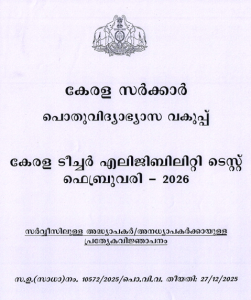
Special notification to conduct an exclusive K-TET examination for serving teachers
That notification has resulted in the 8-9 August examination.
The Supreme Court, however, remained firm on the larger principle.
During hearings on the review petitions in May, the division bench comprising Justices Dipankar Datta and Manmohan reminded petitioners that the RTE Act is fundamentally a law enacted for children.
“The Right to Education Act exists for the children. Do not be self-centred to say ‘I will only get orders protecting my security of tenure but will not think about the children’,” the Bench observed.
Justice Manmohan added that the court had only reiterated the statutory requirement already found in the legislation.
“Higher educational qualifications are sought to get better teachers. Unless a child gets good quality education, how will he/she improve?” the judge observed.
Later, while disposing of the review petitions on 29 May, the Supreme Court granted in-service teachers one additional year, extending the deadline for acquiring TET qualification from 31 August 2027 to 31 August 2028.
The Bench directed all states to conduct TET examinations regularly, preferably twice every year, so that teachers receive adequate opportunities to qualify.
At the same time, it made it clear that no further extension would be granted.
“The RTE Act is a child-centric legislation,” the judgment said, adding that the quality of children’s education could not be compromised. While acknowledging the practical hardship faced by teachers, the court held that “a perceived sense of insecurity is not a sufficient reason” to dilute the statutory requirement.
Also Read: CorroHealth bars laid-off employees from entering office premises
Despite the additional time granted by the Supreme Court, teachers’ organisations say their concerns remain largely unaddressed.
They argue that the dispute is fundamentally about fairness, service rights and the treatment of teachers who entered the profession through legally valid appointments long before the Teacher Eligibility Test became mandatory.
Their principal objection is that thousands of teachers joined the service under the recruitment rules that existed at the time and have continued to teach for years — many for decades — without ever being required to pass K-TET. According to the unions, introducing the qualification as a compulsory condition after years of service amounts to changing the rules midway through a teacher’s career.
“These teachers were appointed by competent authorities after completing every procedure prescribed under the law prevailing then. It is difficult to justify asking someone with 20 or 30 years of classroom experience to prove their eligibility through an examination meant primarily for fresh recruits,” said an office bearer of the Kerala School Teachers Association (KSTA).
Teacher organisations, including the KSTA, the All Kerala School Teachers’ Union (AKSTU) and the Kerala Pradesh School Teachers Association (KPSTA), maintain that experience accumulated over decades cannot be equated with performance in a written eligibility test.
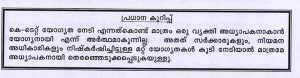
One of the instructions in the K-TET notification which says that ‘passing K-TET alone doesn’t make someone a teacher’
Union leaders contend that K-TET places greater emphasis on theoretical knowledge than on the practical skills teachers develop through years of handling classrooms, understanding students and adapting to changing educational needs.
“A teacher’s ability cannot be measured solely through a written examination. Teaching is a profession built on experience, interaction and continuous learning inside the classroom. Those qualities are difficult to assess through an objective test,” a senior KPSTA office-bearer said.
To strengthen their argument, teacher organisations often point to the results of the Andhra Pradesh Teacher Eligibility Test (APTET)-2025. Of the 31,886 in-service teachers who appeared for the examination, only 15,239 qualified, translating into a pass percentage of just 47.82.
Union leaders say the figures raise an important question.
“If more than half of experienced teachers fail an eligibility examination after spending years in classrooms, does that necessarily mean they are incapable of teaching? Or does it indicate that the examination measures something entirely different?” asked an AKSTU leader.
The qualifying marks prescribed for K-TET have also become a major point of disagreement.
Currently, candidates from the general category must secure 90 marks out of 150 to qualify.
The minimum is 82 marks for candidates belonging to Scheduled Castes, Scheduled Tribes, Other Eligible Communities and Other Backward Classes, while persons with disabilities require 75 marks.
Teacher organisations have urged the government to prescribe a common qualifying mark for all in-service teachers, arguing that those who have already been serving in schools for years should not be subjected to different benchmarks based on reservation categories.
The implications, unions say, go well beyond passing an examination.
Although the Supreme Court has clarified that teachers who continue to remain unqualified after the prescribed period will not necessarily lose their jobs immediately, it has also made clear that promotions cannot be granted without the mandatory qualification.
Teacher organisations fear that this could seriously affect career progression, service benefits and retirement prospects for thousands of teachers nearing the end of their careers.
The unions indicated that between 40,000 and 65,000 teachers could be affected by the requirement.
They further argue that any large-scale disruption involving experienced teachers would inevitably have consequences for the state’s school education system.
“There is no dispute over improving educational standards. Our concern is whether long-serving teachers should be penalised because qualification norms changed long after they entered service,” another KSTA leader said. “Reforms should strengthen education without undermining those who have devoted their working lives to it.”
With the Supreme Court making it clear that no further extensions are likely, teacher organisations are now looking beyond the judiciary. They have intensified efforts to persuade the Union Government to provide legislative relief by amending the Right to Education framework or introducing a one-time exemption for teachers appointed before the TET regime came into force.
Union leaders describe such a measure as a “grandfather clause” that would protect appointments made under earlier rules while preserving the objective of ensuring qualified recruitment in future.
Also Read: Police investigation reveals alleged misuse of the POCSO Act in Kerala
While the verdict triggered anxiety among many teachers, it has also found support within sections of the teaching fraternity.
Those backing the ruling argue that the requirement to clear the TET is not an unreasonable burden but a necessary measure to safeguard the quality of school education.
They endorse the court’s observation that the continued service of teachers “cannot come at the cost of the educational future of children,” saying the emphasis on maintaining academic standards is both justified and long overdue. They also point to the court’s view that nearly 15 years have passed since the implementation of the RTE Act, giving teachers ample time to acquire the prescribed qualification.
An aided school teacher who cleared the Kerala Teachers Eligibility Test K-TET on her second attempt dismissed claims that the examination is exceptionally difficult.
“I won’t say it is an exam that is impossible to clear. I passed on my second attempt, but many of my colleagues cleared it the very first time. If someone has been teaching the subject for years and has kept up with the basics, it is certainly manageable,” she said.
Explaining the pattern of the examination, she said K-TET consists of 150 multiple-choice questions carrying one mark each. The paper is divided into three broad sections.
The first, carrying 40 marks, covers Child Development and Pedagogy for teachers handling Classes I to VIII, while candidates for higher classes are tested on Adolescent Psychology, Learning Theories and Teaching Aptitude. Another section assesses language proficiency linked to the medium of instruction, carrying 30 marks. The remaining 80 marks are allotted to subject-specific questions and pedagogy.
“The questions are not designed to trap candidates. They test whether a teacher possesses the minimum professional knowledge expected in a classroom. It is a qualifying examination, not a competitive one,” she said.
Several teachers who support the ruling argue that years of classroom experience should naturally equip an educator to meet the benchmark set by the test.
“If a teacher has been handling the same subject for a decade or more, clearing a basic eligibility examination should not be beyond reach. Teaching is a profession that demands continuous learning. We cannot insist that students keep updating themselves while teachers remain exempt from demonstrating their own competence,” another teacher with a government school, who is also a member of KSTA, remarked.
Some also believe that the public debate around the issue has exaggerated the difficulty of the examination.
“There is a lot of fear being spread. It is being portrayed as though experienced teachers are being asked to write an impossible examination. That simply isn’t true. Anyone who prepares sincerely and has a sound grasp of the subject can qualify,” said another teacher who has mentored K-TET aspirants.
(Edited by Muhammed Fazil.)



