

Published Jul 18, 2025 | 11:00 AM ⚊ Updated Jul 18, 2025 | 11:00 AM

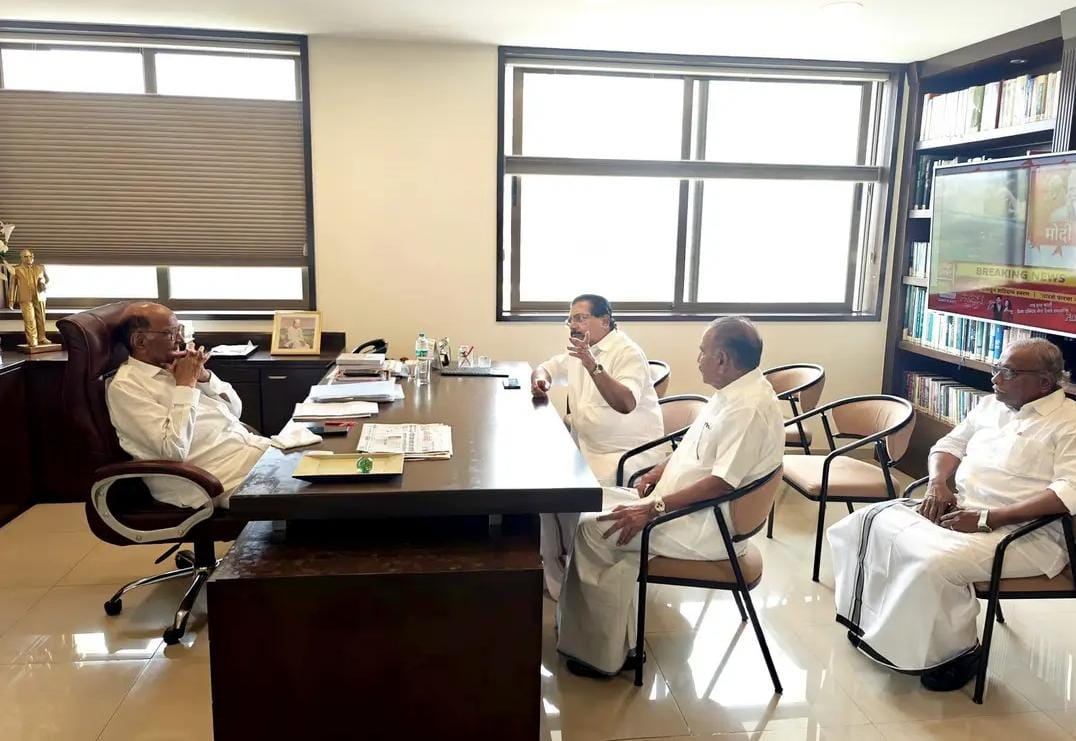
AK Saseendran, PC Chacko and Sharad Pawar.

Synopsis: Praful Patel, national working president of the Ajit Pawar-led NCP and chairman of its central disciplinary committee, announced the expulsion of the two leaders, AK Saseendran and Thomas K Thomas, for six years. He accused them of engaging in anti-party activities, defying official party lines, and functioning as an independent political entity outside the ambit of the “authentic” NCP.
Praful Patel, national working president of the Ajit Pawar-led NCP and chairman of its central disciplinary committee, announced the expulsion of the two leaders for six years.
He accused them of engaging in anti-party activities, defying official party lines, and functioning as an independent political entity outside the ambit of the “authentic” NCP.
A quiet churn is unsettling the ruling Left Democratic Front (LDF) in Kerala, as four of its legislators—including two ministers—find themselves caught in a deepening identity crisis.
Belonging to the state units of the Nationalist Congress Party (NCP) and the Janata Dal, these leaders now stand at a political crossroads, their affiliations blurred and loyalties questioned.
Sensing an opportunity, the Opposition has pounced—accusing the LDF of harbouring leaders with fractured loyalties and exposing what it calls the front’s ideological hollowness and political duplicity.
The long-running crisis in the NCP, which began with a dramatic split between Sharad Pawar and his nephew Ajit Pawar in 2023, has now landed with full force on Kerala.
On Tuesday, 15 July, the Ajit Pawar faction of the NCP — now recognised by the Election Commission of India (ECI) as the original party — disqualified two prominent Kerala legislators aligned with the Sharad Pawar camp: State Forest Minister AK Saseendran, who represents the Elathur Assembly constituency, and Kuttanad MLA Thomas K Thomas.
Praful Patel, national working president of the Ajit Pawar-led NCP and chairman of its central disciplinary committee, announced the expulsion of the two leaders for six years.
He accused them of engaging in anti-party activities, defying official party lines, and functioning as an independent political entity outside the ambit of the “authentic” NCP.
Both Saseendran and Thomas were elected in the 2021 Assembly elections on the NCP’s traditional ‘Clock’ symbol, which now belongs legally to the Ajit Pawar faction following the ECI’s 2023 decision.
Citing this, Patel argued that the two MLAs had no moral or legal right to continue in office under the NCP banner while openly supporting a rival faction.
He warned that the party would pursue legal action under the Anti-Defection Law and the Representation of the People Act if the legislators failed to resign from the Cabinet and Assembly.
However, Saseendran, a veteran politician and LDF ally, responded by stating that the Supreme Court’s order awarding the party name and symbol to Ajit Pawar was only an interim one.
He maintained that he was awaiting the apex court’s final verdict on the matter.
“I have already submitted an affidavit before the Supreme Court pledging allegiance to Sharad Pawar,” Saseendran told reporters, accusing Ajit Pawar of betraying the NCP’s founding ideals of secularism and social justice.
The Sharad Pawar camp in Kerala also dismissed the disciplinary action, saying Patel held no legitimate authority as “national working president” since such a post does not exist in the party’s constitution.
“There’s no NCP split in Kerala — we are with the founder,” said a leader close to the Sharad Pawar faction.
Meanwhile, even before the latest escalation, the NCP’s Kerala unit was grappling with internal churn.
Earlier this year, a factional tug-of-war emerged between Saseendran and Thomas over control of the party’s state leadership and Cabinet representation.
In February, then-state president PC Chacko attempted to replace Saseendran with Thomas as the NCP’s minister in the LDF Cabinet.
However, Chief Minister Pinarayi Vijayan reportedly refused to entertain the proposal.
The move backfired, prompting a rare truce between the rivals Saseendran and Thomas, which ultimately forced Chacko to resign. Thomas was then made the new state president.
It’s said that the latest action by Ajit Pawar’s faction puts the LDF in an awkward position.
Both Saseendran and Thomas are key allies in the ruling front and have continued to function as NCP representatives within the coalition — albeit aligned with Sharad Pawar’s ideology.
Their potential disqualification could spark a legal and political conundrum, especially if the Ajit faction pursues their removal through the courts.
The issue also brings to the fore a larger national question: How should elected representatives function when their party splits and the ECI assigns name and symbol rights to one faction?
For NCP in Kerala, the coming months may involve complex legal battles and a delicate balancing act with its allies.
As the dust settles, one thing is clear: the NCP’s Maharashtra-centric schism has now become a full-blown political storm in Kerala.
The Janata Dal (Secular) [JD(S)] in Kerala is in the final stages of severing all ties with its national leadership, following a deepening rift over the party’s alliance with the BJP.
What began in 2023 as a disagreement over political ideology has culminated in 2024 with the Kerala unit deciding to launch a new political party with a distinct name, flag, and symbol—firmly rooted in the socialist legacy of Ram Manohar Lohia and Jayaprakash Narayan.
The move was triggered by JD(S) national leader HD Kumaraswamy’s induction into the Narendra Modi Cabinet, which Kerala leaders described as “the last straw.”
State leaders like Electricity Minister K Krishnankutty and Mathew T Thomas, MLAs from Chittur and Thiruvalla, respectively, declared that the state unit no longer wished to carry the “political stigma” of being in the BJP-led NDA at the Centre while also being part of the CPI(M)-led LDF in Kerala.
The breaking point came earlier when JD(S) supremo HD Deve Gowda claimed that Chief Minister Vijayan had greenlit the BJP alliance—an assertion strongly refuted by Kerala JD(S) leaders.
A resolution passed by the state unit’s executive committee in 2023 reiterated its commitment to remain an anti-BJP, non-Congress force allied with the LDF.
Efforts are also underway to bring together like-minded regional socialist groups, potentially including the Kerala unit of the NCP (Sharad Pawar faction), to create a broader political front.
The fear of disqualification under the anti-defection law had temporarily delayed the move of Kerala leaders to float a new party.
JD(S) was originally founded in 1999 as a breakaway from Janata Dal over the issue of support to the BJP-led NDA.
Now, history repeats itself in Kerala, as the state unit distances itself once again from Gowda’s pro-BJP stance, charting a new political path that stays within the LDF framework.
Sure! Here’s a rephrased and journalistic version of the passage, with the peg clearly focused on the Opposition’s stand regarding the JD(S) and NCP issue in Kerala.
Main opposition, Congress has sharpened its attack on the ruling LDF, accusing it of compromising on its ideological stance by continuing ties with allies of the BJP at the national level.
Leader of the Opposition VD Satheesan alleged that the LDF had “no ethical nor moral compass” in retaining parties like the Janata Dal (Secular) in its fold, despite their open alignment with the BJP-led National Democratic Alliance (NDA) elsewhere in the country.
Satheesan said the LDF’s association with the JD(S), which holds two seats in the Kerala Assembly including that of Electricity Minister K Krishnankutty, was particularly telling.
He pointed out that the party’s national leadership has officially joined the NDA, raising serious questions about the CPI(M)’s “grandstanding against the Sangh Parivar.”
Congress leaders also weighed in, saying the continued presence of Krishnankutty in the state Cabinet was clear proof of an “undercurrent” of understanding between the CPI(M) and the BJP in Kerala.
The Congress-led United Democratic Front (UDF) sees the development as an opportunity to challenge the LDF’s secular credentials and blunt its appeal among minority communities — particularly with the 2025 local body elections on the horizon.
(Edited by Majnu Babu).



