

Published Jul 23, 2026 | 9:00 AM ⚊ Updated Jul 23, 2026 | 9:00 AM

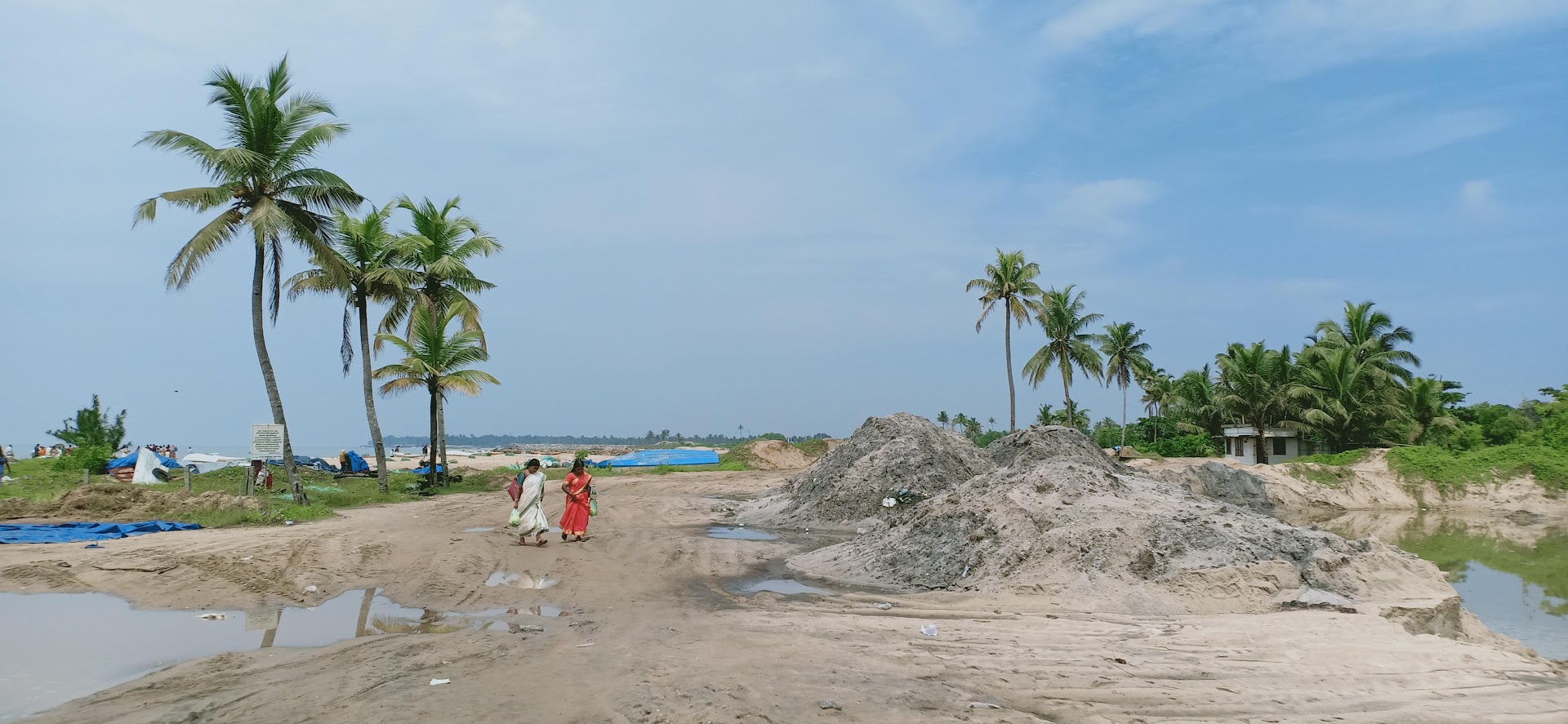
Mined mineral sand awaits transportation at Alapad in Kollam. Photo: K A Shaji

Synopsis: The Kerala High Court recently struck down the Kerala Minerals (Vesting of Rights) Act, 2021, ruling that the state cannot take ownership of mineral deposits beneath private land without constitutional authority or compensation, setting up a major legal battle over property and mineral rights. With the CPI(M) urging the UDF government to appeal to the Supreme Court, the verdict has sparked a wider debate over whether control over natural resources lies with the state or the Centre.
The Kerala High Court’s decision to strike down the Kerala Minerals (Vesting of Rights) Act, 2021, has set the stage for what could become one of the state’s most significant constitutional battles over natural resources.
Beyond the immediate legal fallout, the ruling has reopened a larger debate: who has the authority to control mineral wealth beneath private land—the state or the Centre?
With calls growing louder for the matter to be taken to the Supreme Court, the verdict is likely to have implications that extend far beyond Kerala.
A Division Bench of the Kerala High Court comprising Justices AK Jayasankaran Nambiar and AK Preetha, on 16 July, declared the Kerala Minerals (Vesting of Rights) Act, 2021, unconstitutional, holding that the state legislature lacked the constitutional competence to enact such a law.
The legislation, published in November 2021, vested ownership of mineral rights in the Malabar region even when the surface land belonged to private individuals.
The CPI(M), which was then in power as part of the Left Democratic Front (LDF) government in 2021, has urged the present UDF government to challenge the judgment before the Supreme Court.
According to the party, the law was intended to ensure the state’s control over mineral resources so that they could be managed and distributed for the larger public good in line with the Directive Principles of the Constitution.
While the UDF government is yet to indicate its next course of action, the judgment has already sparked a wider debate over legislative powers, property rights and the ownership of natural resources. With mounting demands for an appeal to the Supreme Court, the High Court’s ruling is unlikely to be the final word on the issue.
Also Read: Kerala demands withdrawal of Centre’s offshore atomic mineral rules
The legislation at the centre of the issue, the Kerala Minerals (Vesting of Rights) Act, 2021, was notified by the state’s Law (Legislation-C) Department in November 2021.
The Act was enacted to transfer ownership and control of mineral rights beneath land across Kerala to the state government, except areas covered by the erstwhile Travancore Proclamation of 14 June 1881, and the Cochin Proclamation of 1905.
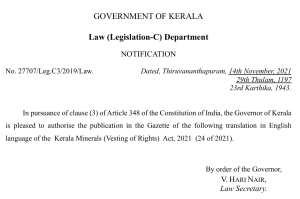
The legislation in question
According to the Act, every right over minerals lying in the soil and subsoil of land—irrespective of the ownership or nature of tenure—is vested in the government from the date the law came into force. Although notified in 2021, the legislation was given retrospective effect and is deemed to have been in force from 30 December 2019.
The preamble states that the law was introduced to vest mineral rights in the state while excluding lands governed by the historic Travancore and Cochin proclamations.
Subsequently, the legislation vests all rights in the minerals in the soil and subsoil of lands in the Malabar region of the state, like that specified under pre-constitutional legislation in 1881 and 1905.
Also Read: Landslide puts focus on Kerala’s missing mineral and mining policy
At the same time, the division bench ruled that the legislation sought to deprive landowners of their rights over minerals beneath their land without laying down any procedure for such deprivation and without providing any compensation.
It observed that the Act effectively extinguished private rights in sub-soil minerals while offering no safeguards required under the Constitution.
Importantly, the court held that it violates Articles 14, 19, 21 and 300-A of the Constitution.
The court noted that since the Act did not enjoy the protection available under Articles 31-A or 31-C, its validity had to be tested against the guarantees under Articles 14, 19, 21 and 300-A. It found that the legislation failed that test.
While Articles 14,19 and 21 (known as the golden triangle of the Constitution) deal with the right to equality, freedom to practice any profession or carry on any trade, business or occupation and the right to life respectively, Article 300-A says that “no person shall be deprived of his property save by authority of law.”
Holding that the Act contained no provision protecting the constitutional rights available under Article 300-A and provided “no compensation” rather than merely “nil compensation”, the bench said it could not qualify as a valid law authorising deprivation of property.
It therefore declared the Kerala Minerals (Vesting of Rights) Act, 2021 unconstitutional.
Also Read: How ‘donations’ to politicians, kin are ruining environment and life
The division bench also pointed out another serious defect in the legislation, observing that it exceeds the legislative powers granted to the state under the Constitution.
It noted that while states have the authority to regulate only minor minerals, the impugned law extends its scope to major minerals as well.
The regulation of major minerals rests with Parliament under the Mines and Minerals (Development and Regulation) Act, 1957, after the Union declared that it was in the public interest to assume control of the sector.
According to the court, this renders the state law unconstitutional to the extent it seeks to vest rights in major minerals, as the state legislature lacks authority to enact such a provision.
The bench observed that if this had been the only defect, the court could have considered limiting the law’s operation to minor minerals by “reading down” its provisions. However, it found that the legislation suffers from another fundamental flaw.
Even if its application were confined to minor minerals, the law would still fail to meet the constitutional requirements under Article 300A, which protects a person’s right to property except by authority of a valid law.
In view of these findings, the court held that the legislation cannot be sustained merely by narrowing its scope, as it falls short of the constitutional standards required for depriving individuals of property rights.
It was some quarry owners from the Malabar region who challenged the state government’s authority to collect royalty on granite extracted from private land, arguing that such a demand is legally unsustainable for the period before the Kerala Minerals (Vesting of Rights) Act, 2021 came into force.
The petitioners, who own granite quarries in Kozhikode and other parts of the Malabar region, contend that the government had no ownership over minerals beneath private land until the 2021 law vested those rights in the state with retrospective effect from 30 December 2019.
Citing the Supreme Court’s ruling in the Thresiamma Jacob case, they argued that royalty could be levied only if mineral rights had been legally vested in the government through legislation.
They also challenged provisions of the Kerala Minor Mineral Concession Rules, 2015, which make payment of royalty mandatory for obtaining movement permits and require environmental clearance for mining permits. According to the petitioners, the state cannot insist on royalty as a condition for granting regulatory approvals when ownership of the minerals itself was in dispute.
Several quarry owners said they had received royalty demand notices without clarity on the period to which the dues applied. They argued that any royalty sought for the period before the 2021 Act is unconstitutional and liable to be quashed.
The petitioners have also questioned the validity of the 2021 Act itself, contending that the state legislature lacked the authority to enact a law vesting ownership of sub-soil minerals in the government.
At the same time, the state government has defended its law vesting mineral rights in the state, telling the High Court that landowners cannot claim ownership over minerals beneath their property to avoid paying royalty or complying with mining regulations.
In a counter-affidavit filed in the case, the government argued that even if landowners had previously held sub-soil rights, that did not prevent the state from regulating the extraction of minor minerals under the Mines and Minerals (Development and Regulation) Act and the Kerala Minor Mineral Concession Rules. It maintained that royalty could legally be collected as a condition for granting mining leases, licences or permits.
The government further pointed out that the legal position had changed after the Kerala Minerals (Vesting of Rights) Act, 2021, came into force on 30 December 2019. Under the new law, mineral rights were specifically vested in the state, rendering earlier arguments based on prior court rulings inapplicable.
Defending the legislation, the state said the Act was enacted to fulfil the constitutional objective of ensuring that the country’s natural resources are managed for the benefit of the public. Since the law was intended to serve the common good, it argued that there was no requirement to compensate landowners whose mineral rights stood vested in the state.
The government also argued that paying compensation only to landowners in the Malabar region would create an unfair distinction. It noted that mineral rights in the erstwhile Travancore and Cochin regions had already vested in the state under pre-Independence laws without any compensation. Extending compensation to one group while denying it to another, it contended, would amount to discrimination.
The state further maintained that the 2021 Act was supported by constitutional provisions empowering states to legislate on land and minerals, and that its overriding clause insulated it from challenges under existing land acquisition laws.
The CPI(M), now in the Opposition but was part of the Left government which framed and enacted the Act, has urged the UDF government to challenge the High Court’s decision in the Supreme Court.
It said that the law was enacted to protect public interest and ensure equitable control over the state’s mineral wealth.
According to the CPI(M)’s state secretariat, the legislation was introduced to remove the long-standing disparity in mineral ownership between different regions of Kerala.
While old royal proclamations gave the government ownership of minerals beneath private land in the erstwhile Travancore and Kochi regions, those rights remained with landowners in the Malabar region.
The 2021 Act sought to bring the Malabar region under the same legal framework.
The party said the law reflected the constitutional principle that natural resources should be managed for the public benefit.
It argued that allowing private ownership of minerals could lead to unequal treatment of landowners and weaken public oversight over the use of valuable natural resources.
Describing the verdict as a setback to public interest, the CPI(M) urged the government to take the matter to the Supreme Court.
(Edited by Majnu Babu).



