

Published Jan 09, 2026 | 8:00 AM ⚊ Updated Jan 09, 2026 | 8:00 AM

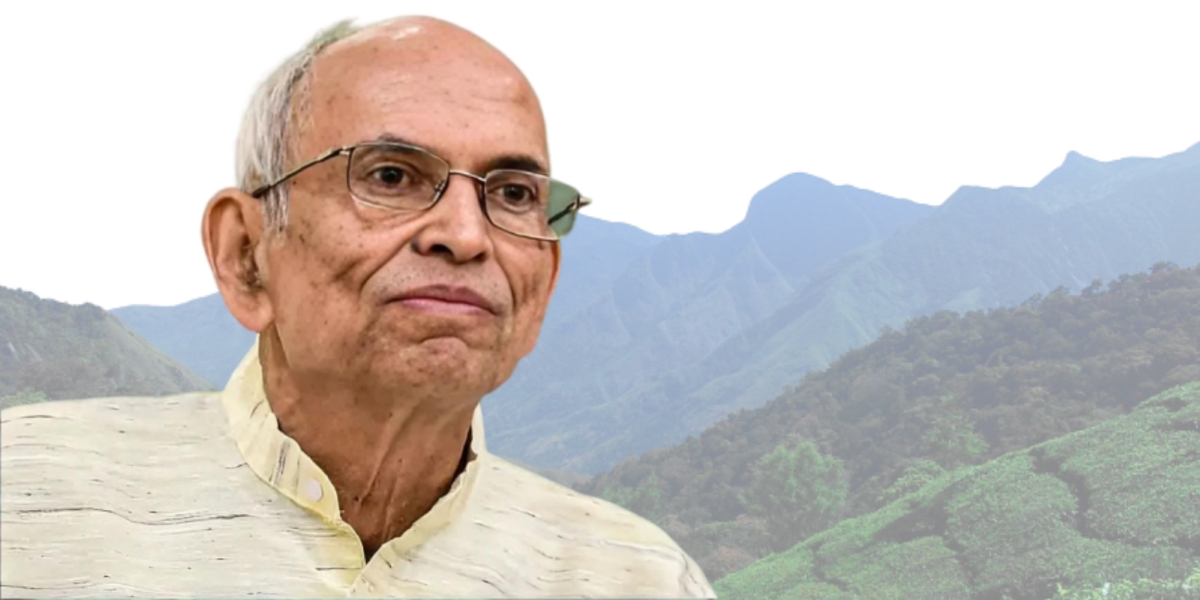
Madhav Gadgil. (Supplied)
Synopsis: Submitted in September 2011 and published in May 2012, the report proposed classifying the Ghats into three Ecologically Sensitive Zones (ESZs), with graded restrictions on mining, quarrying, large dams, and polluting industries.
On a December evening in 2012, the Kerala Legislative Assembly debated late into the night—past 9.30 pm—over a scientific report that would soon become one of the most controversial documents in the state’s environmental history.
By the time the House rose, it had unanimously resolved to reject the recommendations of the Western Ghats Ecology Expert Panel (WGEEP), chaired by ecologist Madhav Gadgil.
More than a decade later, as nature lovers and environmentalists mourns the death of Gadgil on 8 January, the same Western Ghats he sought to protect appear to be issuing a grim postscript.
Landslides, floods, and ecological collapse have transformed a once-reviled report into what many now acknowledge as an unheeded warning.
Appointed in 2010 by the Centre under then environment minister Jairam Ramesh, the WGEEP was tasked with preparing a roadmap for conserving the Western Ghats, one of the world’s eight “hottest” biodiversity hotspots.
Submitted in September 2011 and published in May 2012, the report proposed classifying the Ghats into three Ecologically Sensitive Zones (ESZs), with graded restrictions on mining, quarrying, large dams, and polluting industries.
In Kerala, where the Western Ghats cut across almost half the state and host dense human settlements, the response was immediate and ferocious.
Political parties across the spectrum—UDF, LDF, and the Kerala Congress factions—joined hands to denounce the report as “anti-people” and “anti-development.”
Religious institutions, including powerful church bodies in the high ranges, warned of mass displacement.
Farmer organisations claimed the report would destroy agriculture and livelihoods. Local bodies passed resolutions rejecting it.
What emerged was a rare political consensus: the Gadgil Report must go.
For nearly a decade, Madhav Gadgil’s name provoked anger and resentment in parts of Idukki and Wayanad.
He was burned in effigy, black-flagged, and portrayed as a man who valued “frogs and snakes over human lives.”
Protesters threatened to break his legs if he entered certain hill towns.
A powerful narrative was built around him—that he wanted to evict people from their homes and turn the Western Ghats into a human-free wilderness.
Gadgil repeatedly countered this, arguing that his vision was rooted in community-led conservation, decentralised governance, and sustainable livelihoods.
Few listened.
Land mafias and quarrying interests—many with political patronage—also had much to lose.
The report threatened to expose illegal encroachments into forests and unregulated extractive industries operating in fragile zones.
The Assembly debate on December 20, 2012, laid bare Kerala’s anxieties.
CPI(M) leader Kodiyeri Balakrishnan initiated the discussion, warning that the report made it “impossible to settle in many areas.”
Legislators cited figures showing that 42 of Kerala’s 63 taluks and 633 local self-government institutions would fall under ecological zoning. Senior Congress leader Joseph Vazhakkan accused the report of “destroying the agricultural base of Kerala.”
Others echoed concerns about population density, settler farmers, and development. Yet, even amid the rejection, dissenting notes emerged.
Then MLA VD Satheesan warned that rumours were being spread by illegal mining and sand mafia lobbies. He argued that organic farming and conservation did not mean eviction.
Left leader Mullakkara Ratnakaran acknowledged the scientific soundness of the report but faulted governments for failing to prepare society for such changes.
Then Chief Minister Oommen Chandy struck a conciliatory note, praising the report’s environmental intent but calling its zoning approach impractical.
The House unanimously passed a resolution urging the Centre not to accept the recommendations.
The discussion ended at 9.28 pm.
Gadgil was effectively put on trial—and convicted.
Responding to the backlash, the Centre appointed the Kasturirangan Committee in 2012.
Its 2013 report sharply reduced the ecologically sensitive area, excluding human settlements and plantations, and scaled back restrictions.
Even then, Kerala saw protests. Implementation stalled. Large parts of the Western Ghats remain without notified ESZs to this day.
Gadgil publicly criticised the dilution, warning that it weakened the very safeguards needed to protect the ecosystem.
The ultimate assessment of Gadgil’s work did not come from political forums, but from the land itself.
Since 2018, Kerala has experienced a series of devastating floods and landslides.
The July 2024 landslides in Wayanad—among the deadliest in the state’s history—became a turning point. Gadgil described the disaster as “man-made,” pointing to quarrying, slope cutting, deforestation, and construction in zones he had marked as highly sensitive.
Post-disaster analyses revealed an uncomfortable truth: many landslides occurred precisely in areas where the WGEEP had recommended the strictest protections.
Climate change intensified rainfall, but it was ecological neglect that turned rain into catastrophe.
Very few political leaders stood by Gadgil when it mattered.
Former Congress MP PT Thomas paid a heavy political price for supporting the report, facing mock funerals and eventual marginalisation. Satheesan and a handful of others remained consistent voices, but they were exceptions.
In death, the tone has changed.
In his condolence message, Satheesan described Gadgil as a visionary who championed “human-centred environmental protection, balanced development, and decentralised governance.”
It was the same argument Gadgil had made all along.
Kerala gave Madhav Gadgil resistance, ridicule, and rejection. It gave him protests instead of dialogue, fear instead of trust, and delay instead of action.
In return, nature has given Kerala floods, landslides, and warnings written in mud and debris.
As the state bids farewell to the ecologist it once vilified, Gadgil’s legacy stands stark: science ignored does not disappear—it waits, and returns, as disaster.
The question now is not whether Gadgil was right. It is whether Kerala is finally ready to listen.
(Edited by Sumavarsha)


