

Published Aug 31, 2026 | 9:53 PM ⚊ Updated Aug 31, 2026 | 10:01 PM

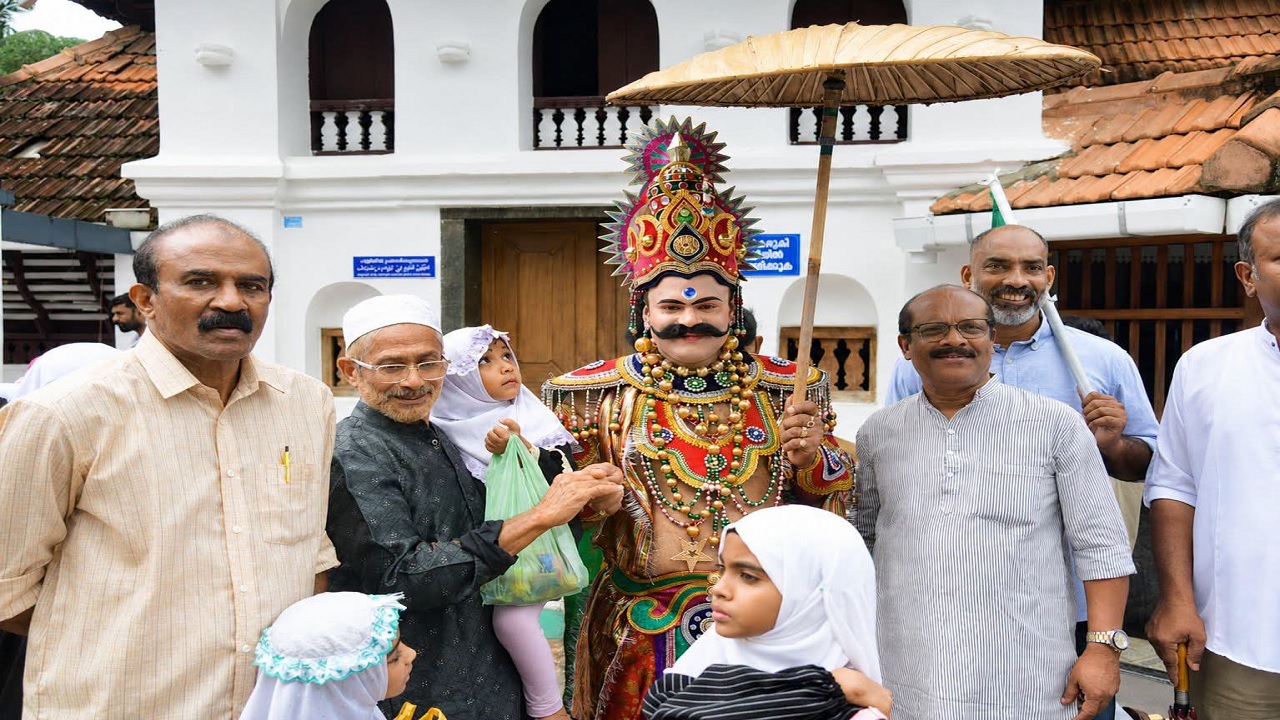
At Kottayam's Thazhathangadi Juma Masjid, Onam has been celebrated in a spirit of unity, with people dressed as Mahabali visiting the mosque

Synopsis: Onam has become a cultural battleground, with the Sangh Parivar attempting to push the Vamana Jayanti narrative and conservative Muslim groups seeking to restrict women’s participation in Onam celebrations. Amid these competing narratives, Kerala’s Gen Z Muslim women are asserting their right to dress, dance and celebrate as they choose, reflecting the state’s long-standing tradition of secular and inclusive Onam celebrations.
On a Sunday night, Kaloor Stadium in Kochi was transformed into a sea of white. Men in crisp white shirts and mundus arrived from different corners of Central Keralam, filling the stadium for the 21st Hubbu Rasool Conference, held under the theme ”Khalbilundu Ente Nabi”- ”My Prophet is in My Heart.”
For nearly two decades, the conference has brought together thousands, presenting itself as a space for spiritual thought and the celebration of the Prophet. The evening unfolded amid devotional speeches and prophetic praise, culminating in an address by Indian Grand Mufti Kanthapuram AP Aboobacker Musliyar.
But as the speech approached its conclusion, the tone shifted.
Kanthapuram said bringing women onto public platforms would lead to ”great destruction” and argued that Islam prescribed purdah for women to prevent such consequences.
The words landed against a Keralam already wrestling with a battle over who gets to decide what its people should celebrate, wear and become.
Just days earlier, a series of Onam reels had set social media alight. Young Muslim women in hijabs danced to popular film songs at college Onam celebrations. For some, the videos were nothing more than Gen Z — or Zoomers — claiming their moment of Onam joy. For others, they became an occasion for moral outrage.
On one side stands the attempt by the Sangh Parivar to recast Onam through the lens of Vamana Jayanti, shifting the cultural spotlight from Mahabali- the beloved king at the heart of Onam- towards Vamana, the avatar of Lord Vishnu.
In the end, the question is not whether Mahabali belongs to one community or whether a Muslim girl should dance in a hijab.
The targets may look different. The language may be different. But the instinct carries an uncomfortable resemblance- who gets to decide what Keralam is allowed to be?
Also Read: Muslim body says worshipping football stars against Islam
Speaking to South First, historian Pallikonam Rajeev said there is no historical evidence to establish that Onam originally belonged to any particular religion. He said the festival is closely associated with Keralam’s agricultural harvest and the welcoming of a new season.
”During the 8th to 12th centuries, Brahmanical, particularly Vaishnava, culture was strong in Keralam. During this period, the story of Onam became connected with Lord Vishnu. The association of Onam with Vamana and Mahabali emerged from this period,” he said.
According to the popular narrative, King Mahabali was a generous and benevolent ruler of Keralam loved by his people. Lord Vishnu appeared in the form of Vamana and asked Mahabali for three paces of land. After Vamana covered the earth and heavens in two steps, Mahabali offered his own head for the third. Pleased with his devotion, Vishnu allowed him to return to Keralam once a year to meet his subjects, a return that is traditionally celebrated as Onam.
Rajeev also pointed to a Muslim oral tradition associated with Onam. He said that, in earlier times, some members of Keralam’s Muslim community prepared a jaggery-based sweet rice dish (Chakkarachor) on Onam to commemorate the journey of a Chera king.
According to the local oral tradition, the Chera king witnessed the splitting of the moon, a miracle attributed to Prophet Muhammad. He subsequently abdicated his throne, travelled to Arabia, met the Prophet in Mecca, embraced Islam and took the name Tajuddin.
However, Rajeev stressed that this account, too, lacks verified historical evidence.
”The conclusion is that the earliest available historical evidence of Onam dates to AD 861–62, in the Thiruvattuvai Cheppad. There is no mention of Mahabali in the inscription,” he said.
Cheppad refers to a copper-plate inscription historically used to record grants, agreements and other important matters.
Also Read: Muslim groups oppose Zumba in Kerala schools
Women and Child Development Minister Bindu Krishna strongly criticised Kanthapuram’s remarks, calling them unacceptable and unfit to be emulated in society.
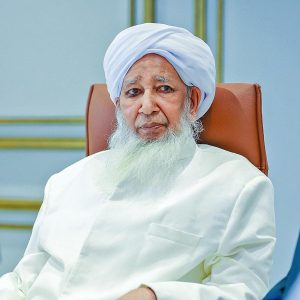
Kanthapuram A.P. Aboobacker Musliyar
Krishna said everyone has the right to follow their religious beliefs, but such freedoms must coexist with respect for the Indian Constitution, which guarantees equality and equal rights to women.
She pointed out that women have repeatedly demonstrated their abilities and leadership across different spheres of public life. Referring to India’s President as a woman, Bindu also cited former leaders such as Indira Gandhi, Benazir Bhutto and Sheikh Hasina as examples of women who have occupied positions of political authority.
The minister asserted that asking women to remain away from public spaces is fundamentally contrary to the idea of a gender-just society. She said views that seek to push women back by centuries cannot be accepted or allowed to become models for society.
Kanthapuram’s remarks came amid a directive issued by the Kanthapuram faction of the Samastha Keralam Jamiyyathul Ulama, led by president E Sulaiman Musliar and general secretary Kanthapuram Aboobacker Musliar. The directive urged mahal and madrasa authorities to prevent women from sharing stages with men, appearing alongside unrelated men in public spaces or being publicly displayed during religious celebrations.
His remarks have drawn criticism from several Left and student leaders, including CPI(M) leader KK Shailaja, AIDWA leader CS Sujatha and SFI state secretary PS Sanjeev, who described the views as deeply anti-women and regressive.
Also Read: Islam upholds women’s safety and security, but clerics often distort it, says VP Zuhra
The Samastha directive came amid a growing wave of young Muslim women openly participating in Onam celebrations.

Mubeena Nijas aka Mubis Paradise
The trend gained momentum after Muslim religious influencer Mubeena Nijas, who goes by the handle Mubis Paradise on social media, urged college girls to dress modestly, follow Islamic deen and stay away from celebrating Onam.
Students responded strongly, openly celebrating Onam and sharing their performances on Instagram. Several Muslim colleges also allowed such programmes.
”Even in this modern era, a section of society is against secular and modern thoughts. Which dress to wear, whether to dance or not, whether to wear hijab or not — everything is deeply personal. No girl of this generation will listen to them. They prioritise their choices, not any religion.” SFI leader Noodhan Dheera from Kozhikode told South First.
Greeshma G, a student from Farook College, said her institution had not restricted any celebrations.
”Our institution hasn’t limited any celebration. My friends who danced in the Onam celebrations come from religious backgrounds, and most of them are believers, not atheists. They dressed modestly and wore hijab as part of their belief. Then what is the issue? Here in college, there is no discrimination. The entire controversy is unnecessary,” she told South First.
For many of these young women, the question is not whether they are religious. It is about whether their personal choices should be dictated by someone else.
They can wear a hijab and still dance. They can be religious and still celebrate Onam. They can follow their faith and still participate in a festival that has long been part of Keralam’s shared cultural life.
Also Read: Kerala doesn’t celebrate Deepavali because it has fewer Hindus?
While one side seeks to determine how Muslim women should participate in public celebrations, another narrative has attempted to redefine the cultural meaning of Onam itself. Manoj S Nair, a BJP activist from Kochi, told South First that the earlier Vamana Jayanti narrative around Onam had not gained wider acceptance.
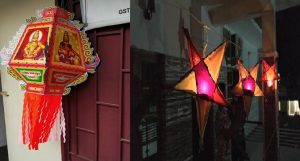
Makara Nakshatram
”The earlier Vamana Jayanti narrative of Onam has not gained wider acceptance. So now every leader and party is mentioning Onam as Onam, not as Vamana Jayanti,” he said.
A few years ago, articles in RSS publications such as Kesari asserted that Onam marks the birth of Lord Vamana and promoted calling the occasion Vamana Jayanti. But this narrative has not even gained wider acceptance among BJP activists.
And it is not only Onam. Christmas too has faced attempts at narrative manipulation from the Sangh Parivar in Keralam.
In December 2020, right-wing outfits associated with the Sangh Parivar in Keralam initiated a campaign asking Hindu households to avoid hanging decorative Christmas stars. Instead, they promoted calling them ”Makara Nakshatram” (Makara Star), rather than traditional Christmas stars, during the winter festive season.
In 2025, Keralam Police registered a case against a teacher at Sirajul Uloom English High School in Kadavallur, Thrissur, for allegedly asking Muslim students to avoid participating in Onam celebrations. The teacher, identified as Khadija, sent parents a voice message describing Onam as a festival of another religion.
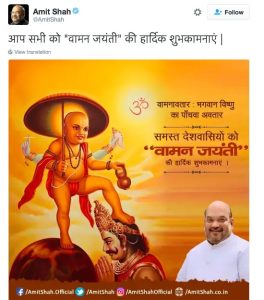
Amit Shah’s 2016 Vamana Jayanti post
Most Malayalis have celebrated Onam together, and its inclusivity is even visible in the food on the table—some prefer a vegetarian meal. In contrast, others have non-vegetarian meals on the same day.
At Kottayam’s Thazhathangadi Juma Masjid, Onam has been celebrated in a spirit of unity, with people dressed as Mahabali visiting the mosque and being welcomed as part of the celebration.
For generations, Onam and Nabidinam (Milad-un-Nabi) have often fallen around the same season, and people have celebrated them together — at homes, in neighbourhoods and in colleges.
That is the Keralam that has existed beyond political and religious narratives. The secular Keralam has never truly entertained attempts to appropriate its festivals or dictate who can celebrate them- whether those attempts come from the Sangh Parivar or from Samastha.
At its heart, Onam is about Mahabali returning to see his people. And the Keralam of today is about people deciding for themselves how they want to welcome him.
No gender. No religion. No politics. Just the joy of celebrating together.
(Edited by Majnu Babu).



