

Published Feb 13, 2026 | 12:02 AM ⚊ Updated Feb 13, 2026 | 12:02 AM

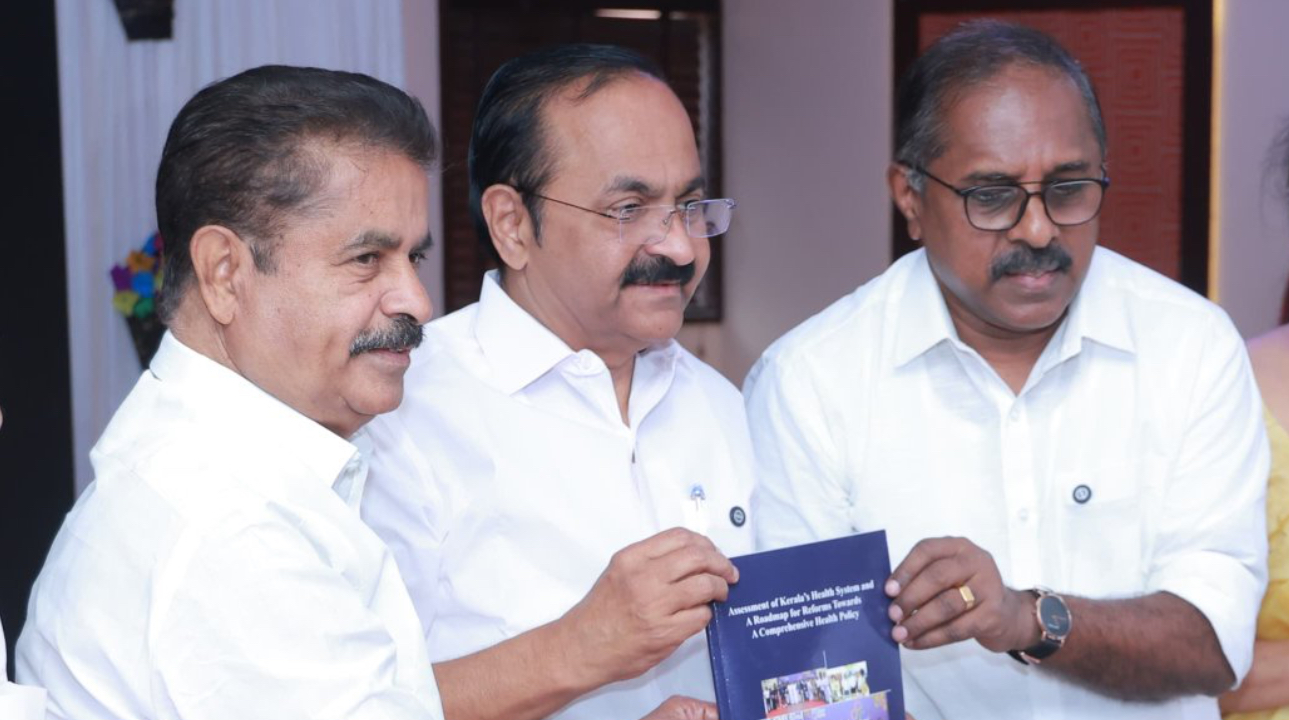
Leader of the Opposition VD Satheesan unveiled the policy document in Kozhikode on Thursday.
Synopsis: The Congress-led United Democratic Front has placed health at the centre of its campaign for the Kerala Assembly elections with the release of a policy document in Kozhikode on 12 February. The report, prepared by a UDF Health Commission set up in June 2025, says Kerala’s public health system faces structural strain, staff shortages and weak coordination despite strong overall indicators. The UDF has proposed restoring Universal Health Coverage as the guiding principle of reform, increasing public investment, filling vacancies and overhauling procurement and management systems.
With the Kerala Assembly elections approaching, the Congress-led United Democratic Front (UDF) has made its opening move by placing the health sector at the centre of political debate.
In Kozhikode on Thursday, 12 February, Leader of the Opposition VD Satheesan unveiled a policy document titled “Assessment of Kerala’s Public Health System and a Roadmap for Reforms”, presenting it as both a critique of the incumbent LDF government’s record and a promise of sweeping reforms if the front returns to power.
The UDF has accused the Left government of presiding over a system that is “overstretched, uneven in performance and drifting away from its core public-service ethos.”
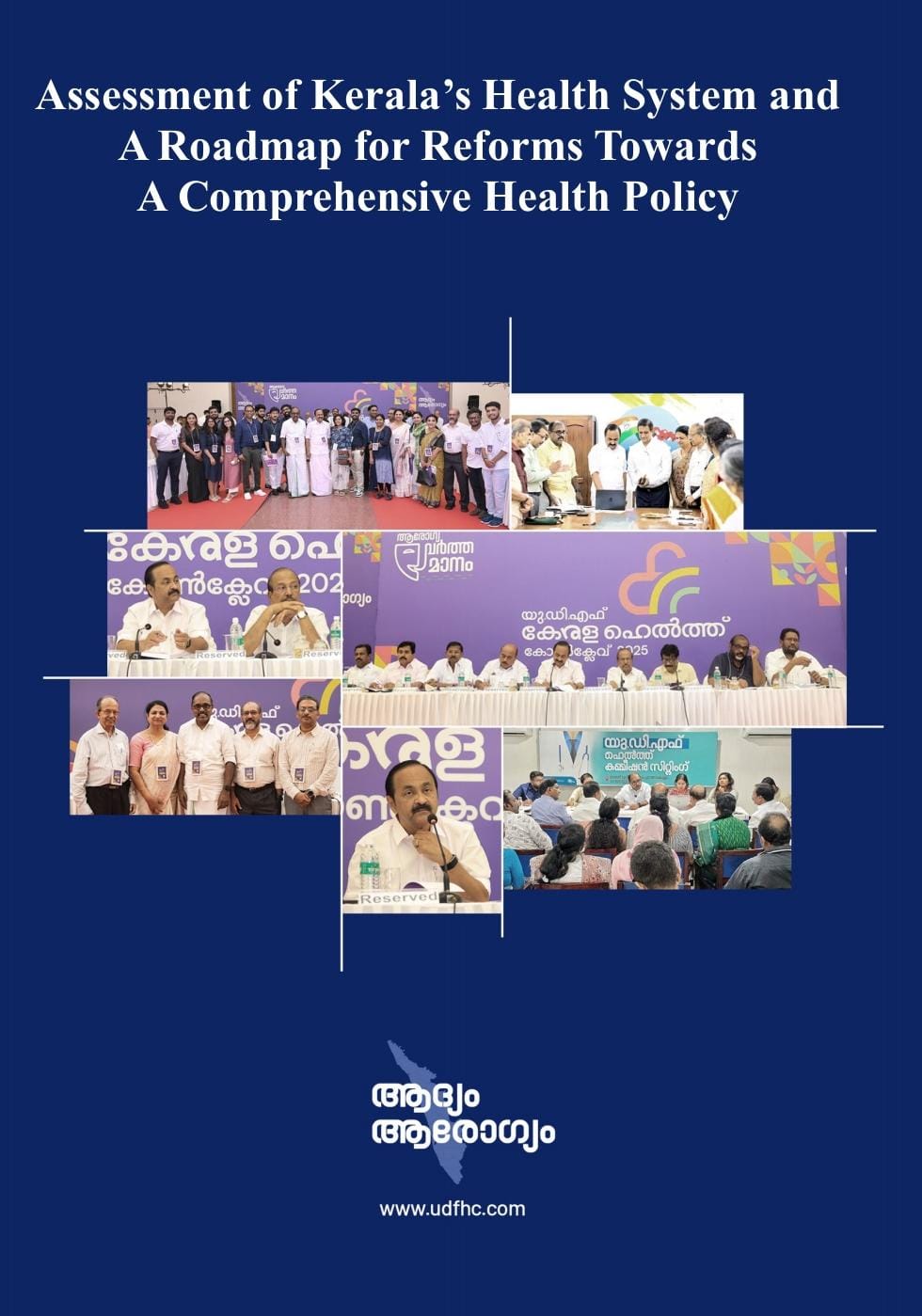
The report of the UDF Health Commission
At the same time, the front says the document is not an attack on Kerala’s public health legacy but an effort to safeguard and modernise it in line with new challenges.
Built around the idea of “health first”, the manifesto promises universal access to treatment, the right to diagnostics and medicines in government hospitals, and an end to care being denied for lack of money—setting up health as a central plank of the coming electoral contest.
Kerala’s much-celebrated public health model is at a critical juncture, with structural fatigue and policy drift threatening to erode decades of progress, the report by the UDF Health Commission warns.
The policy traces its origins to June 2025, when the UDF set up a Health Commission to study what it called the “complex and serious problems” that emerged in the health sector during the tenure of the first and second Pinarayi Vijayan governments and to recommend long-term corrective measures.
The Commission was chaired by Dr SS Lal, a global health expert and UDF candidate from Kazhakootam in the 2021 Assembly elections. Other members included Dr Sreejith N Kumar, Prof. Dr Rajan Joseph Manjooran, Dr PN Ajitha and Dr OT Muhammed Basheer.
When it was formed, the Congress state unit said the report would draw on detailed evidence from the public, government hospital staff, non-government health workers, public health experts and specialists from related sectors. It said the findings would precede an alternative health policy and lay the foundation for a broader Kerala Health Vision 2050.
A health conclave organised by the UDF in August 2025 at Kovalam further shaped the policy. Calling it a first in Kerala’s political history, Leader of the Opposition VD Satheesan said it marked the first time an Opposition front had convened a dedicated health conclave to set out an alternative vision.
“For the last four and a half years, we have been pointing out shortcomings in the health sector. But criticism alone is not enough. We must place our alternative before the people,” he said while inaugurating the event.
The commission also said in the report that between July 2025 and January 2026 it held wide-ranging consultations with more than 600 stakeholders—from patients and community volunteers to international experts. Those consulted included doctors, nurses, public health professionals, administrators, bureaucrats, health finance specialists, economists, researchers, academics, elected representatives, hospital managements, entrepreneurs and representatives of vulnerable and special-needs groups.
UDF sources said the health policy is part of a broader exercise. More sector-specific reports are expected in the coming days as the front seeks to present detailed alternatives across key areas of governance.
“With this report and others on the anvil, those who accuse the opposition of merely criticising will see that we have concrete plans to address the issues,” a senior UDF leader said.
The document seeks to shift political debate from criticism to an alternative roadmap, UDF sources said, promising universal access to diagnostics and medicines in government hospitals and a structural overhaul of the sector if voted to power.
Releasing the report, Leader of the Opposition VD Satheesan struck a confident note.
“When the UDF returns to power, there will be no situation where treatment is denied for want of money,” he said, stressing that the right to healthcare would not remain a slogan.
The policy makes a clear assertion: diagnostic tests and medicines are the right of every person who walks into a government hospital.
The UDF has promised to reinstate free services discontinued in recent years and ensure no patient is forced to buy medicines or undergo laboratory tests from private facilities because of shortages in public institutions.
The Opposition has also pledged a permanent solution to the long-pending grievances of ASHA workers, whose protests over wages and service conditions have recurred across the state.
Describing it as a structural intervention, the UDF has proposed a “One Health Platform” integrating human, animal and environmental health systems.
Using the World Health Organisation’s Health System Strengthening framework, the report gives a stark but forward-looking diagnosis: Kerala still has strong foundations and enviable health indicators, but demographic pressures, rising non-communicable diseases, urban stress, workforce gaps and growing household financial burdens are exposing deep cracks in the system.
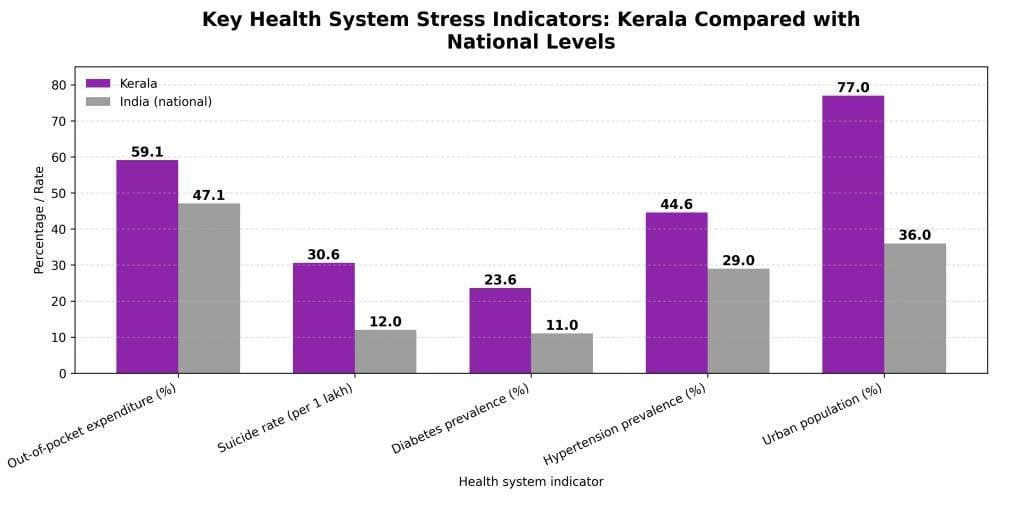
An excerpt from the report
More than 225 buildings across 134 government hospitals have been flagged as structurally unsafe. Trauma care is also grossly inadequate: only three of 14 major hospitals have emergency operation theatres and just one has a dedicated trauma ward, despite rising road accidents and cardiac cases.
Many institutions do not meet Indian Public Health Standards, and nurse-to-patient ratios in some wards have fallen to 1:50 or worse, fuelling burnout and migration.
The report also flags fragmented governance, blurred accountability between the Health Department, NHM units and local self-governments, and the absence of a dedicated Public Health Management Cadre.
Health spending is about 5.5 percent of total state expenditure. Funding is scattered across departments and schemes, which leaves little room for local innovation.
Without an updated, publicly stated health policy aligned with SDG-3 and Universal Health Coverage, the state has relied heavily on programme-driven responses such as the Aardram Mission.
The report calls for people-centred care, stronger public provision, regulatory reform and renewed investment in surveillance, infrastructure and workforce modernisation. It argues that timely adaptation—not preservation alone—will decide whether Kerala’s public health legacy endures.
In a blunt, wide-ranging diagnosis of Kerala’s healthcare system, the report says the state is not short of hospitals, schemes or institutional legacy, but of direction.
Over time, it notes, the system has drifted from its founding premise—that healthcare exists first to serve people, especially in moments of vulnerability. That drift has led to delayed decisions, fragmented accountability, overcrowded public facilities and a widening gap between policy claims and patient experience.
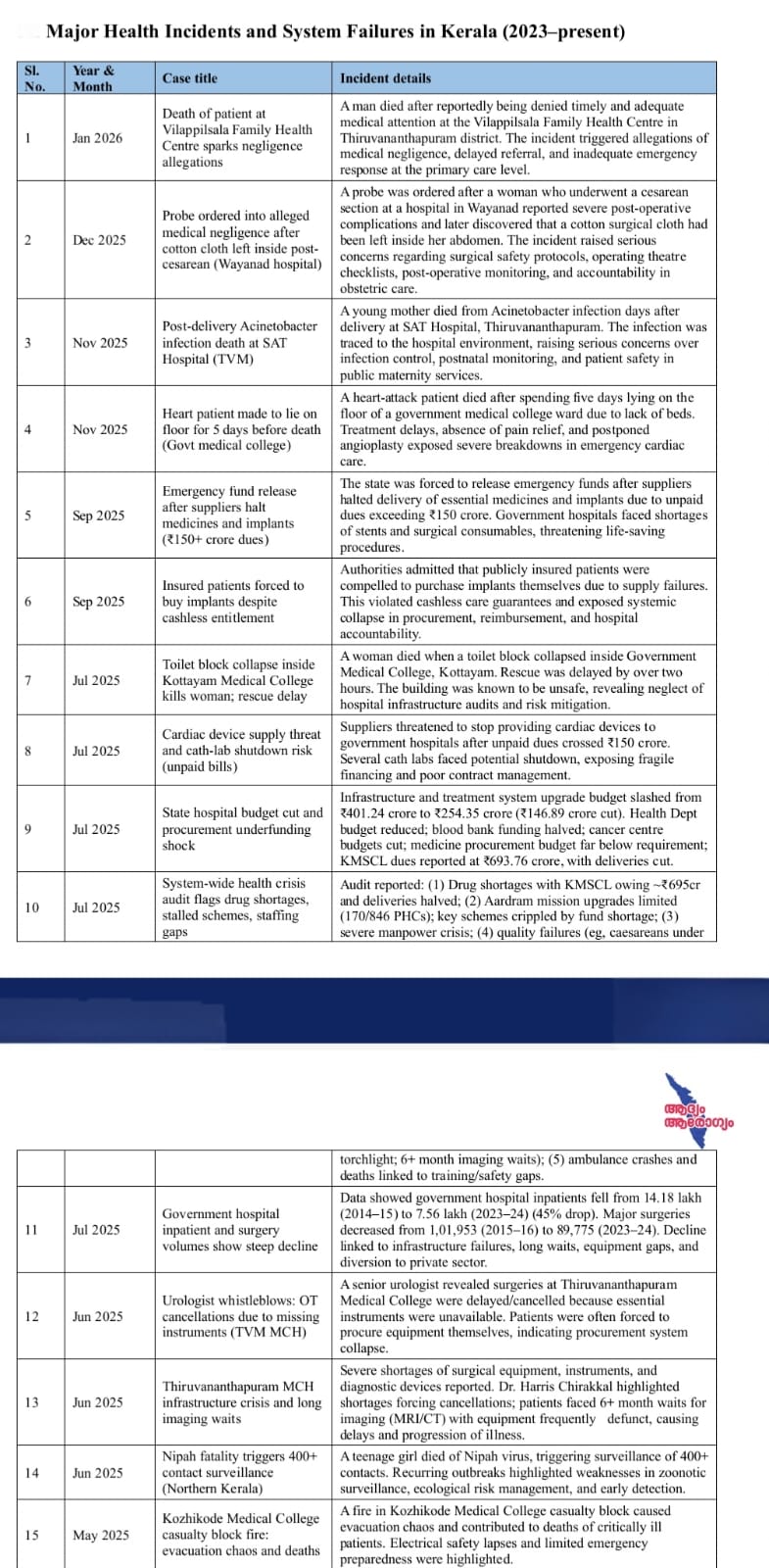
An excerpt from the report that lists, Major health incidents and system failures in Kerala (2023–present). 34 such incidents were listed
At the centre of this drift is a weakening commitment to Universal Health Coverage (UHC)—not as a slogan, but as a guarantee that every individual can access timely, quality care without financial hardship, the report says.
It calls for UHC to be restored as the organising principle of reform, with renewed investment in public hospitals, diagnostics, drug supply and primary care so citizens are not pushed into expensive private treatment.
To ease congestion in tertiary centres, the report recommends strengthening secondary hospitals so they can handle moderately complex medical, surgical and obstetric cases, backed by coordinated patient navigation through existing e-health platforms. Emergency care capacity must also expand, with more advanced life-support ambulances and trained personnel.
The blueprint spans governance and systems reform: time-bound recruitment to end prolonged vacancies; a dedicated Public Health Management Cadre to strengthen surveillance and preparedness; and a State Medical Research Board to align research with Kerala’s epidemiological profile.
It also calls for modernising procurement through a fully digital, end-to-end platform and restructuring KMSCL with diversified suppliers, flexible tenders and strict enforcement of delivery timelines to prevent stock-outs. Free, uninterrupted access to essential medicines, particularly for chronic and mental health conditions, is described as non-negotiable.
Further, the report presses for round-the-clock grievance redress in public facilities, financial protection for the “missing middle”, stronger rabies prevention and animal birth control drives, an evidence-driven AYUSH Commission, women-led “She Hospital” models to improve gender-responsive care, and Tribal Health Cluster PHCs to better serve indigenous hamlets.
Together, the recommendations set out a course correction aimed at restoring trust in Kerala’s public health system.


