

Published Dec 30, 2025 | 2:19 PM ⚊ Updated Dec 30, 2025 | 2:19 PM

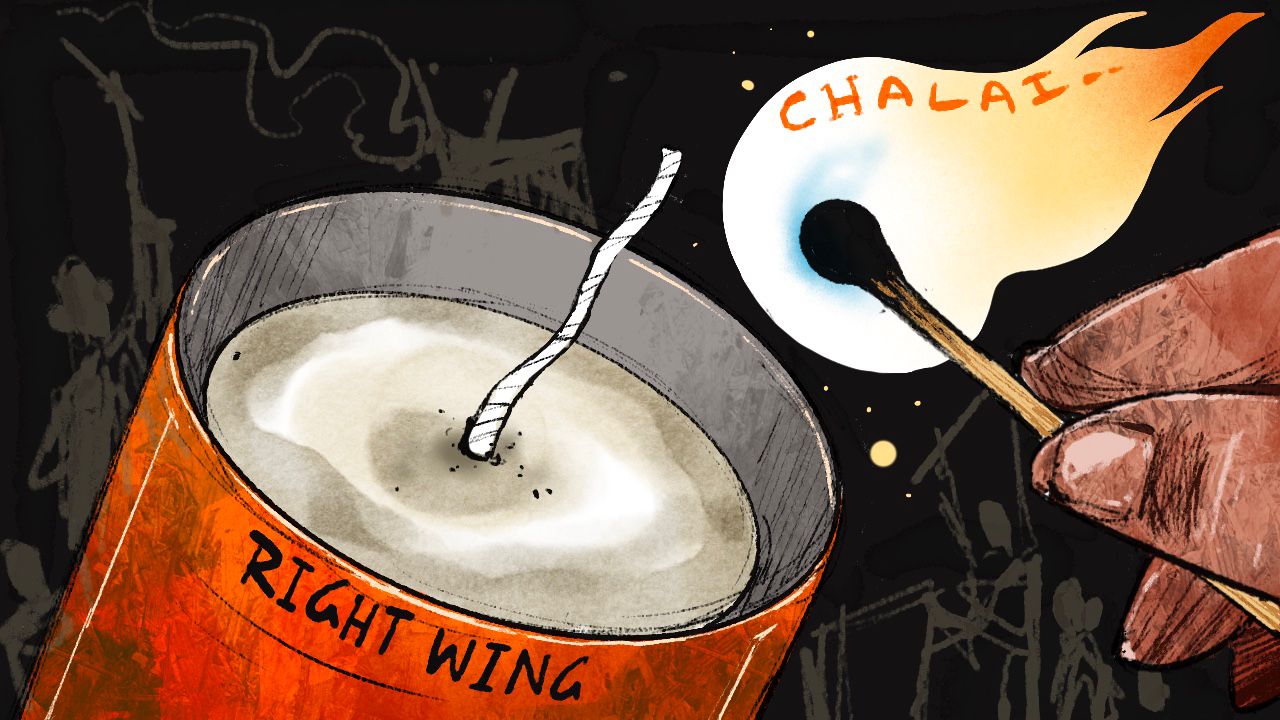
Four decades later, the memory of the 1982 Chalai violence still flickers through Kerala’s political subconscious.
Synopsis: Forty-three years ago in December 1982, violence in Thiruvananthapuram’s historic Chalai market jolted the state’s political conscience — an episode many within the Sangh Parivar still recall as one of the moments in which the right-wing announced its arrival in Kerala’s public sphere.
When the results of the Kerala Local Body Polls, 2025, were declared on 13 December, the BJP found itself staring at a moment it had long imagined but rarely tasted in the state: relevance with momentum.
The party’s historic surge in the capital city, culminating in administering the Thiruvananthapuram Corporation, has prompted the national leadership to speak once again of Kerala as fertile ground, not merely a peripheral battleground.
For a party aspiring to emerge as a credible third front in a state long dominated by the CPI(M)-led LDF and the Congress-led UDF, the numbers have offered more than celebration; they have offered reflection.
Yet, this December moment is not without precedent.
Long before electoral arithmetic began tilting in the BJP’s favour, another December altered the trajectory of the right-wing in Kerala.
Forty-three years ago, in December 1982, violence in Thiruvananthapuram’s historic Chalai market jolted the state’s political conscience — an episode many within the Sangh Parivar still recall as one of the moments in which the right-wing announced its arrival in Kerala’s public sphere.
As the BJP today weighs its growing influence in the capital city, the question is not merely how far it has come, but whether its current rise is a sudden breakthrough — or the culmination of a journey that began, quietly and controversially, decades ago.
Four decades later, the memory of the 1982 Chalai violence still flickers through Kerala’s political subconscious — not merely as an episode of arson and chaos, but as a turning point that quietly altered the capital’s political balance and opened a narrow but lasting space for right-wing mobilisation in the heart of Travancore.
What began as a protest against police high-handedness in Alappuzha spiralled into one of the most destructive urban riots Thiruvananthapuram had witnessed, leaving behind not just charred markets and displaced families, but a narrative of grievance that would later be harnessed electorally.
For decades, Milad-i-Sharief processions in Alappuzha had passed without incident. Like most religious and political marches in Kerala’s congested towns, they caused traffic snarls, irritation, and temporary inconvenience — but little else.
On 28 December 1982, however, trouble began even before the procession moved out of the Juma Masjid.
Tensions simmered around the presence of a sub-inspector in the escort team who had earlier objected to the use of loudspeakers by traders during a religious event.
After intervention at higher levels and a reported transfer order from the Home Department, the officer was still found accompanying the procession.
Heated exchanges followed, escalating into a scuffle in which the small police contingent — including the circle inspector — was overwhelmed and injured.
The procession regrouped and proceeded, only to be stopped later by a reinforced police team. Orders to disperse were resisted.
Moments later, police firing rang out. One youth was killed.
Panic turned into fury, and Alappuzha descended into violence through the night, with government offices attacked and police vehicles targeted.
The following day, opposition parties called for a hartal. Shops remained shut, roadblocks sprang up, armed gangs roamed the streets, and arson was reported, including the burning of a fire engine.
At the funeral of the youth killed in firing, tensions again flared. Police lathi-charges failed, shots were fired once more, and another person later succumbed to injuries.
By the time calm was restored with reinforcements, suspensions and transfers followed — but the embers of resentment had already spread beyond Alappuzha.
On 30 December, Thiruvananthapuram awoke without a formal hartal call.
Life appeared normal — until news trickled in that parts of the city were burning.
Groups began erecting barricades, compelling traders in the Chalai Bazaar to down shutters.
For reasons never fully explained, one group entered the airport premises and set fire to grasslands near the runway, sending plumes of smoke skyward and spreading panic in adjacent localities.
The real flashpoint emerged at Inchakkal, midway between the city centre and airport.
Barricades were dismantled by a group widely believed to include RSS activists. Those enforcing the hartal resisted. Stone-pelting followed. As more people joined in, violence escalated.
Shops, workshops and vehicles were attacked — with a pattern becoming evident. Muslim-owned establishments were largely spared at first. Hindu-owned houses and commercial spaces bore the brunt. Lorries under repair were torched. A Hindu-owned clinic was damaged. Retaliation came swiftly.
The house of IUML district president EA Rashid was pelted with stones.
The office of Mathrubhumi daily was set ablaze. A search for Muslim homes began. A colony derisively referred to as “Bangladesh”, owing to its Muslim concentration, was razed. Residents fled in time, escaping fatalities.
In the Chalai market near the railway station, arsonists made distinctions with chilling precision: Muslim-owned shops were ransacked, while adjacent Hindu-owned ones were left untouched.
By the end of the day, goods worth crores lay destroyed.
Police, widely accused of standing by under political instructions, intervened only after irreversible damage had been done. The Army was eventually deployed.
Official records later presented a muted account. Ten cases were registered — seven against Muslims, one against the police. Only one death was formally acknowledged in the Chalai violence, even as property losses ran into crores.
While some disturbances in areas like Poonthura were recorded as communal clashes, several contemporary reports described Chalai as descending into opportunistic looting by anti-social elements rather than a premeditated riot. Yet, perception mattered more than classification.
And perceptions were hardening.
Political observer A Jayashankar recalled that the BJP in the early 1980s was still a marginal force in Kerala.
“In the 1980s, the BJP began gaining visibility in Travancore, but only in small pockets of Thiruvananthapuram. The city had a Nair majority, and Nairs were largely with the Congress, the Praja Socialist Party under Pattom Thanu Pillai, and the Nair community’s own National Democratic Party,” he told South First.
The Chalai riot altered the emotional landscape.
“There was a perception that the Congress government under K Karunakaran was appeasing Muslim groups,” Jayashankar said.
“Right-wing quarters spread the narrative that compensation was reaching only Muslim traders, while Hindu victims were ignored. That sense of injustice lingered,” he said.
The first major political outcome surfaced in the 1984 Lok Sabha elections.
Kerala Varma Raja of the Poonjar royal family contested from Thiruvananthapuram under the banner of the Hindu Munnani, backed by the BJP.
Led at the time by Kummanam Rajasekharan, the mobilisation consolidated Hindu votes in a manner unseen before.
Though Varma Raja finished third, his vote tally crossed one lakh, significantly denting the prospects of sitting MP A Neelalohithadasan Nadar, who eventually lost. Congress candidate A Charles won, but the margin revealed an unmistakable shift.
In the 1987 Assembly elections, the momentum continued.
Rajasekharan, contesting as an independent backed by the BJP from Thiruvananthapuram East, emerged second with 23,835 votes.
In Thiruvananthapuram West, Kerala Varma Raja secured 18,544 votes, finishing third.
By the 1988 local body elections, the BJP further improved its performance.
From then on, the party established a steady, if limited, organisational presence in the capital.
As the BJP’s national and state leadership celebrates its unprecedented control of a municipal corporation in Kerala, the triumph carries echoes far older than the ballot boxes of 2025.
The party’s ascent in Thiruvananthapuram did not emerge overnight, nor was it solely the product of recent organisational discipline or electoral alliances.
The Chalai violence was not the birth of Kerala’s right wing — but it was its first real opening in Thiruvananthapuram.
(Edited by Majnu Babu).


