


Published Mar 25, 2026 | 11:52 AM ⚊ Updated Mar 25, 2026 | 11:52 AM

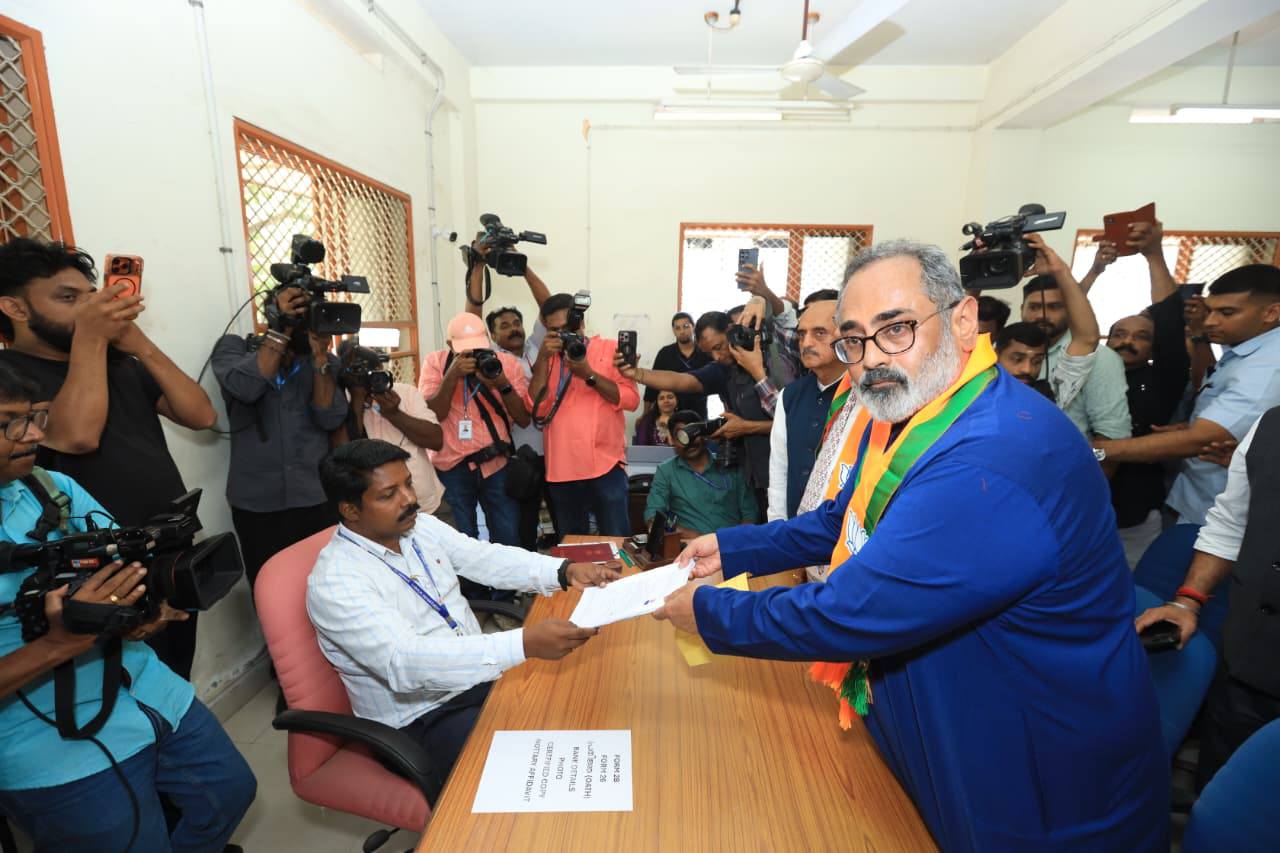
BJP state chief Rajeev Chandrasekhar filing his nomination papers on 21 March.
Synopsis: Rajeev Chandrasekhar is again under scrutiny in Kerala, with his 2026 nomination from Nemom reviving old questions from 2024—especially around a Koramangala property that appears as an address but not in the assets list, even as income swings and asset shifts show up across the two affidavits.
For Rajeev Chandrasekhar, election paperwork has a way of refusing to stay in the background.
In Kerala, where political memory is long and rival camps rarely miss a detail, the BJP state chief now finds himself once again answering familiar questions, even as the 2026 Assembly election gathers pace.
Chandrasekhar, contesting from Nemom—a seat the NDA has long treated as its foothold in the state—had his nomination accepted on 24 March.
But the clearance has not settled things. If anything, it has reopened an old argument.
This is not new territory.
In the 2024 Lok Sabha election, both the Congress-led UDF and the ruling LDF had raised pointed objections to his affidavit—alleging omissions, undervaluation, even misrepresentation in the declaration of assets and income. That episode never fully faded. It lingered.
Now, in 2026, the same fault lines are visible again. The immediate trigger this time is a property in Bengaluru’s Koramangala—already part of the earlier row—which the Congress has flagged during the scrutiny of nominations on 24 March.
The returning officer, after hearing objections, allowed the nomination to stand. Technically, that should have closed the matter. It hasn’t.
The Congress is pushing ahead, signalling a legal challenge despite the setback. Chandrasekhar, for his part, is not stepping back. He has dismissed the charges, almost curtly, and gone a step further—daring his opponents to test their claims in court.
There’s nothing dramatically new at first glance. And yet, read the two affidavits side by side, and the differences begin to stack up—in income patterns, in financial positioning, even in what is not said.

As mentioned in the affidavit for 2024 Lok Sabha election. Rajeev contested from Thiruvananthapuram but lost to Shashi Tharoor by 16,077 votes
Start with the basics.
In the 2024 Lok Sabha affidavit, Chandrasekhar describes himself as a resident of No. 408, 2nd A Cross, III Block, Koramangala, Bengaluru.
A precise address, clearly stated.
But when it comes to the assets column in that same affidavit, that residence doesn’t show up as declared property.
That absence remains unchanged in the 2026 Assembly affidavit too—no trace of the Koramangala residence in the asset list, even though the address itself had been formally cited earlier.
Instead, in both documents, what appears consistently is a different property: a non-agricultural plot at No. 419, II A Cross, III Block, Koramangala, Bengaluru, measuring 9,600 sq ft.
The cost of acquisition is held steady at ₹5.26 crore across both affidavits.
Only the current market value shifts—₹14.4 crore in 2024, nudging up to ₹15.07 crore in 2026. A routine revision on paper, perhaps. Or simply a reflection of Bengaluru’s real estate curve.
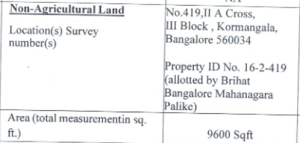
Property mentioned in both affidavits
Income is where things start to look uneven.
The 2024 affidavit lays out a five-year span from 2018–19 to 2022–23.
The numbers jump around sharply: ₹10.83 crore in 2018–19, dropping to ₹4.48 crore the next year, then sliding further to ₹17.5 lakh in 2020–21.
And then comes the figure that triggered the most attention at the time—just ₹680 in 2021–22. It picks up slightly to ₹5.59 lakh in 2022–23, but the overall pattern is already irregular.
Now move to the 2026 Assembly affidavit.
The window shifts forward—2020–21 to 2024–25—and the same ₹17.5 lakh and ₹680 entries reappear for 2020–21 and 2021–22. That continuity matters; it confirms those earlier disclosures weren’t one-off errors. But beyond that, the trajectory changes. ₹5.59 lakh in 2022–23 is followed by a sharp rise to ₹85.26 lakh in 2023–24, and then ₹92.91 lakh in 2024–25. Not quite back to the multi-crore levels seen in 2018–19, but clearly a recovery phase.
His spouse’s income tells a slightly steadier story, though with its own spikes. In 2024, the declared figures move from ₹2.5 lakh in 2018–19 up to ₹1.32 crore in 2022–23, with a gradual climb in between.
In the 2026 affidavit, that ₹1.32 crore figure carries forward into the new five-year window, but what follows is a dip—₹61.77 lakh and ₹60.50 lakh in the last two years. So, a peak and then a tapering off.
Then there’s the more visible financial shift—where the money seems to be sitting.
Bank deposits held by the couple have nearly halved, dropping from around ₹11 crore in 2024 to ₹5.54 crore in the latest filing.
At the same time, investments in shares, bonds and debentures have surged—from ₹5.32 crore to ₹40.95 crore. That’s not a marginal change. It suggests a clear repositioning of assets, away from liquid holdings toward market-linked instruments.
Put together, the two affidavits don’t contradict each other outright. The property details remain largely consistent, the controversial income figure is repeated rather than corrected, and the disclosures broadly track forward.
But the gaps—especially the missing residential asset tied to a declared address—haven’t been closed either.
Citing this omission, that of the property No. 408, 2nd A Cross, III Block, Koramangala, Bengaluru, the Congress in Kerala on Monday, 23 March, demanded the disqualification of Chandrashekar’s candidature from the Nemom constituency, alleging that he failed to disclose a 49,000 sq ft mansion in the upscale Koramangala neighbourhood in Bengaluru.
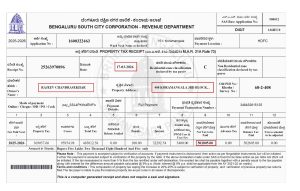
Tax receipt of the property in question shared by the Congress on the X platform
“This is a 1.07-acre property in one of the most expensive locations in the country, where many Indian billionaires live. Land here costs around ₹35,000 to ₹50,000 per sq ft or more. By a fair estimate, the land value alone could be around ₹200 crore,” the official account of Congress Kerala on X said in a post.
“Rajeev Chandrasekhar is a habitual offender and appears to believe he can mislead the Election Commission of India repeatedly. His affidavit even suggests that he owns no residential property or car despite being a billionaire businessman. We request you to intervene in this matter and disqualify the candidate as per the People’s Representation Act. Otherwise, it is only fair for the public to question whether the office is acting impartially.”
Despite the Grand Old Party’s objections, the returning officer accepted the nomination after scrutiny on Tuesday.
Chandrashekar, meanwhile, has maintained that the property belongs to a partnership firm in which he is a stakeholder, and that the relevant disclosures had been made to the Election Commission. According to his affidavit, his declared assets stand at ₹93.88 crore.
However, publicly available tax records for the Bengaluru property, first shared by the Congress, list Chandrashekar as the sole owner paying property tax. Just over ₹5 lakh was paid in tax on 17 March.
On Tuesday, there was a brief pause and a fair bit of back-and-forth between the ECI, UDF candidate KS Sabarinadhan and the BJP during the scrutiny process.
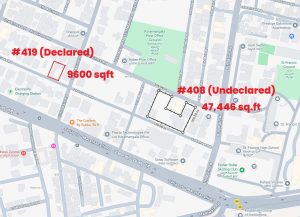
A post by Congress on the undeclared property
During arguments, the BJP’s legal representatives said questions on asset disclosure fall outside the Returning Officer’s scope at this stage. If there is a dispute, they said, it can only be settled in court after the election. The officer then accepted the nomination.
Party leaders later said there was nothing amiss with Form 26 and dismissed the allegations as routine poll-time attacks.
“There is no issue with owning assets. The question is – why hide them?” he said, also taking a swipe at the CPI(M) for what he called a “missed opportunity” to corner the BJP, hinting at a tacit understanding.
Chandrasekhar, meanwhile, called the charges “manufactured controversies.”
“This is a pattern. Before every election, the Congress shifts to personal attacks,” he said. Sabarinadhan said the acceptance of the nomination “does not amount to a clean chit,” and indicated that legal options are being explored.
In 2024, a petition raising similar allegations was dismissed by the Kerala High Court, which said such disputes cannot be examined at the nomination stage and must be pursued through an election petition after results are declared.
Under Article 329(b) of the Constitution and Section 80 of the Representation of the People Act, courts are barred from intervening in electoral matters once the process is underway. The law allows only one remedy: an election petition filed after the results are declared.
This position was reinforced in NP Ponnuswami vs Returning Officer (1952), where the Supreme Court held that electoral disputes cannot be challenged at intermediate stages.
For now, the argument is likely to play out in campaign speeches rather than courtrooms.


