

Published Jan 07, 2026 | 9:00 AM ⚊ Updated Jan 26, 2026 | 8:50 AM

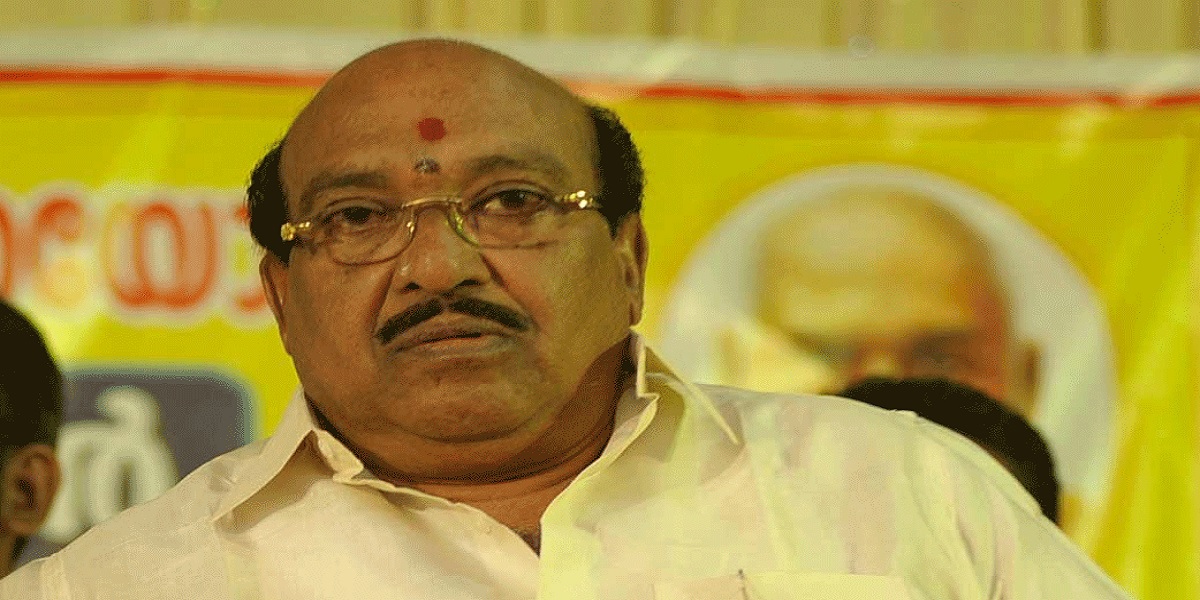
SNDP Yogam general secretary Vellappally Natesan
Synopsis: SNDP Yogam General Secretary enjoys an immunity no one else in Kerala could boast of. Despite making unsavoury remarks, he remains untouched, and apparently protected by the government in the poll-bound state. The political patronage that cuts across party lines seems to have embolden the man who helms an organisation founded to spread the teachings of social reformer Sree Narayana Guru.
‘Branding’ seems to be the favourite weapon for those in the public sphere to take on their rivals.
In the age of Islamophobia, winning the “terrorist” tag is easy if a person meets any one of the three criteria: If he is from Erattupetta ruled by a Muslim-dominated local body in Kerala’s Kottayam, or had been part of the Muslim Students Federation, or has a Muslim identity.
Rahees Rasheed, a journalist with a Malayalam television channel, has all three.
On 2 January, general secretary of the Sree Narayana Dharma Paripalana (SNDP) Yogam, Vellappally Natesan, had no second thoughts about branding Rasheed a terrorist.
The provocation was the uncomfortable questions Rasheed shot at Natesan during a media interaction.
Natesan blew through his hat on hearing the question, made an intimidating gesture and left. Later he termed the journalist a terrorist, sparking widespread condemnation.
Demands for apology came from different quarters, and the 89-year-old community leader is not the one to follow such courtesy. Instead, he repeated the ‘terrorist’ charge. However, he did not offer any evidence to support his charge.
It was not unexpected from an individual helming a social service organisation founded in 1903 to propagate the teaching of social reformer Sree Narayana Guru.
Among Guru’s teachings was “one caste, one religion, one god for humankind.” Still, for Natesan, Rasheed is a terrorist!
Natesan repeating the ‘terrorist’ taunt was not unexpected. In April 2025, he singled out Malappuram, painting it as a land of fear where people supposedly cannot breathe freely or speak their minds. Words that wound an entire district.
Yet, there was no case, no police action, no accountability.
In contrast, police detained Congress leader N Subramanian over a Facebook post and AI-generated image, invoking stringent sections for allegedly inciting unrest, in December.
Why does Vellappally Natesan continue to roam free after repeated communal remarks? Is he really that big a fish in Kerala’s political pond?
A few years ago, Natesan casually told the media that he came from a family that earned over one lakh coconuts a year, at a time when coconuts were the yardstick of wealth.
Born into abundance, Natesan was the seventh of 12 children of Vellappally Kesavan and Devaki Amma of a prosperous Ezhava household in Kanichukulangara, Alappuzha.
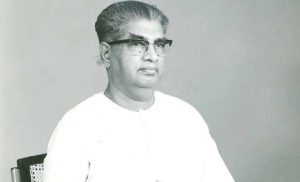
Former Kerala Chief Minister R Sankar (30 April 1909 – 6 November 1972).
Politics and reform entered his life early. Former Chief Minister R Sankar, a leading Ezhava figure and frequent visitor to his home, introduced the young Natesan to the ideas of Sree Narayana Guru and a wider political world.
A natural leader from his school days, Natesan rose through the Students Congress and became a familiar face in Alappuzha, a district shaped by strong communist traditions.
It was through social work, however, that he shaped his image as a community leader. In villages without banks or cooperatives, he formed the Grama Swaraj Samithi, supporting poor families through initiatives such as managing kadinjool thengu—coconut trees temporarily entrusted by landlords to tenants.
These efforts helped generate revenue and improve the lives of thousands of marginalised people, all of which is vividly narrated in his autobiography Ente Ennalekal (My Past).
The effort earned him support at the grassroots level. In 1962, at just 26, he contested the Thakazhi Grama Panchayat election as a Communist Party candidate and lost by six votes. Ideological differences soon pulled him away from party politics.
His rise within community leadership culminated in 1995, when he became general secretary of the SNDP Yogam.
From then on, both the organisation and Ezhava community politics came firmly under his control, alongside the expansion of institutions and a vast business empire across the globe.
Natesan stirred the communal cauldron with his unsavoury remark against the journalist even as his ride with Chief Minister Pinarayi Vijayan in the latter’s car to Pampa for the Global Ayyappa Devotee Sangamam last September was being questioned in the state.
The controversy triggered by Natesan’s communal remarks exposed a deeper political confusion within LDF. While the CPI(M), CPI, and Vijayan project themselves as part of a unified front, their sharply differing responses to Natesan reveal visible fractures.
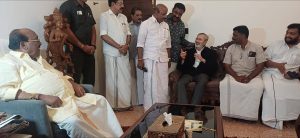
BJP leader Prakash Javadekar meets Vellappally Natesan
CPI(M) state secretary MV Govindan attempted a calibrated response. On one hand, he distanced the party from Natesan, stating clearly that he holds no position in the CPI(M).
On the other, Govindan sought to retain political flexibility by acknowledging Natesan as a community leader whose ”democratic” interventions are sometimes acceptable—while drawing a line at overtly anti-minority remarks.
This balancing act reflected the CPI(M)’s dilemma: rejecting communalism in principle, while remaining cautious not to alienate a powerful caste leader.
The CPI, however, took a firmer stand.
State secretary Binoy Viswam openly dismissed Natesan’s authority to comment on the LDF’s internal affairs, stressing that the SNDP leader has no role in evaluating Left policies or strategies.
While maintaining respect for the SNDP as an institution inspired by Guru, Viswam made it clear that political accountability within the LDF does not extend to external caste organisations.
It was here that the contradiction deepened.
Vijayan publicly rejected Viswam’s remarks, asserting his personal rapport with Natesan and reaffirming the CPI’s importance within the LDF. By doing so, the chief minister effectively undermined his ally’s position.
”Binoy Viswam may not take Natesan in his car, but I will” the Chief Minister said.
Meanwhile, the BJP has been quietly exploiting this ambiguity. Senior BJP leader Prakash Javadekar’s visit to Natesan’s residence on Sunday, 4 January, signalled the NDA’s intent to court the Ezhava vote—nearly 23% of Kerala’s population and one of the most influential OBC blocs.
Political analyst Joseph C Mathew pointed out that Natesan’s political position is no secret. His wife, Preethi Natesan, campaigned for BJP leader Sobha Surendran in the last elections, and his son, Thushar Vellappally, is a prominent NDA leader.
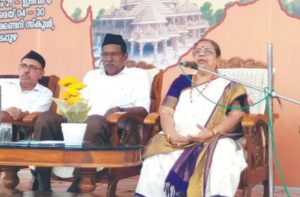
Preethi Natesan at an RSS outreach programme (File photo)
After the Left’s setback in the local body polls, CPI identified Vijayan’s car ride with Natesan as one of the contributing factors.
Mathew said that while Viswam and Vijayan have every right to offer a lift to anyone in their personal cars, the chief minister’s vehicle carries strong political and democratic symbolism.
”In a democracy, the people and even allies have a moral claim over the chief minister’s car,” he opined.
Mathew added that Vijayan has long been aware of Natesan and had said openly in the past.
”The question is why he is compelled to tolerate Natesan now. Vellappally has become a political bridge—and that is why he is being accommodated” he said.
Meanwhile, Natesan continues as the chief of the Kerala government’s Navodhana Samithi (Renaissance Forum), even as leaders from the SNDP protection committee have openly opposed him.
Even before the Bharath Dharma Jana Sena (BDJS) was formally launched in 2015, Natesan had begun articulating a broader political imagination.
His call for ‘Nayadi to Namboothiri‘ unity (from the marginalised tribal groups to the privileged Brahmin community within the Hindu society) was aimed at consolidating Hindu communities under a single political narrative.
While the idea initially found some resonance, it soon ran into resistance. The Nair Service Society (NSS), after briefly engaging with the concept, stepped back.
Nearly a decade later in 2024, Natesan revised the slogan, expanding it from ‘Nayadi to Namboothiri’ to ‘Nayadi to Nasrani‘ (Nasrani refers to Christians). The new formulation widened the ambit to include Christian communities, while conspicuously excluding Muslims.
Justifying this shift, Natesan argued that Muslims were gaining disproportionate political influence in Kerala. ”That is why I am proposing this idea. Several Christian community leaders have personally conveyed their support,” he claimed.
To bolster his argument, he cited incidents ranging from the hand-chopping case involving the PFI to the Munambam waqf issue.
However, the revised slogan also met with sharp resistance. Several prominent voices rejected the idea including the Malankara Mar Thoma Syrian Church, which publicly distanced itself from Natesan’s proposal.
Speaking to South First, Kadakampally Manoj, an Ezhava community activist and petitioner in the microfinance scam case against Natesan, offered a political reading of these developments.
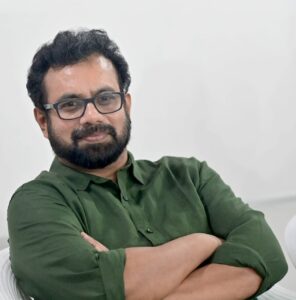
John Brittas
He said Natesan continues to enjoy protection despite repeatedly undermining Kerala’s secular fabric.
He recalled that when the BDJS was formed, both VS Achuthanandan and Vijayan had taken firm positions against Natesan. ”But Pinarayi Vijayan has changed significantly over the years, especially in terms of his political rigidity,” Manoj said.
He added that multiple sources had told him that CPI(M) MP John Brittas played a key role in mediating between Vijayan and Natesan to restore strained relations.
Brittas’s name has surfaced in other political contexts as well.
In December 2025, Union Education Minister Dharmendra Pradhan told the Rajya Sabha that Brittas had acted as a bridge between the Centre and the Kerala government in discussions related to the PM SHRI scheme.
Pradhan even congratulated him, recalling meetings involving General Education Minister V. Sivankutty and Brittas to convey Kerala’s willingness to join the programme.
Brittas, however, publicly rejected the minister’s claims and denied having any role in finalising the MoU. Viswam responded, saying that he trusted Brittas over Pradhan during the controversy that emerged ahead of the local body elections.
However, a party source told South First that the issue was discussed at an LDF meeting following the local body setback, and that the CPI was unhappy with the Union minister’s claims.
CPI General Secretary D Raja has demanded that the CPI(M) clarify the contradictory disclosures regarding the PM-SHRI scheme. The clarification is still pending.
Meanwhile, the UDF has seized the moment, intensifying its cyber campaign with slogans such as ‘You Too, Brittas‘.
Manoj argued that Vellappally’s political survival depends on the patronage of both the state and the Centre. He pointed to a 2018 episode when the Enforcement Directorate questioned Vellappally for nearly three hours at its Kochi office over allegations of receiving overseas funds.
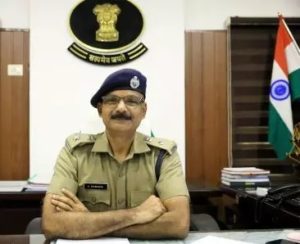
S. Sasidharan, Superintendent of Police.
”Does anyone know what happened to that case?” Manoj asked. He also noted that Vijayan himself has faced scrutiny from central agencies. ”They protect each other. That is the reality. Every word Natesan speaks is political—it is never merely an outburst of anger or ignorance,” he said.
A significant legal development followed in September 2025.
The Kerala High Court dismissed a petition filed by the state government seeking to replace the police officer heading the investigation into the microfinance fraud case registered against Natesan.
The government had requested that S Sasidharan, Superintendent of Police in the Vigilance and Anti-Corruption Bureau (VACB), later posted as Additional Director at the Kerala Police Academy, be removed from the probe and replaced by Karthick K, DIG VACB, to lead the Special Investigation Team.
The court refused the request.
What made the episode more striking was that Sasidharan, who has never been in good book of politicians, is the officer leading the Sabarimala gold theft case, an investigation being closely monitored by the High Court.
In the microfinance case, the SNDP Yogam is accused of misusing funds obtained at concessional interest rates, ranging between 2 and 5 percent—from the Kerala State Backward Classes Development Corporation and other banks.
South First has found that there are as many as 124 FIRs registered against Natesan, with chargesheets filed in 21 cases. More about the cases in the next part.
(To be concluded. Edited by Majnu Babu).


