

Published May 22, 2026 | 3:04 PM ⚊ Updated May 22, 2026 | 4:55 PM

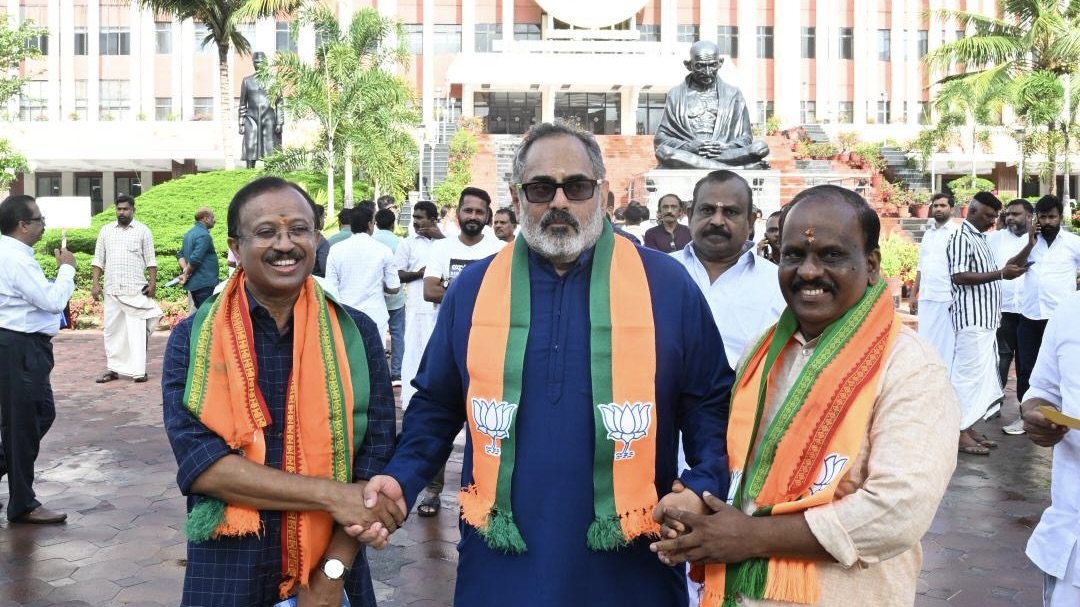
BJP MLAs V Muraleedharan, Rajeev Chandrasekhar and BB Gopakumar in front of the Kerala Legislative Assembly.

Synopsis: The BJP’s historic three-member presence in the Kerala Assembly has opened up a new internal power struggle, with Rajeev Chandrasekhar and V Muraleedharan locked in a contest over who will lead the party on the Assembly floor. Behind the debate lies a larger question for the BJP – whether it can turn a modest electoral breakthrough into a serious and lasting political presence in Kerala’s legislature.
Ten years after making a historic breakthrough in Kerala by winning its first Assembly seat, the BJP now has three times as many seats.
The party, which lost its sole Nemom seat in the 2021 elections despite securing a higher vote share than in 2016, has now translated that growing support into victories in Nemom, Kazhakootam and Chathannoor in 2026.
The party even nominated Chathannoor MLA BB Gopakumar for the Speaker election on 22 May – a situation once unimaginable for the saffron party in the state.
At the same time, jubilation over the party’s success has given way to an unexpected leadership contest within the Assembly.
With state unit president and Nemom MLA Rajeev Chandrasekhar and former Union Minister and Kazhakootam MLA V Muraleedharan both staking claim to the post of legislative party leader, the state unit has failed to arrive at a consensus.
The matter is now believed to have reached the BJP high command for consideration.
Also Read: Kerala IAS officer to stand trial nearly 7 years after journalist’s death in car crash
Even before the first sitting of the 16th Kerala Legislative Assembly began on 21 May, the question of leadership within the BJP’s Assembly unit had surfaced.
The BJP state leadership held back-to-back meetings on 15 and 16 May, including core committee and leadership meetings, but failed to arrive at a resolution.
Early signals from within the party strongly suggested that V Muraleedharan would be chosen as the BJP legislature party leader.
Many in the party considered him the natural choice.
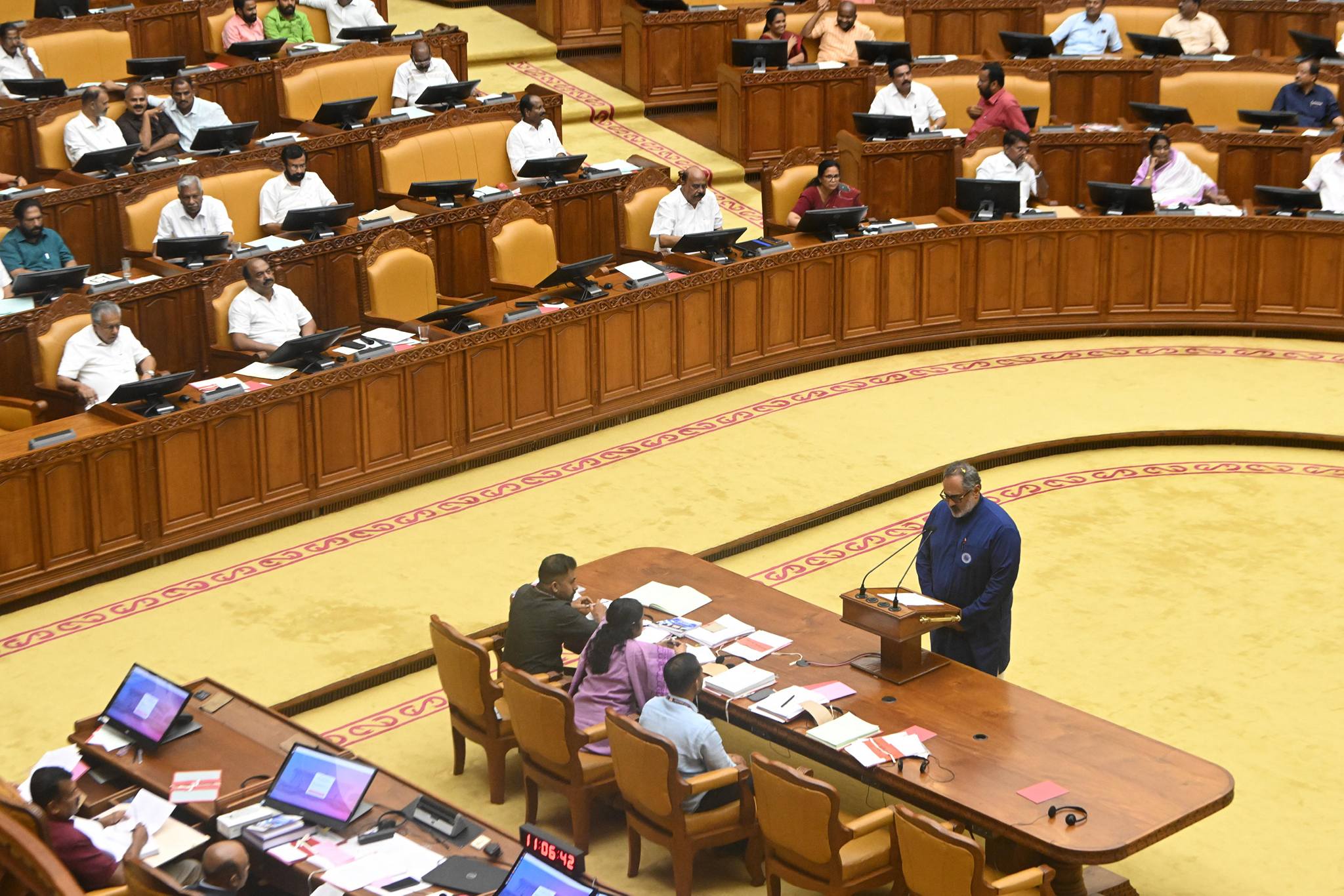
Rajeev Chandrasekhar takes oath as an MLA.
Seniority, years of organisational work, and his stint as Union Minister of State for External Affairs and Parliamentary Affairs between 2019 and 2024 were all factors in his favour. His ability to take on rivals on the Assembly floor was also seen as an advantage.
In the days leading up to the Assembly session, social media handles associated with BJP workers and supporters circulated congratulatory posters projecting Muraleedharan as the incoming legislature party leader.
But on the morning of 21 May, when the Assembly convened, it was Rajeev Chandrasekhar who occupied the front row on the Opposition side.
Muraleedharan was seated behind him, while BB Gopakumar took a seat in the third row.
Party sources attempted to play down the development, describing it as a temporary arrangement and maintaining that a formal announcement on the legislature party leadership was yet to be made.
Still, leaders close to Muraleedharan privately expressed dissatisfaction, arguing that one individual holding both the state presidency and legislature party leadership would not be healthy for the organisation.
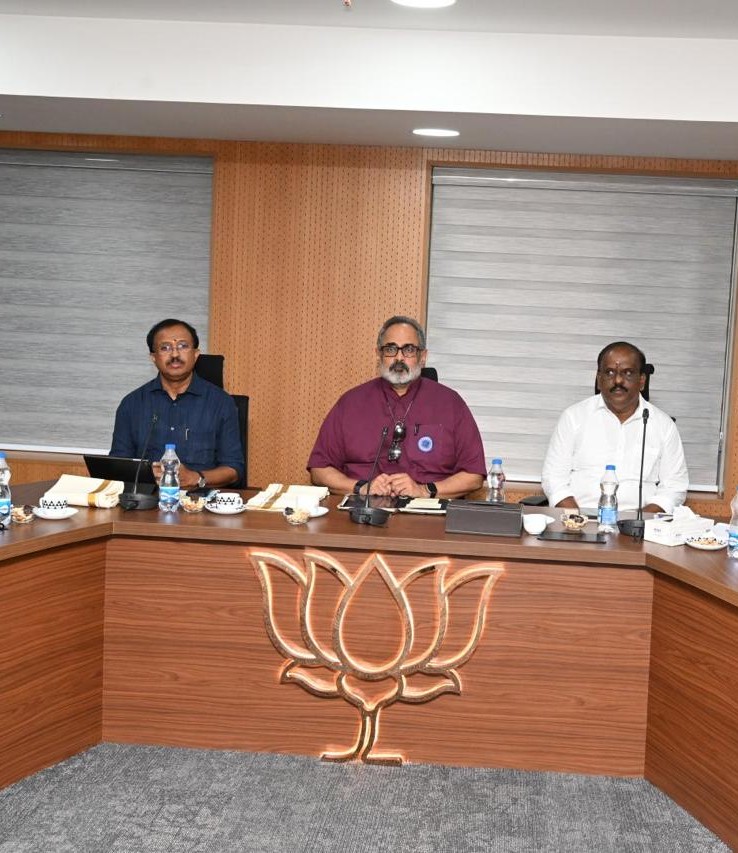
BJP MLAs during the core committee meeting on 15 May.
“The BJP has entered a new phase in Kerala. Decisions now have long-term implications. The legislature wing and organisational structure cannot become concentrated around one individual,” one of them said.
Questions are also being raised over Chandrasekhar’s lack of legislative experience and his discomfort with speaking Malayalam – something he himself has previously acknowledged.
A senior BJP leader close to the Muraleedharan camp said Chandrasekhar might feel out of his depth in the Assembly.
“The Assembly is not a television studio or a corporate boardroom. Floor management in Kerala demands political reflexes, language command, and deep knowledge of parliamentary practice,” the leader added.
Despite the murmurs of discontent, the party appears to be leaning towards naming Chandrasekhar as its legislature party leader. Muraleedharan could be appointed legislature party secretary, while BB Gopakumar is likely to be named party whip.
Also Read: A minister for AI in Satheesan’s Cabinet: The new Kerala ministers and their portfolios
The choice of legislature leader is especially important for the saffron party given its jump from a solitary MLA 10 years ago to three members in the current Assembly.
At Nemom, Rajeev Chandrasekhar reclaimed the constituency for the BJP after defeating CPI(M) candidate and former General Education Minister V Sivankutty by 4,978 votes.
Muraleedharan scraped through in Kazhakootam after a tightly fought contest against CPI(M) leader Kadakampally Surendran, winning by just 428 votes.
The biggest surprise came from Chathannoor, long viewed as a Left stronghold, where Gopakumar defeated CPI candidate R Rajendran by 4,398 votes.
“For years, the BJP in Kerala was treated as a footnote in Assembly politics. Three MLAs may still look small numerically, but politically, it changes the conversation,” said a senior BJP office-bearer.
BJP leaders believe the party now has an opportunity to project itself not merely as an occasional electoral disruptor, but as a structured political force capable of challenging both the LDF and the UDF.
That ambition, however, depends heavily on how effectively the party performs inside the Assembly.
Strong performances on the floor routinely dominate television debates, newspaper headlines and social media discussions.
BJP leaders privately admit that without a forceful legislature party leader, the party risks being overshadowed by the numerical dominance and debating experience of the Congress-led UDF and the CPI(M)-led LDF.
A senior BJP office-bearer said the legislature party leader would have to do more than merely raise constituency issues.
“The BJP cannot afford a passive presence in the House anymore. The leader has to create political moments. The party needs somebody who can force both fronts to respond,” they added.
Within the BJP, there is also recognition that Kerala remains one of the few major states where the party has struggled to build a sustained legislative identity despite electoral gains elsewhere in the country.
Party strategists believe a visible and aggressive floor presence could help weaken the long-standing perception that Kerala politics is permanently locked between the LDF and the UDF.
“One MLA can be dismissed as an exception. Three MLAs functioning as a coordinated political bloc is different,” said another leader.
The legislature party leader is expected to play multiple roles simultaneously – countering the Congress-led UDF, attacking the CPI(M)-led LDF, defending central policies and amplifying the BJP’s claim that it represents an alternative political axis in Kerala.



