


Published Jan 30, 2026 | 2:07 PM ⚊ Updated Jan 30, 2026 | 6:38 PM

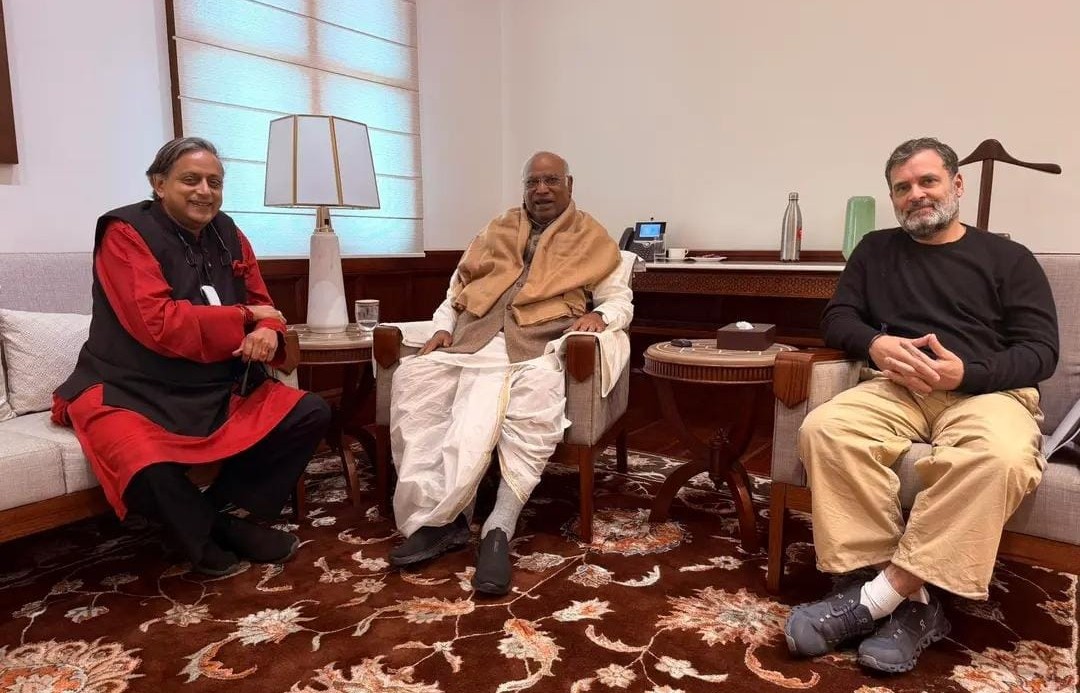
Shashi Tharoor's meeting with Mallikarjun Kharge and Rahul Gandhi is being projected as a signal that all was well within the Congress.
Synopsis: Party insiders pointed out that the meeting between Tharoor and the Congress top brass marks a calibrated pause, rather than a full stop, to weeks of political murmurs around his equation with the party leadership.
Few in contemporary Indian politics command the kind of attention Shashi Tharoor does—often without trying.
The four-time Thiruvananthapuram MP has an uncanny knack for drawing headlines, stirring debate and, inevitably, unsettling his own party.
In the Congress party, where political dissent is usually handled with a heavy hand, Tharoor has survived a series of controversies that would have sidelined many others.
Time and again, his comments and political positioning have left both the central and Kerala leaderships scrambling for damage control.
Speculation follows him like a shadow. From whispers of a possible drift towards the BJP to the more improbable chatter about a move to the CPI(M), rumours about Tharoor’s next political turn have rarely died down.
The latest round suggested a potential alignment with the Left in Kerala, just as the state edges closer to another Assembly election. Tharoor, however, has categorically rejected these claims, insisting that he remains firmly within the Congress fold.
Tharoor’s meeting in New Delhi on Thursday, 29 January—with Congress president Mallikarjun Kharge and Leader of Opposition in the Lok Sabha Rahul Gandhi—has been projected as a signal that all is well within the party.
Publicly, the optics suggest unity and shared purpose. Privately, the question lingers: does this meeting mark a genuine truce, or is it merely a pause in a long-running political intrigue that refuses to end?
Party insiders pointed out that the meeting between Tharoor and the Congress top brass marks a calibrated pause, rather than a full stop, to weeks of political murmurs around his equation with the party leadership.
The Thiruvananthapuram MP’s conspicuous absence from a key Kerala poll strategy meeting in New Delhi, followed by reports of his interactions in Dubai with individuals linked to the CPI(M), had lent traction to speculation that his differences with the Congress were no longer merely personal but politically consequential.
At the heart of the disquiet lay a familiar mix of perceived slights and structural marginalisation — most notably Gandhi’s failure to acknowledge Tharoor at the Kochi ‘Maha Panchayath’ event, an omission that party insiders described as the tipping point in a series of accumulated grievances.
Tharoor’s own responses, however, reveal a leader keen to arrest speculation without overtly retreating from his sense of grievance.
By stressing that he was “not looking for any new job” and reiterating his electoral mandate and record of campaigning for the party, Tharoor, on 29 January, sought to frame the episode as one of communication gaps rather than ideological drift.
His explanation for skipping the Sonia Gandhi-hosted strategy meeting — a late invitation and prior travel commitments — was also aimed at blunting the perception of a deliberate snub.
The 29 January meeting with Kharge and Gandhi, followed by Tharoor’s emphatic public assertion that “we are all on the same page”, serves as a classic Congress damage-control exercise ahead of crucial Kerala polls.
Yet, the episode underscored a deeper challenge for the party: managing high-profile leaders with independent standing while projecting unity.
As one senior Congress leader told South First, “For now, the conversation has reset things. Whether it stays that way will depend on what comes next — not on what was said in one room in Delhi. In Kerala, optics matter more than explanations. When a senior MP is not seen at a core meeting, people will talk — whether that talk is fair or not.”
A closer look at the backdrop of the latest interaction between Tharoor and the Congress leadership suggests that this is not an isolated effort at damage control but part of a recurring pattern.
Notably, a similar round of talks took place almost exactly a year ago, in February 2025, when Tharoor faced sharp internal backlash for publicly praising Prime Minister Narendra Modi’s diplomatic performance during a US visit.
His remarks at the time — describing the outcomes of Modi’s engagement with US President Donald Trump as “encouraging” and broadly beneficial for India — were seen as breaking ranks with the Congress’s adversarial posture towards the BJP leadership, especially as Gandhi was simultaneously sharpening his attack on Modi over the Adani issue.
The disquiet was compounded by Tharoor’s subsequent article lauding Kerala’s startup ecosystem under the LDF government, which Kerala Congress leaders viewed as an indirect endorsement of a rival political dispensation.
Though the high command intervened then with the expectation that the consultations would temper Tharoor’s public positions, that outcome did not materialise.
In the months that followed, his outspoken views on issues ranging from Operation Sindoor and India’s counterterrorism doctrine to the Emergency, dynasty politics, and even a sympathetic reassessment of BJP veteran LK Advani, only deepened unease within the party.
Against this backdrop, the current engagement appears less like a one-off reconciliation and more like an acknowledgement by the leadership that Tharoor’s independent public voice — and the tensions it generates — has become a recurring feature rather than a passing phase.
The remarks by senior Congress leaders reveal a nuanced—if slightly uneasy—view of Tharoor within the party’s Kerala leadership.
Ramesh Chennithala’s observation that Tharoor is “not a 100 percent party member” is less a charge of disloyalty than an acknowledgment of his atypical political style.
Tharoor, by Chennithala’s own admission, operates at “a different level”, articulating independent views while continuing to cooperate with the organisation and participate in party activities such as the KPCC’s Lakshya 2026 camp.
This reading is reinforced by AICC general secretary (organisation) KC Venugopal, who strikes a more institutional note by underlining Tharoor’s value to the Congress, while also conceding that the party has, at times, cautioned him on public statements.
Venugopal’s emphasis on “using someone like Shashi Tharoor” signals a strategic calculation: the party sees in him a nationally recognisable figure with global reach, even if he does not always conform to traditional organisational instincts.
Leader of the Opposition in the Kerala Assembly VD Satheesan’s assertion that reports of discord have “no basis” and that Tharoor remains in constant touch with the leadership appears aimed at drawing a line under speculation.
In effect, the leadership seems to be closing ranks around a consensus that Tharoor is neither an outsider nor a dissident—but a high-profile asset whose individualistic approach continues to sit somewhat apart from the Congress’ conventional political rhythm.
At the same time, Tharoor’s statements appear crafted less as a rebuttal of the Congress leadership and more as a careful repositioning of himself amid talk of internal discord.
Speaking at the KPCC’s Lakshya 2026 leadership camp and later at the Kerala Literature Festival, during the first week and penultimate week of the month, the Congress Working Committee member sought to draw a firm distinction between disagreement and disloyalty.
His core argument is one of continuity: that across parliamentary interventions, public remarks and opinion pieces, he has not crossed the party’s stated positions.
By repeatedly stressing that his record in Parliament aligns with the Congress line, Tharoor is clearly pushing back against the narrative that he is freelancing politically.
At the same time, he does not deny a principled divergence on Operation Sindoor.
Instead, he owns it—unapologetically—presenting his stance as grounded in national interest rather than partisan impulse.
His account of advocating a limited, targeted response after the Pahalgam incident, followed by the government adopting a similar course, allows him to frame his position as prescient rather than provocative.
This, in turn, reinforces his claim that robust debate need not weaken party unity.
Equally telling is Tharoor’s critique of media-driven controversies, which he attributes to selective reading and headline-driven outrage.
By underlining his long tenure in the Congress and his cordial relations within the organisation, he signals a desire to cool speculation of an impending rupture.
Taken together, his remarks suggest a bid to normalise internal debate while firmly rejecting the idea that he stands outside the party’s collective discipline.
Senior journalist and political observer Roy Mathew felt Shashi Tharoor’s moves were driven more by personal ambition than party loyalty. “Tharoor is essentially an opportunistic politician,” he said.
“At different stages, he tried to project himself as a chief ministerial aspirant in Kerala, but the Congress state leadership shut that down early. Later, he set his sights on the post of Deputy Leader of the Opposition in the Lok Sabha, but that position went to Gaurav Gogoi instead,” he pointed out.
Mathew argued that Tharoor has been in constant search of ‘new pastures’. “There has never been a sense of deep commitment to the Congress. Despite the party making him a Union minister and a four-time MP, Tharoor seems to believe he has nothing more to gain from it,” he said.
Referring to Tharoor’s 29 January meeting with the party’s top leadership, Mathew noted that while the details remain unknown, the political compulsion is obvious.
“If the Congress wants to keep him on board, it will have to offer something that satisfies Tharoor’s sense of importance. The question is—what could that be?”
According to Mathew, one possibility is that Tharoor had explored switching political alliances, but that effort may not have worked out on his own terms.
“Within the Kerala Congress, he enjoys little support, barring MP M K Raghavan. That makes the outcome of this meeting all the more intriguing,” he added.
“The most likely compromise could be giving Tharoor greater prominence during the ongoing Budget Session in Parliament. Another possibility is that he may be considered for the post of Deputy Leader of the Opposition in the Lok Sabha, should Gogoi move to Assam politics after the 2026 Assembly elections. For now, all one can do is wait and watch,” Mathew said.
At the same time, political analyst Sreejith Panicker told South First, “Though details of the meeting are still unclear, one can only draw inferences. My assessment is that Tharoor is unlikely to remain in the Congress for long. His ideological positions and the party’s current political messaging are increasingly at odds. He is also clearly uncomfortable with the leadership of Mallikarjun Kharge and Rahul Gandhi.”
“That makes a shift almost inevitable. Whether it is to the BJP, an NDA ally or even the Left remains to be seen. But Tharoor will not walk out alone — others are likely to follow. He has been in sustained conflict with the party, and there appears to be little enthusiasm within the Congress for accommodating his political trajectory.”
“There are deeper, unresolved issues, particularly around leadership. Taken together, the chances of Tharoor eventually moving on from the Congress are quite high.”
(Edited by Majnu Babu).


