


Mithun’s tragic death has intensified calls for safer schools and stricter infrastructure audits, serving as a stark reminder of the systemic failures endangering children in supposedly secure learning space

Published Jul 19, 2025 | 11:15 PM ⚊ Updated Jul 19, 2025 | 11:15 PM


Suja bidding farewell to her son Mithun
Synopsis: Hundreds gathered in Thevalakkara, Kollam to mourn 13-year-old Mithun, a Class 8 student electrocuted at school—a tragedy that has sparked outrage and urgent calls for safer school infrastructure across Kerala
A wave of grief and public outrage swept across Thevalakkara and neighbouring regions in Kollam on Saturday as hundreds turned up to bid an emotional farewell to 13-year-old Mithun, a Class 8 student of Thevalakkara Boys’ and Girls’ High School, Kollam who was electrocuted on the school campus on Thursday.
The shocking tragedy, widely seen as preventable, has triggered a state-wide debate on student safety and school infrastructure accountability.
Amid tears, silent prayers, and floral tributes, Mithun’s mortal remains were cremated at his home in Vilanthara, Sasthamkotta, with his younger brother Sujin performing the final rites.
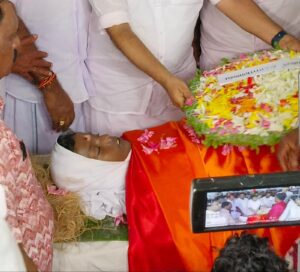
Mithun
Mithun’s body, kept at the Sasthamkotta Taluk Hospital morgue overnight, was first brought to his school around 11 am on Saturday.
There, a public homage was held in the courtyard, which had once echoed with his laughter and school games.
Now, it was filled with mourners — students, teachers, neighbours, and well-wishers.
The school’s NCC cadets led a solemn road march, escorting the coffin into the school compound.
Many classmates and teachers broke down as they laid flowers and offered final prayers.
Several fainted in grief, including Mithun’s class teacher and his paternal grandmother Maniamma, both of whom were admitted to Sasthamkotta Hospital. Maniamma was later discharged and brought home. From the school, the funeral procession made its way to Vilanthara.
Along the route, locals lined up with flowers, some weeping openly, others standing in silence to get one last glimpse of the boy whose life was tragically cut short.
The most gut-wrenching moment came when Mithun’s mother, Suja, who was working abroad, reached home from Türkiye early Saturday morning.
She was received at Cochin International Airport by relatives and local leaders and escorted to Vilanthara by police.
Upon seeing her son’s lifeless body, Suja collapsed in uncontrollable grief, hugging the coffin as relatives tried in vain to console her. Mithun’s father Manu, devastated and silent, stood nearby, unable to bear the weight of the loss. The entire village grieved with the family.
Local MP Kodikunnil Suresh, senior Congress leader Ramesh Chennithala and others visited the home to offer condolences, and thousands gathered to witness the final rites by 4:30 pm, standing in solemn silence as young Sujin lit the pyre.
The incident occurred on the morning of 17 July when Mithun climbed onto the school’s cycle shed to retrieve a chappal.
In the process, he reportedly slipped and came into contact with a high-voltage three-phase power line hanging overhead. Though rushed to the hospital, he could not be saved.
The circumstances of the accident have triggered intense public anger, with many calling for strict action against those responsible for the lapse in safety.
Activists and parents have questioned how live electric lines could run above a school structure without any warning or safeguards.
Responding to mounting pressure, the manager of Thevalakkara Boys and Girls High School issued a suspension order against the Head Teacher, S. Suja, on Friday night.
The action followed a preliminary inquiry by the Deputy Director of Education (DDE), which found clear negligence in adhering to student safety protocols.
The inquiry cited lapses despite circulars issued by the education department on 13 May and 18 June warning schools about infrastructural hazards. Senior teacher G. Molly has been appointed acting Head Teacher, and the school has been directed to report compliance with all safety measures.
Meanwhile, General Education Minister V Sivankutty on Saturday condemned attempts to politicise the tragedy.
“It is unfortunate to see Mithun’s death being used for political gain. Protests such as blocking public representatives from visiting the school and showing black flags to ministers are unacceptable,” the minister said.
Sivankutty highlighted that the government had reopened schools this academic year after extensive preparations, including cleaning and maintenance across 14,000 institutions. A safety audit was carried out as per a directive issued by the Director of Public Education on May 13, he added.
In light of Mithun’s death, a second round of safety checks has been ordered through an online meeting convened by the department.
Assuring support to the grieving family, the minister announced that the Scouts and Guides under the department will construct a house for Mithun’s family. Financial assistance is also being extended through various departments, and Mithun’s brother will receive support to continue his education up to Class 12, including exam fee waivers.
“The General Education Department has taken all necessary precautions to avoid such incidents in the future,” Sivankutty said.
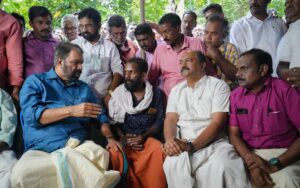
Ministers V Sivankutty and K N Balagopal at Mithun’s home on Friday
On Friday, Ministers V. Sivankutty and K.N. Balagopal visited Mithun’s home to offer condolences. MLA Kovoor Kunjumon, accompanied by Kerala State Electricity Board (KSEB) officials, handed over ₹5 lakh as financial assistance to the bereaved family.
Yet, for a grieving community, monetary aid and suspensions offer little solace.
As the state mourns Mithun’s untimely death, the demand for safer schools and strict enforcement of infrastructure audits grows louder. Mithun’s death has become a painful reminder of the cracks in the system meant to protect children.
For the people of Thevalakkara and beyond, his funeral was not just a farewell to a promising young boy — it was a call to ensure no child ever pays such a price for institutional negligence again.
(Edited by Ananya Rao)


