

Published Nov 02, 2024 | 8:52 AM ⚊ Updated Nov 02, 2024 | 9:13 AM

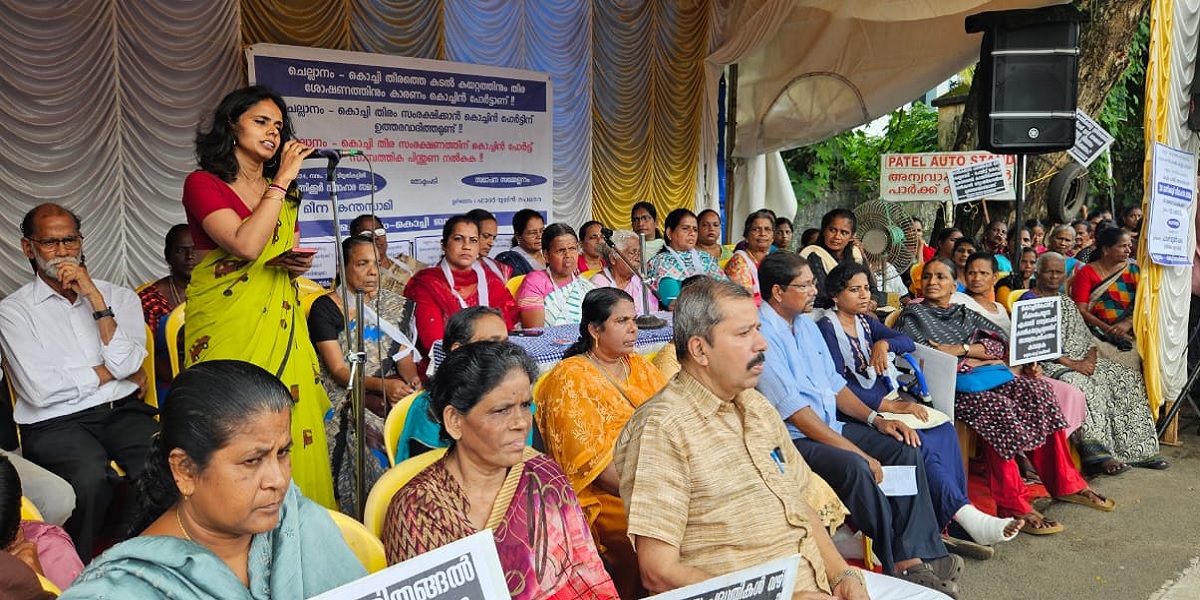
Poet and activist Meena Kandasamy joined the 24-hour hunger strike, amplifying the voices of those affected by the ongoing crisis.

On 1-2 November, the Chellanam Janakeeyavedi, a people’s forum advocating for the rights of the Chellanam village in central Kerala that has faced hardship on account of the steady erosion of the coast by the sea, organised a hunger strike on the shore of Kochi-Chellanam.
The protest highlighted the urgent responsibility of Cochin Port to safeguard the coastline, as the local fishing communities grapple with the severe consequences of the sea eroding the coast and leaving their homes standing precariously on the edge.
Poet and activist Meena Kandasamy joined the 24-hour fast, amplifying the voices of those affected.
Fisherfolk formed a large part of the group of protesters, united in their demand for immediate government action to protect their livelihoods and ensure sustainable coastal management.
Chellanam Janakeeya Vedi, a community group led by advocate Thushar Nirmal Saradhi, Suja Bharathy, and VT Sebastian, has been engaged in raising awareness and organising protests to force the government to protect this fragile coastal region of Chellanam.
Each year, the monsoon brings distress to residents, as tidal waves hit the village, flooding homes and damaging personal belongings.
Protesters have pointed to construction shortcomings by the Cochin Port as a major factor contributing to coastal erosion, and the ingress of seawater into their village.
The erosion has accelerated since the 1970s, and locals assert that the erosion is an artificial disaster, resulting from the work undertaken by the Cochin Port to increase the depth of off-port channels by dredging sand.
Off-shore dumping of the dredged material has not helped replenish sand along the Chellanam coast.
In November 2018, the National Centre for Earth Science Studies at Thiruvananthapuram published a shoreline assessment study for southwest India using multi-dated shoreline images and topographic charts from the Survey of India between 1968 and 2014 that showed that almost 60 per cent of the Kerala coastline was eroding.
Human activity was exacerbating the erosion of the coastline, apart from sea level rise.
Many families along the Chellanam coastline, especially in the northern Puthenthode area near Kannamaly, grapple with fear of the land slipping away from under them as sea intrusion intensifies with rising tides.
Sebastian noted that areas reinforced with tetrapod walls have remained safe from the high tidal waves, unlike other regions that have experienced significant inundation.
However, this cannot be a lasting solution, and in April 2022 a special bench of the National Green Tribunal stalled the construction of all hard structures, including groynes and seawalls across India’s coast and recommended that state governments explore more sustainable solutions.
Reports of flooding and sea encroachment have been documented in several locations, including Puthenthode, the vicinity of Kannamaly Sree Rama Temple, around the water tank and police station, as well as in Cheriyakadavu, Kattiparambu, and Saudi, located at the northern edge of the Chellanam coast near Fort Kochi.
Sebastian said the people of Chellanam, especially the women, have been protesting daily for over 1,500 days, holding on to hope that their problem will find solution.
“I think Chellanam is a very vital protest for everyone anywhere in the world. It’s an example of grassroots people organising and carrying on a sustained struggle. For five years now, they have kept up the momentum, made solid demands, and ensured that the state has accepted their preliminary demands,” Meena Kandasamy told South First.

Meena Kandasamy and Suja Bharathy at Chellanam in Kochi.
“This new protest is an escalation of the struggle. It is impossible to follow the news and not learn about Chellanam. I keep visiting Kerala frequently, so I know about it,” she said.
She said she was fascinated by the steps taken by the people of Chellanam collectively — whether the relay fast that has lasted 300 days, or women attempting the jalasamadhi.
“When death is at one’s doorstep, people will come up with the most important protests that just cannot be ignored. The issue of sea incursion and erosion in Chellanam is dire,” she said.
“If there’s no seawall, no groynes, and if the dredged sand from the Cochin port isn’t deposited on the south side to enable fortification, Chellanam will cease to exist as an inhabitable place,” she said, adding that she had only joined the fast for seven hours.
“I’ve only fasted for seven hours now. Let’s see if I can hold out for the next 17 hours,” Meena said on Friday, adding, “I think the political point is that we all have to stand up against corporate land grab. The one-word answer is solidarity. ”
The hunger strike is expected to end at 11 am on Saturday, 2 November.
(Edited by Rosamma Thomas).



