

Published Apr 13, 2026 | 3:55 PM ⚊ Updated Apr 13, 2026 | 3:58 PM

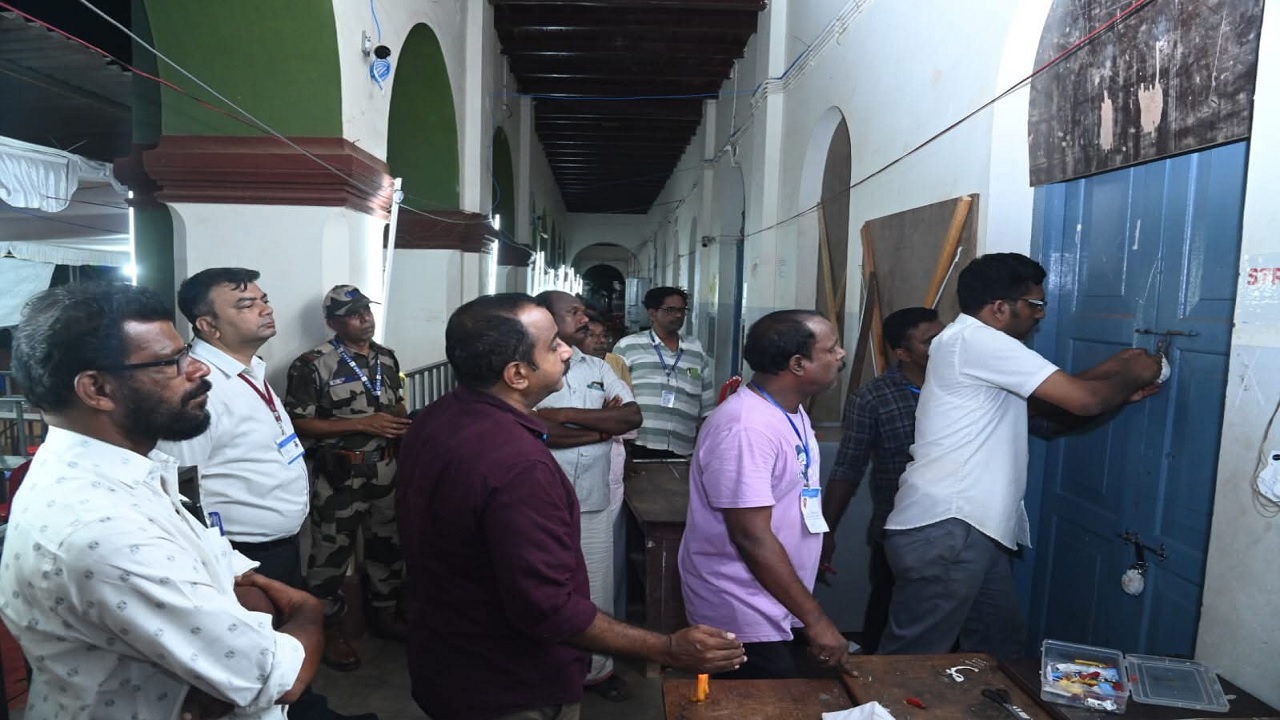
The strong room at St Aloysius School in Kollam being sealed after voting machines were stored.
Synopsis: EVMs and VVPATs have been moved to strong rooms under heavy security. However, the prolonged wait for counting the votes cast on 9 April has raised concerns among the candidates and political parties.
Polling for the 2026 Kerala Assembly election concluded on 9 April across 30,495 polling stations, recording a provisional voter turnout of 78.27 per cent.
With voting complete, Electronic Voting Machines (EVMs) and Voter Verifiable Paper Audit Trail (VVPAT) from the state’s 140 Assembly constituencies have been shifted to specially secured strong rooms across 43 centres.
These machines will remain under guard for the next 24 days until the counting day on 4 May. Though the machines are stored in centralised facilities, separate counting centres have been arranged for every constituency.
Immediately after the polling had ended, officials transported the voting machines from polling booths to reception centres in each constituency under police escort. From there, the machines were shifted to the designated strong rooms in GPS-enabled vehicles accompanied by tight police security.
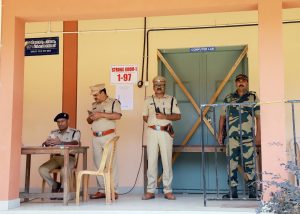
Multi-layer security around strong rooms
The rooms where the machines are stored have been sealed and protected using a three-layer security arrangement involving central paramilitary forces, armed state police personnel and local police.
According to the Election Commission’s security protocol, at least one platoon of armed personnel has been deployed at every strong room centre.
After the EVMs and VVPATs were placed inside the strong rooms, the locks were sealed using wax and cloth. Wooden planks were also fixed to strengthen the security of the doors.
Apart from physical security, all strong rooms are being monitored through round-the-clock CCTV surveillance.
A web-based surveillance system has also been put in place, allowing candidates and their representatives to view the CCTV feed.
Chief Electoral Officer Dr Rathan U. Kelkar said all polled EVMs and VVPATs have been stored in the presence of contesting candidates, their representatives and central observers appointed by the ECI. The entire process was videographed and carried out strictly according to the commission’s prescribed protocol.
Reserve EVMs and VVPATs have also been stored separately in reserve strong rooms under the same security arrangements.
Candidates have been informed in writing to appoint representatives to monitor the security arrangements. Their representatives have also been allowed to remain outside the inner security perimeter and keep watch over the strong rooms until the counting day.
The strong rooms will be opened only on 4 May in the presence of candidates, their representatives and central observers.
The opening process will once again be videographed.
Election officials say multiple checks have been built into the system to ensure that votes remain protected.
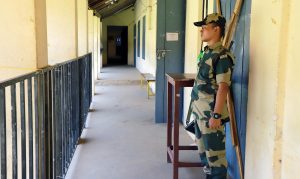
A strong room in Wayanad where EVMs are kept
Once polling concludes at a booth, the Control Unit of the EVM is electronically closed and the total number of votes recorded is entered in Form 17C. Polling agents of all candidates verify this total before the machine is physically sealed.
Officials and polling agents also note down the serial numbers of the paper seals used on the machines and place their signatures on them. The sealed machines and records are then moved to the strong rooms under guard.
On the day of counting, the machines will be opened in the presence of the agents of the candidates. Before counting begins, the agents will verify whether the seal numbers and signatures remain unchanged.
When the result button is pressed on the control unit, the machine displays the number of votes secured by each candidate.
Instead of manually recounting every machine, the Election Commission follows a verification system in which VVPAT paper slips from five randomly selected polling stations in every constituency are counted manually. This is done to cross-check the electronic results.
Election officials also said that if a voting machine develops a technical problem during polling and has to be replaced, the votes recorded in the original machine remain safe. Both the original and replacement machines are sealed and brought to the counting centre.
If the display panel of a control unit fails during counting, the result of that particular polling station is determined by manually counting the VVPAT slips stored in the machine’s drop box.
The ECI has published a list of all counting centres.
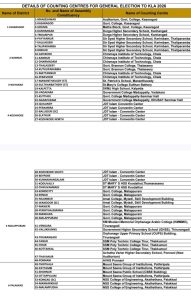
List of counting centres
Even as security remains tight, political tension continues outside the strong rooms.
Kannur, which had one of the highest numbers of sensitive polling booths in the state, witnessed a few incidents of clashes and attacks between political parties after polling.
Speaking to South First, Priya, a Congress councillor from Kannur who served as a booth agent at Booth No. 94 in the Irikkur Assembly constituency, said stronger protection is needed at strong rooms, especially in districts like Kannur.
”Even my booth was a sensitive one, and there were attempts at bogus voting. There were also many lapses. The EVM developed a technical error, but we could not immediately report it because of restrictions on mobile phone use. It was fixed only after 6.15 pm, and repolling had to be held. The number of open votes was also unusually high,” she said.
Priya said that although the machines are now assumed to be secure inside the strong rooms, political workers remain anxious.
“Now the machines are locked away and are assumed to be safe until 4 May. But we cannot escape the tension, as we have to remain vigilant day and night,” she said.
Speaking to South First, Congress leader Joby George from Kottayam alleged “gunpoint democracy”, condemning strong room incidents and the directive to keep keys with locks as a violation of EVM security norms.
He also accused CISF personnel of intimidating officials at gunpoint, while praising District Collector Chetan Kumar Meena for upholding rules. He demanded a probe into the Observer’s conduct, warning that such actions threaten electoral credibility.
Meanwhile, Kottayam District Collector and Election Officer Chetan Kumar Meena dismissed the allegations as completely baseless.
He said concerns over strong room key custody were addressed transparently in the presence of officials, observers, party representatives and polling agents, strictly following ECI norms.
He also clarified that no untoward incidents occurred and denied claims of security personnel pointing guns
In Malappuram, IUML alleged that the District Collector ordered the opening of a strong room, calling it sabotage and said parties were not informed. The Collector denied this, stating only unused machines were shifted as per norms, while used machines remained sealed.
For BJP and CPI(M) workers, too, the anxiety is far from over. Concerns over technical glitches, CCTV failures, generator breakdowns and even the possibility of attacks on strong rooms, especially in sensitive areas, continue to cast a shadow. For all the major fronts, the days until counting are likely to be long, tense and sleepless.
(Edited by Majnu Babu).


