

Published Feb 15, 2026 | 9:10 PM ⚊ Updated Feb 15, 2026 | 9:10 PM

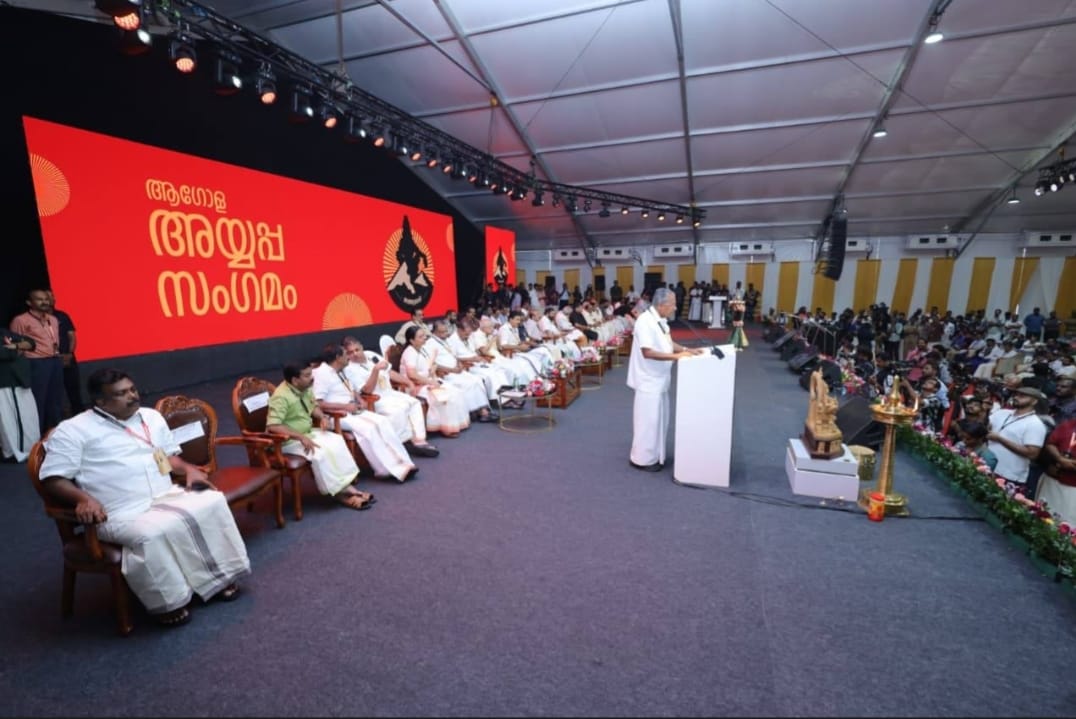
Chief Minister Pinarayi Vijayan at the Global Ayyappa Sangamam.
Synopsis: The Sabarimala row has resurfaced after the Kerala High Court flagged serious lapses in the audited accounts of the Global Ayyappa Sangamam held in September 2025 and sought detailed explanations from the Travancore Devaswom Board and the State Audit Department. The court found discrepancies in bills, measurements, sponsorship disclosures and fund use, despite earlier directing that the event should not use temple funds and that audited accounts be submitted within a fixed deadline.
Just when the ruling CPI(M)-led Left Democratic Front in Kerala may have hoped it had blunted the Congress offensive in the Sabarimala gold misappropriation row, the controversy flared again after the Kerala High Court, on 11 February, raised doubts about alleged irregularities in the audit report submitted by the Travancore Devaswom Board (TDB) in connection with the Global Ayyappa Sangamam, a conclave of devotees held on the banks of the Pampa on 20 September 2025.
The row began with allegations of gold mismanagement at the revered Sabarimala shrine, and the Congress cast itself as the torchbearer of accountability in temple administration.
The ruling front initially appeared on the defensive, as questions arose about transparency in handling temple assets.
But allegations linking senior Congress leader and Attingal MP Adoor Prakash to Unnikrishna Potti, the prime accused in the misappropriation case, shifted the spotlight and unsettled the Opposition’s moral high ground.
The controversy over the temple’s flag mast (kodimaram) added another layer, as records showed the maintenance work was carried out when Congress leaders Prayar Gopalakrishnan and Ajai Tharayil headed the Board, a detail the CPI(M) seized on to mount a pointed counter-offensive.
Now judicial scrutiny of the Global Ayyappa Sangamam, which Congress leaders had from the start called an extravagant spectacle, has added another layer.
The LDF said the Global Ayyappa Sangamam at Pamba was conceived as a spiritual and developmental initiative, not a political exercise.
Organised under the aegis of the TDB to mark its 75th anniversary, the conclave aimed to bring together around 3,000 delegates, including Ayyappa Seva Sanghams, Malayali associations from India and abroad, spiritual organisations and public representatives, to discuss a masterplan to elevate Sabarimala into a global pilgrimage centre.
Cooperation and Devaswom Minister VN Vasavan said the programme was primarily a TDB initiative, with the government providing logistical support. He said neither state funds nor Devaswom resources were being spent, as sponsorships would meet the expenses.
Chief Minister Pinarayi Vijayan said the gathering was non-political, highlighting Sabarimala’s message of harmony and inclusiveness, symbolised by devotees paying respects at Vavar before ascending the shrine.
But Leader of the Opposition VD Satheesan criticised the event as an attempt at “majority appeasement”. He said the government’s renewed enthusiasm for Ayyappa followed electoral setbacks and accused it of politicising faith for strategic gains.
The conduct of the Global Ayyappa Sangamam was not smooth, as litigation cast doubt over whether it could go ahead.
Petitions before the Kerala High Court questioned the TDB’s decision to convene what was described as a large-scale, non-religious event, alleging political overtones and possible diversion of temple resources.
This legal challenge briefly clouded preparations for the 20 September programme at Pampa.
On 11 September, a Division Bench of Justices Raja Vijayaraghavan and KV Jayakumar allowed the event to proceed, affirming the Board’s statutory authority under the Travancore-Cochin Hindu Religious Institutions Act.
At the same time, the court set clear financial guardrails.
It directed that the conclave must not use temple funds and must rely solely on sponsorships and voluntary contributions.
The Bench also ordered detailed, audited accounts of every receipt and expenditure within 45 days, making clear that each rupee would face statutory scrutiny.
The first rift with the Kerala High Court surfaced on 8 January, when it deprecated the TDB’s delay in placing the audited accounts of the “Global Ayyappa Sangamam 2025” before the Sabarimala Special Commissioner.
While allowing the event earlier, the court had stipulated that the Board must maintain clear and detailed accounts of the total estimated cost, including accommodation and travel expenses, along with sponsor contributions.
It then ordered the accounts to be audited and a copy submitted to the Special Commissioner within 45 days of the event, so they could be placed before the court with a report.
The court fixed the 45-day deadline on 11 September and, on 7 November, granted an additional 45 days.
Even after that extension, the Board sought more time on 8 January. It said it had handed the files to its Chartered Accountant, who returned them with queries and said the Indian Institute of Infrastructure and Construction (IIIC), the event organiser, had not submitted complete and revised bills.
The Board said it had issued communications and that the IIIC later produced another set of bills and vouchers on 23 December 2025. It added that the verification report was still awaited.
The Division Bench of Justices Raja Vijayaraghavan V and KV Jayakumar expressed dissatisfaction with the explanation and deprecated the delay, but granted a final one-month extension to place the audited accounts before the Special Commissioner.
Also Read: UDF puts Kerala’s health system on Assembly poll plank, unveils reform plan
On 11 February, the Sangamam controversy took a decisive turn. The court recorded that the Special Commissioner had finally placed the audited accounts before it, and the independent auditor’s report has opened a Pandora’s box for the TDB.
The Division Bench noted that the Board had entrusted the audit to the Chartered Accountancy firm Vijayan and Associates. Its qualified opinion set out serious lapses in financial discipline and procedural compliance.
The Board is responsible for maintaining proper books, safeguarding assets and ensuring internal financial controls. But the audit points to glaring deficiencies.
Foremost is the award of execution works to the IIIC without any tender or competitive bidding process.
The contract was granted on an “expenditure plus 10 percent” administrative charge basis, raising questions about transparency and prudence.
The agreement required an authorised Board representative to inspect the venue and certify compliance through Joint Measurement Sheets (JMS). But discrepancies between the Bill of Quantity (BOQ) and the JMS have surfaced.
Fifteen centre tables became nineteen in the certification. ₹2.80 lakh earmarked for cabling does not appear in the JMS. Of 150 beds listed, only 100 appear on record, leaving 50 beds worth ₹1.73 lakh unaccounted for. Extra items worth ₹24.17 lakh listed in the BOQ do not appear in the measurement sheets.
Invoices lacked proper classification under accounting heads, making ledger verification impossible.
Subcontractor agreements and “centage” charges were not backed by documents.
Stocks of Aravana, Appam, Vibhuti, Manjal-Kunkumam, Adi Sistam Ghee and sandalwood distributed for the event were not accounted for in monetary terms.
Furniture and mattresses procured for the event could not be physically verified.
In addition, details of ₹2 crore in sponsorship income remain undisclosed, while a similar amount drawn from the General Fund has not been recouped.
Taken together, the court said these findings require detailed explanations from the Board and the Kerala State Audit Department, signalling a strong judicial push for accountability when the matter comes up again on 27 February.
Amid the Adoor Prakash–Unnikrishnan Potty episode and the flag mast maintenance issue, the Congress has mounted a sharp offensive against the government over alleged irregularities in the Global Ayyappa Sangamam.
Senior leader Ramesh Chennithala, speaking from Kottayam, called the event a “massive scam” and said ₹7 crore was spent on a conference that ended by noon.
He cited the High Court’s observations and its direction to probe transactions during the Mandala-Makaravilakku season, and demanded legal action against those responsible, including former Devaswom Board officials.
Leader of the Opposition VD Satheesan alleged that crores were looted under court supervision, with inflated attendance figures, fake accounts and questionable spending on pandals and artistic programmes.
KPCC President Sunny Joseph also called for a High Court-monitored investigation. He accused the CPI(M) of misusing Devaswom funds and shielding wrongdoers.
The row escalated further when Chennithala moved a breach of privilege notice against Devaswom Minister VN Vasavan, alleging that contradictory replies in the Assembly misled the House on the use and reimbursement of funds.
Amid mounting controversy over alleged irregularities in the Global Ayyappa Sangamam, the TDB denied what it called a “deliberate misinformation campaign”.
In a clarification issued on 14 February, the Board described media reports of extravagant spending, including claims that ₹1 lakh was spent on a mattress for the Chief Minister, as baseless and misleading.
The TDB said neither the audit report nor the Special Commissioner’s submission to the High Court mentions any such mattress purchase.
It said the ₹3,83,439 allocated under “Furniture and Miscellaneous Items for Existing Office Complex and Guest House” was for renovations to the Devaswom guest house at Pampa, which Union ministers and members of the higher judiciary often use.
Any items procured are Devaswom property, it added.
On the Nanda Govindam Bhajans, the Board said the group declined to participate because of prior commitments.
It said musician Ishan Dev then led a coordinated performance involving 35 artistes and technicians.
The ₹8 lakh expenditure covered five days of stay, rehearsals, logistics and technical arrangements.
The Board admitted an error in the auditor’s report and blamed a careless statement by the event management agency, IIIC, which is empanelled under KIIFB and operates under the Kerala Academy for Skills Development.
It also set out the event’s financial structure.
Of the ₹5 crore budgeted under Religious Convention & Discourse, ₹3 crore was advanced to IIIC and later restored to the General Fund after ₹3 crore in sponsorship was received from Dhanlaxmi Bank and Kerala Bank.
An additional ₹1 crore has been promised by the Adani Group.
The Board said no funds remain unaccounted for and that ₹1.74 crore, including interest, remains in the special account.
It said food distribution, extended to devotees and workers, was inclusive and not inflated.
Final decisions will follow further scrutiny at its meeting on 17 February, the Board said.


