


Published Jan 09, 2026 | 6:26 PM ⚊ Updated Jan 09, 2026 | 9:58 PM

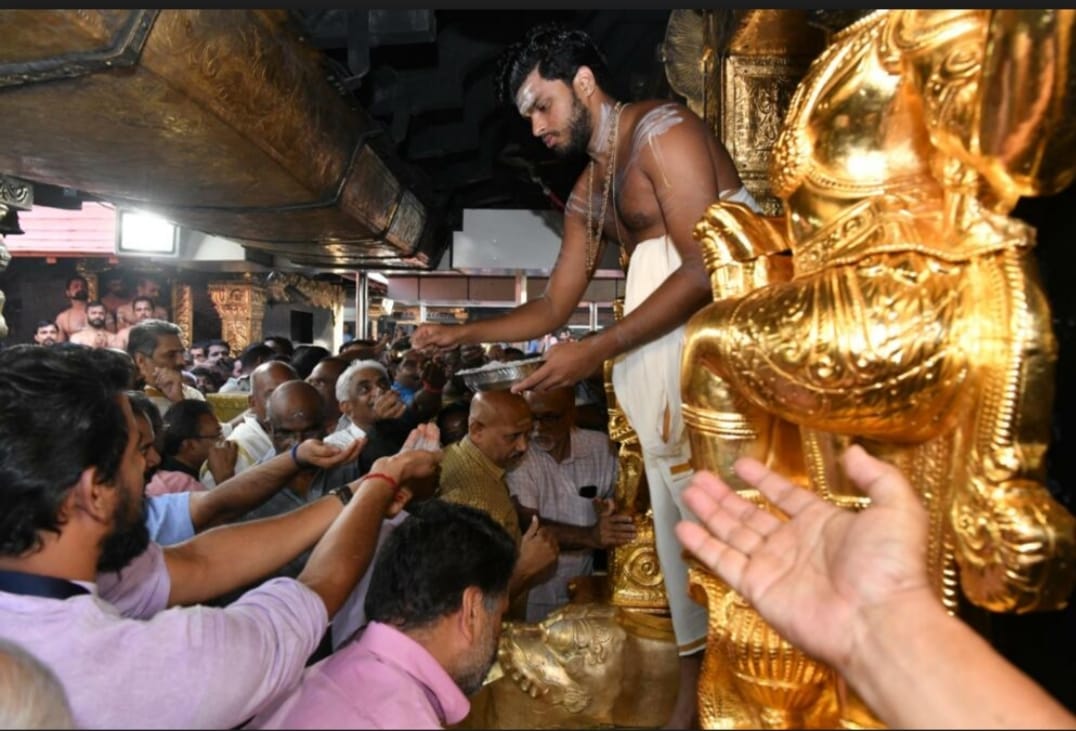
A priest distributing 'prasadam' by the gold-plated Dwarapalaka sculptures at Sabarimala.
Synopsis: The Enforcement Directorate has registered an Enforcement Case Information Report in the case under the provisions of the Prevention of Money Laundering Act. The ECIR has been filed by the Kochi unit of the ED following indications of large-scale black money transactions linked to the alleged gold theft.
A Special Investigation Team (SIT) arrested Kandararu Rajeevaru, the former chief priest of the Sabarimala Sree Dharma Sastha Temple, in connection with the alleged misappropriation of the shrine’s gold-plated religious artefacts.
The former tantri — or chief priest — was arrested on Friday, 9 January, after a prolonged questioning by the high court-appointed SIT.
It’s learnt that the SIT had sought legal opinion on whether the tantri’s role, rooted in priestly authority, fell within the ambit of the Prevention of Corruption Act, or whether offences such as criminal conspiracy and abetment could be considered.
Rajeevaru denied any wrongdoing while speaking to reporters as he returned to the residence of the Kollam Vigilance Court Magistrate after completing a medical examination.
He was produced before the court on Friday night and remanded in custody for 14 days, until 23 January.
He will be lodged at the Thiruvananthapuram Special Sub Jail. His bail application is scheduled to be considered on 13 January.
The SIT named Rajeevaru as the 13th accused in the remand report. It states that he had a prior association with Unnikrishnan Potty and used this relationship to grant tacit permission for the removal of gold bars from the temple.
The SIT further alleged that the kattilapalli (door frames) were handed over in violation of tantrika customs and without the consent of the deity.
The SIT has placed considerable emphasis on the decades-old association between the tantri and the prime accused, Unnikrishnan Potti.
Investigators noted that:
The SIT claimed Potti facilitated VIP darshans and special pujas, including for film stars and celebrities, and maintained close ties with the tantri’s family.
Photographs submitted to the court reportedly show Potti’s involvement in arranging pujas at private residences of affluent devotees using the tantri’s family.
While the report accuses the tantri of criminal complicity, it does not cite any financial transactions.
State Police Chief Rawada Chandrasekhar on Friday said the SIT was proceeding in the right direction and functioning independently without any external pressure.
He said the SIT was working under the supervision of the High Court and would move forward strictly on the basis of evidence collected during the investigation.
A key point of contention in the case has been the permission allegedly granted to remove gold-clad artefacts from the temple.
Former Travancore Devaswom Board (TDB) president A Padmakumar, currently under remand, told the SIT that:
However, the tantri denied these claims, stating that:
In a detailed report to the High Court submitted earlier this week, the SIT alleged that the accused were involved in a larger criminal conspiracy to steal additional gold from the temple, including from:
The SIT stated that after the case reached the High Court in October 2025, Potti, Govardhan, and Pankaj Bhandari held a secret meeting in Bengaluru to discuss damage control and destruction of evidence.
This was corroborated through mobile phone records, the report said.
The SIT has also accused certain Travancore Devaswom Board officials of active connivance.
According to the report:
Scientific analysis of samples collected from original gold plates at the Sannidhanam is currently underway at the Vikram Sarabhai Space Centre.
In a significant escalation, the Enforcement Directorate (ED) has registered an Enforcement Case Information Report (ECIR) in the case under the provisions of the Prevention of Money Laundering Act (PMLA).
The ECIR has been filed by the Kochi unit of the ED following indications of large-scale black money transactions linked to the alleged gold theft.
Registration of an ECIR is procedurally similar to an FIR and allows the ED to formally initiate a money laundering probe.
With this move, a central agency has officially entered the investigation, which had so far been handled by state agencies under the supervision of the High Court.
An officer of the rank of Joint Director or Additional Director, reportedly Rakesh Kumar, is expected to lead the ED probe.
It’s learnt that in the first phase, the ED will examine the financial dealings of:
The agency suspects not only domestic laundering of proceeds of crime but also possible international transactions linked to the gold misappropriation.
The ED had begun preliminary inquiries as early as October, even while the SIT investigation was underway, after detecting potential PMLA violations.
Earlier, the ED had sought case records from the Kollam Vigilance Court, but the request was initially rejected on grounds of a parallel investigation by the SIT.
The ED later moved the Kerala High Court, where the Devaswom Bench ruled in its favour, directing that the documents be provided.
Following scrutiny of these records, the ED obtained approval from the Union government to register its case.
The agency is now expected to record statements of all accused named in the Crime Branch and SIT FIRs, with the possibility of additional accused being identified.
Once offences under the PMLA are established, the ED will initiate proceedings to attach and confiscate properties allegedly acquired using proceeds of crime.
So far, the SIT has arrested 12 persons, including:
Despite earlier resistance from the state government, the Devaswom Board and the SIT to central intervention, the ED probe is now firmly underway, marking a new phase in what has become one of the most sensitive temple-related scandals in Kerala.
With parallel investigations by the SIT and the ED, the case is expected to widen further, both in terms of the number of accused and the scale of alleged financial wrongdoing.
Investigators have reportedly uncovered that Potti first gained access to the hill shrine through the direct patronage of the thantri family.
According to probe findings, Potti entered Sabarimala in 2004 as an assistant to a Parikarmi, who hailed from Alappuzha.
At the time, Potti was serving as a priest at the Srirampur Dharmashastha Temple in Bengaluru.
Crucially, the thantri of the Bengaluru temple was Kandararu Rajeevaru, who simultaneously held the post of Sabarimala thantri.
Investigators said the overlapping priestly authority proved decisive in clearing Potti’s entry into the tightly regulated temple ecosystem at Sabarimala.
Sources close to the investigation said the association with the thantri not only legitimised Potti’s presence at the shrine but also laid the foundation for his gradual rise in influence within temple affairs—an ascent that would later place him at the centre of one of the most serious scandals to rock Sabarimala.
The SIT had earlier recorded Rajeevaru’s detailed statement.
In his statement, the thantri reportedly told investigators that while he was acquainted with Potti, he had issued the controversial written note regarding the temple gold only on the instructions of officials. However, investigators have found this explanation insufficient to dispel the cloud of suspicion surrounding him.
Rajeevaru appeared before the SIT around 4 am on Friday, accompanied by his assistant Narayanan Namboothiri. The questioning, conducted at a secure location, continued for several hours.
The interrogation was led by senior officers, with Crime Branch Chief H Venkatesh personally questioning the thantri in detail, indicating the seriousness with which investigators view his alleged role.
Rajeevaru’s name has figured prominently in the investigation ever since the gold robbery at Sabarimala came to light. The probe took a decisive turn after former TDB president Padmakumar, also an accused in the case, informed the SIT that the thantri had close personal and professional ties with Potti.
Investigators also flagged the written note issued by the thantri, which granted permission to remove gold-plated components from the shrine, as a crucial and suspicious document.
The Devaswom Vigilance report, which initially investigated the 2019 gold plating work, had explicitly referred to the thantri’s note. In the document, the thantri stated that the gold plating on the Dwarapalaka sculptures had worn off, exposing the copper beneath.
Based on this note, Murari Babu, then administrative officer of the shrine, recorded an opinion recommending that the gold-plated sections be removed for cleaning and re-plating.
The Vigilance report quoted the note as saying that since the gold plating on the Dwarapalakas and the southern and northern corners of the sanctum had diminished and copper had become visible, permission could be granted to clean and re-gold-plate the artefacts.
As part of the probe, the SIT has already recorded statements from tantris Rajeevaru and Kandararu Mohanan, underscoring the widening scope of the investigation into the shrine’s highest religious authorities.
KPCC president Sunny Joseph MLA alleged that the incident was the result of collusion between the Thantri and the then Devaswom Minister Kadakampally Surendran.
Speaking to reporters at Iritty in Kannur on Friday, Joseph said the arrest of the Thantri marked progress but criticised the SIT for not extending the probe to higher officials.
He questioned whether former Devaswom Minister Kadakampally Surendran had been properly interrogated and demanded transparency.
(Edited by Majnu Babu).


