

Published Dec 25, 2025 | 4:58 PM ⚊ Updated Dec 25, 2025 | 5:09 PM

One of the most crucial breakthroughs in recent weeks has been the SIT successfully tracing D Mani, who had long been suspected to be a key player in the alleged smuggling network.
Synopsis: With Padmanabhaswamy Temple now mentioned in statements, Jayalalithaa-linked intermediaries named, and international smuggling syndicates suspected, the Sabarimala gold theft case has moved far beyond its origins — reinforcing fears that what has surfaced so far may indeed be only the tip of a much larger iceberg.
The Sabarimala gold theft case is steadily emerging as one of the most complex temple-related crime investigations Kerala has seen in recent decades.
What initially appeared to be a limited case of missing gold plates from the revered hill shrine has now opened up multiple disturbing layers — ranging from organised antiquities smuggling and alleged international syndicates to possible political and underworld links.
Investigators themselves admit that what has been uncovered so far could be just the ”tip of the iceberg”.
At the centre of the latest developments is the tracing of a shadowy figure known as D Mani, also referred to as Diamond Mani, whose real identity has now been confirmed by the Special Investigation Team (SIT) as Balamurugan, a native of Dindigul in Tamil Nadu.
On Thursday, 25 December, SIT has taken into custody D Mani’s close aide, Sreekrishnan, a native of Virudhunagar in Tamil Nadu.
Equally significant is the role played by senior Congress leader Ramesh Chennithala, whose intervention and sharing of intelligence has given a decisive turn to the probe, forcing investigators to look beyond Kerala and seriously examine international smuggling networks.
With fresh statements by an NRI businessman, allegations of planned idol smuggling from the Padmanabhaswamy Temple, claims of links to people associated with former Tamil Nadu Chief Minister J Jayalalithaa, and mounting pressure for a CBI and ED-led investigation, the case has now assumed national and international dimensions.
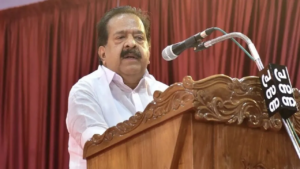
Senior Congress leader Ramesh Chennithala (Supplied)
One of the most crucial breakthroughs in recent weeks has been the SIT successfully tracing D Mani, who had long been suspected to be a key player in the alleged smuggling network. Acting on information shared by Senior Congress leader Ramesh Chennithala, SIT team was dispatched to Chennai.
After days of surveillance and tracking, investigators located D Mani, who is reportedly working as an antique dealer.
While he has been questioned, the SIT has clarified that he has not been arrested so far, and certain details about his background and identity are being kept confidential due to the sensitivity of the probe.
What has added a new and alarming dimension is the statement of an NRI businessman, who told the SIT that D Mani and his associates were introduced to him by people linked to Jayalalithaa. According to the businessman, this group was deeply involved in gold and idol smuggling and continues to operate with large sums of money.
He also revealed that there were concrete plans to smuggle idols from the Padmanabhaswamy Temple in Thiruvananthapuram, one of the wealthiest temples in Kerala.
The businessman claimed that Unnikrishnan Potty, the prime accused in the Sabarimala gold theft case, acted as an intermediary between temple-linked individuals and an international idol-smuggling syndicate.
He stated that during 2019–20, temple valuables, including idols, were allegedly sold to D Mani. The SIT had suspected from the beginning that D mani was a pseudonym, and the recent confirmation of his real identity has lent credibility to these claims.
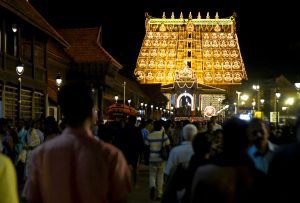
A night view of Sree Padmanabhaswamy Temple in Thiruvanathapuram. (Supplied)
Adding to the seriousness of the allegations, the NRI businessman told investigators that the gang had plans for a scam worth nearly ₹1,000 crore originating from Kerala and that idol trafficking networks connected to private collectors in the US, Europe, Australia and the Gulf were willing to pay crores for rare temple artefacts.
According to SIT sources, gold sheets and idols can command enormous prices in the international black market, especially when routed through underworld channels.
Investigators are also examining claims that gold bars stolen from Sabarimala were smuggled to Dubai and later moved to another Arab country, using established underworld networks.
If confirmed, this would firmly place the case in the realm of international organised crime, making a central agency probe inevitable.
Chennithala, who appeared before the SIT and recorded his statement at the Crime Branch headquarters in Thiruvananthapuram, said the information he shared came from a businessman with direct knowledge of antiquities smuggling networks. While refusing to reveal details publicly, he maintained that premature disclosures could damage the investigation.
He also referred to earlier High Court observations on the role of international smugglers like Subhash Kapoor in trafficking Indian heritage objects.
Chennithala has consistently alleged that gold and valuables taken from Sabarimala were sold as antiquities and estimated the value of missing assets at around ₹500 crore. His intervention, many observers note has significantly widened the scope of the probe.

Roddam Jewellery, Ballari
As the investigation expands, the Kerala High Court has played a central role in monitoring and questioning the progress of the SIT probe. The Devaswom Bench has raised serious concerns about delays, lapses and lack of clarity regarding the fate of the missing gold.
The court has even questioned whether the original gold bars were smuggled out and replaced with copper bars coated in gold.
To resolve this crucial question, the gold currently kept at the Sabarimala shrine has been sent for scientific testing at the Vikram Sarabhai Space Centre (VSSC) laboratory. The test results are expected to be critical in determining whether substitution took place.
Meanwhile, the SIT has been actively pursuing leads across states.
On Wednesday, Kerala SIT team arrived in Ballari, Karnataka, and conducted fresh searches at Roddam Jewellery, owned by Govardhan, who has already been arrested in the case. A five-member team carried out the inspection, temporarily shutting the shop and verifying records and materials.
This is the second raid at the same establishment, indicating that investigators are still trying to trace the original gold sheets.
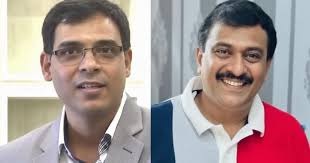
Govardhan and Pankaj Bhandari
Earlier, 470 grams of gold seized from Ballari were found not to belong to the Sabarimala temple, further deepening the mystery.
Govardhan has approached the High Court alleging coercion by investigators.
He claimed that he had paid ₹9,99,995 to the TBD through five demand drafts for 474 grams of gold left after gold-plating the Dwarapalaka idols and submitted documents showing the amount was credited to the Devaswom Board’s Annadhana Trust.
He also told the court that he donated a gold chain worth about ₹2.73 lakh to Sabarimala Ayyappa Swamy and insured it in the name of the Sabarimala executive officer. Alleging double loss, he claimed that the SIT seized the same gold despite his payment to the TDB. He moved a bail application in kerala HC and Justice Muralee Krishna adjourned the plea to 30 December to allow the prosecution to seek instructions.
However, the SIT has maintained in its remand report that Govardhan and Pankaj Bhandari, CEO of Smart Creations in Chennai, bear responsibility equal to that of Unnikrishnan Potty.
Investigators said both attempted to suppress crucial information and that evidence collected during the probe supports their involvement.
The case is now set to enter a new phase with the Enforcement Directorate (ED) expected to formally register an ECIR shortly.
Acting on directions from the Kollam Vigilance Court, the SIT has handed over all case documents to the ED, including statements, remand reports and seized records. The ED’s Kochi unit has sought clearance from its Delhi headquarters and has already begun a preliminary inquiry.
The ED probe will primarily focus on money laundering, black money flows and asset accumulation, though links to gold and idol smuggling are also expected to surface. Sources indicate that Unnikrishnan Potty and former TDB presidents N. Vasu and A. Padmakumar could also be named. Under the PMLA, the ED has sweeping powers, including search and seizure, and bail could be restricted for several months if arrests are made.
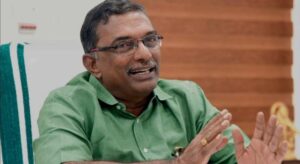
CPI(M) leader A Padmakumar
Parallelly, pressure is mounting for a CBI investigation.
BJP state president Rajeev Chandrasekhar, who filed a petition seeking a CBI probe, has reiterated that the scale and international nature of the case demand central agency intervention.
The High Court has deferred hearing the petition until after the Christmas vacation, but the CBI has already conveyed that it is ready to take over the investigation.
An impleading petition alleging attempts by senior IPS officers to sabotage the probe added another layer of controversy, though the petitioner was fined ₹10,000 for failing to appear before the court.
At present, the SIT is probing two cases related to the alleged theft of gold plates from the Dwarapalaka idols and the gold-plated doors of the sanctum sanctorum. Six people, including two former TDB presidents, have been arrested, but the core question, where the missing gold went remains unanswered.
As investigators follow trails leading from Sabarimala to Chennai, Ballari, Dubai and possibly beyond, the case increasingly resembles a sprawling web of crime rather than a simple theft.
With Padmanabhaswamy Temple now mentioned in statements, Jayalalithaa-linked intermediaries named, and international smuggling syndicates suspected, the Sabarimala gold theft case has moved far beyond its origins — reinforcing fears that what has surfaced so far may indeed be only the tip of a much larger iceberg.
(Edited by Sumavarsha)


