


Published Feb 23, 2026 | 9:29 AM ⚊ Updated Feb 23, 2026 | 9:29 AM


Kerala Chief Minister Pinarayi Vijayan. (Creative Commons)
Synopsis: The Kerala government is facing heat from the Opposition Congress and the state high court over several appointments and the regularisation of jobs in government departments. As election drums grow louder, the controversy threatens to shadow the LDF’s closing chapter in office — turning bureaucratic files into political flashpoints.
With barely weeks left for the implementation of the Model Code of Conduct (MCC) for the Assembly elections, the second Pinarayi Vijayan government in Kerala finds itself navigating choppy waters over a familiar charge — backdoor appointments.
A string of government orders, moves to regularise contract hands across departments, and hurried notifications in state-funded institutions have handed the Opposition fresh ammunition.
Although the Kerala High Court stepped in, staying further regularisation and seeking explanations from the Chief Secretary in contempt proceedings, the Cabinet is understood to be weighing additional files.
For the UDF, the issue has quickly become a campaign plank — alleging that contract employees are being made permanent in the twilight of the government’s term, while thousands continue to wait for PSC ranks to translate into jobs.
As election drums grow louder, the controversy over extensions, redeployments and regularisations threatens to shadow the LDF’s closing chapter in office — turning bureaucratic files into political flashpoints.
Even as the State Cabinet on 28 January cleared the ambitious 583-km Regional Rapid Transit System (RRTS), effectively signalling the end of the controversial Semi High Speed Rail (SilverLine) project, the government granted yet another one-year extension to 205 posts created exclusively for the land acquisition wing of SilverLine.
Ironically, this came after another Cabinet meeting on 4 February. Followed by this, the Revenue Department on 6 February issued an order
granting continuation of these 205 posts from 18 August 2025, for one more year.
The decision has reignited debate over what critics describe as “backdoor continuations” of temporary positions tied to a project widely believed to have been shelved.
It was in August 2021 that a Special Deputy Collector’s office with headquarters in Ernakulam and 11 Special Tahsildar (Land Acquisition) units were constituted solely for acquiring land for the Semi High Speed Railway (SilverLine) project. These units were headquartered in Thiruvananthapuram, Kollam, Alappuzha, Pathanamthitta, Kottayam, Ernakulam, Thrissur, Malappuram, Kozhikode, Kannur and Kasaragod.
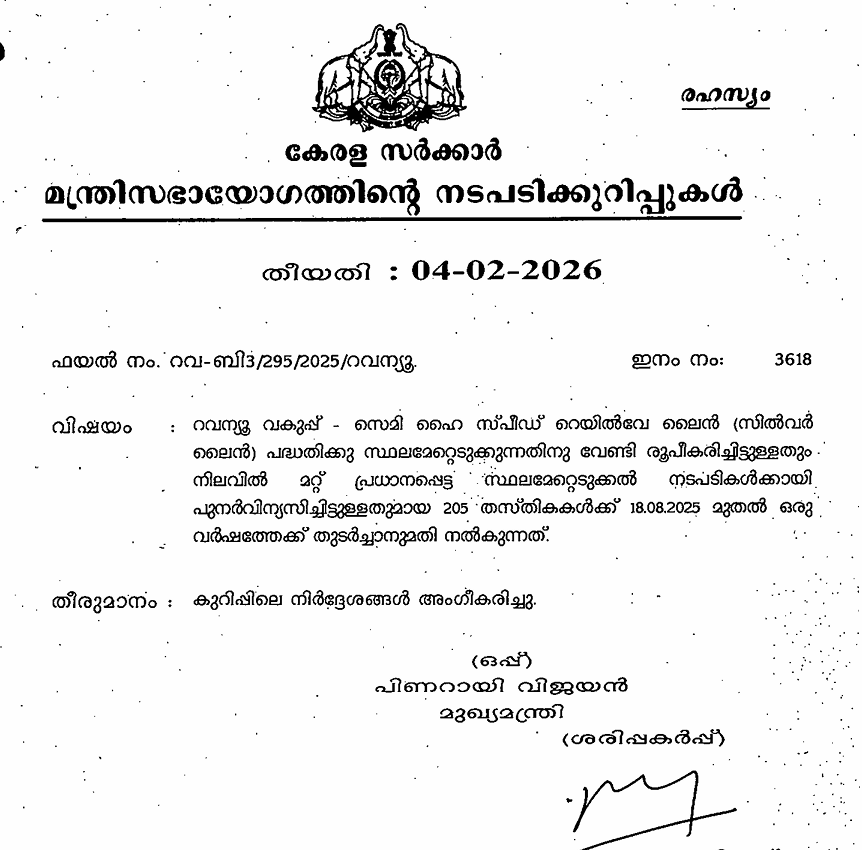
An excerpt of the Cabinet note that gave extension to 205 posts
The offices were explicitly set up for SilverLine-related acquisition work.
The posts were first granted continuation for one year from 18 August 2022. The continuation period ended on 18 August 2023.
Subsequently, government orders allowed the redeployment of employees of the SilverLine project — covering 205 posts across 12 Land Acquisition units — to other “essential projects.”
Further orders extended these 205 posts for one year from 18 August 2023, and again from 18 August 2024. The latest continuation period had expired on 18 August 2025.
On 15 September 2025, the Commissioner of Land Revenue sought another one-year extension from 18 August, 2025, stating that these posts, though created for SilverLine, were currently redeployed for other important land acquisition activities.
Additionally, in an emergency administrative arrangement, certain Special Tahsildar LA units, including Outer Ring Road Units 1, 2 and 3 and the PWD Kasaragod unit, were temporarily shifted to other offices as per a communication dated 21 January 2026.
After examining the matter, the government has now ordered that the 205 posts be continued for one more year from 18 August 2025. The fresh extension comes at a politically sensitive moment.
On 28 January, the Cabinet gave approval for a 583-km Regional Rapid Transit System (RRTS), widely seen as replacing the SilverLine proposal, which had faced sustained public protests and technical objections from the Union Railways Ministry over its Detailed Project Report (DPR).
With the RRTS decision effectively bringing down the curtain on SilverLine, the continuation of posts created “for the sole purpose” of acquiring land for that very project has raised eyebrows.
If the Semi High Speed Rail project is no longer moving forward, why should posts exclusively created for it continue — even under redeployment? Why were these temporary structures not wound up when the project lost momentum?
The official position is that the posts are no longer functioning solely for SilverLine but are being utilised for other critical land acquisition works across the state. The Revenue Department maintains that dissolving the units abruptly would hamper ongoing acquisition processes tied to infrastructure and development projects.
Officials argue that land acquisition expertise built within these units is being effectively redeployed and that the continuation is administrative, not project-specific.
However, Opposition voices allege that repeated annual extensions of project-based posts, even after the parent project stalls, blur the line between temporary deployment and de facto regularisation.
With SilverLine practically off the tracks and RRTS now on the drawing board, the fate — and purpose — of these 205 posts remain under scrutiny.
Meanwhile, fresh allegations of backdoor appointments and last-minute administrative manoeuvres rocked two state-linked higher education institutions, with the Save University Campaign Committee (SUCC), a whistleblower group operating in the higher education sector, accusing authorities of diluting norms and rushing through decisions ahead of the election notification.
At the centre of the controversy is the move to appoint a new Director at the Gulati Institute of Finance and Taxation (GIFT) in Thiruvananthapuram.
The institute, functioning since 2009 with financial assistance from both central and state governments and recognised by the Indian Council of Social Science Research (ICSSR), is also an accredited research institute of Cochin University of Science and Technology (CUSAT).
According to SUCC, the search committee issued a notification on 6 February, relaxing the prescribed UGC qualifications for the post of Director.
Unlike earlier notifications that mandated appointment of a Professor with a PhD and at least 10 years of teaching and research experience — equivalent to the qualifications and pay scale of a Vice-Chancellor — the latest notification replaces that stipulation with a more loosely worded requirement of an “expert with considerable experience in teaching and research.”
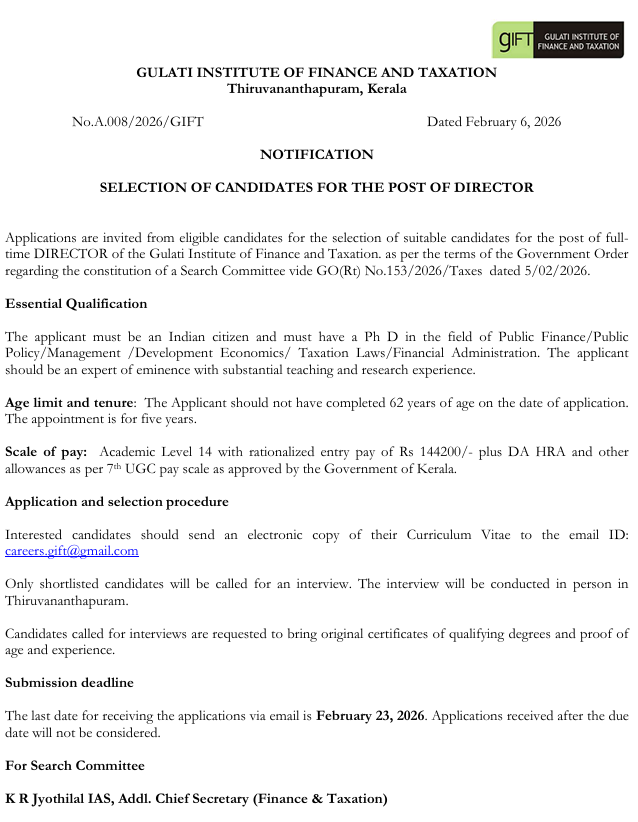
GIFT notification that raised many eyebrows
The committee alleges that the change opens the door for the appointment of a person close to those in power.
GIFT’s Governing Board is chaired by Finance Minister KN Balagopal, placing the Finance Department under scrutiny.
SUCC claimed the notification was issued in haste to complete the appointment before the election notification comes into force.
The application window, traditionally one month, has reportedly been curtailed to just 15 days, with 23 February fixed as the last date for submissions.
A search committee headed by Planning Board Vice Chairman VK Ramachandran was constituted on 5 February to conduct interviews and recommend a panel.
The Director’s tenure is five years, and applicants up to 62 years of age are eligible.
All teaching positions at GIFT, according to past practice, have adhered to UGC norms in qualifications and salary structures.
SUCC argued that appointing a Director without the rank and eligibility of Professor, especially in an institution where several Professors are already serving, would violate UGC regulations and undermine academic standards.
The committee petitioned the Governor, the chief minister, and the CUSAT Vice-Chancellor, seeking cancellation of the notification that diluted the UGC-prescribed qualifications.
In a parallel development, the Governor intervened in decisions taken at Sree Sankaracharya University of Sanskrit, Kalady, following complaints from SUCC.
The Raj Bhavan directed the Vice-Chancellor to freeze a Syndicate decision that allowed an SFI activist, who had failed the four-year BFA (Mural Painting) examination in 2005 and dropped out, to be treated as having passed the BFA after he completed and passed the MFA in 2023.
Admission to the MFA programme had been granted without verification of BFA mark lists, triggering allegations that political influence played a role.
The Syndicate, chaired by interim Vice-Chancellor DKK Geetha Kumari, had reportedly decided to regularise the anomaly as a “special case” by declaring him successful in the BFA. The Governor ordered that decision to be kept in abeyance.
Further, the Governor also blocked the Syndicate’s move to initiate the appointment process of Assistant Professors ahead of the Assembly elections.
SUCC, in its complaint, cited a government audit report regarding severe financial strain at the university and alleged that more teachers had been appointed than warranted by the student strength.
The committee accused the interim VC of acting under pressure from certain Syndicate members and political interests. Four Syndicate members nominated by the Governor have reportedly submitted written complaints to Raj Bhavan detailing alleged irregularities and corruption.
At the same time, the Kerala High Court has put the brakes on the state government’s move to regularise temporary, daily-wage and contract employees across departments and quasi-government bodies, signalling stern disapproval of what petitioners describe as “backdoor appointments” ahead of elections.
Justice CP Mohammed Nias, on 21 February, stayed further regularisation after the Chief Secretary failed to file an explanation in a contempt plea, despite repeated opportunities.
The petition, moved by Malappuram native M Abdul Vahid, alleged that fresh government orders were issued in defiance of an earlier high court judgement barring regularisation in violation of Supreme Court directives.
On 10 November last year, the high court had categorically ordered that temporary employees should not be regularised in violation of Supreme Court directives and the constitutional scheme governing public appointments. The court had made it clear that any such move must strictly comply with the law laid down by the apex court.
Despite this, the petitioner contended, the government issued fresh regularisation orders in January 2026, covering librarians, anganwadi and nursery school teachers, and ayahs who had 10 or more years of service. A government order dated 3 January was produced before the court to substantiate the claim that these employees were regularised as part-time contingent staff.
The contempt plea further alleged that files are under Cabinet consideration to regularise nearly 1,000 more contract employees in institutions under various departments. Moves are also said to be underway to regularise temporary appointees in local bodies.
When the matter came up earlier, the high court had directed the Chief Secretary to file an affidavit explaining the circumstances under which fresh regularisation orders were issued while the earlier judgement restraining such action remained in force. However, despite being granted time on multiple occasions, the government failed to furnish a satisfactory explanation.
It was in this backdrop that Justice Mohammed Nias stayed the operation of further regularisation orders.
The court was also hearing related proceedings arising from a 2025 judgement delivered in a batch of petitions, including one filed by S Vishnu of Adoor and others, challenging the regularisation of daily-wage employees in various public sector undertakings (PSUs). In that judgment, the court had held that public appointments must strictly conform to constitutional requirements. As a one-time measure, however, the court upheld the regularisation of 543 PSU appointments. An appeal against that verdict is currently pending.
The matter is now posted for 2 March, with the government seeking additional time to respond.
Meanwhile, in a separate but related development, Justice PV Kunhikrishnan, while hearing a petition filed by VJ Shanavas of Thiruvananthapuram challenging 29 temporary appointments in the Agency for Non-Conventional Energy and Rural Technology (ANERT), directed that any further such appointments be made only after obtaining orders from the high court.
According to senior Congress leader Ramesh Chennithala, with the state government’s term nearing its end, it is indulging in a “hurried and systematic” move to regularise backdoor appointees across government and semi-government institutions in Kerala.
He claimed that corporations, boards and public sector bodies are attempting to retain temporary and contract staff by “using the PSC as a crutch,” calling it a betrayal of job-seeking youth.
He cited ANERT under the Electricity Department as a recent example, where temporary employees were allowed to continue till project completion based on a request from a former chief officer, later removed amid corruption allegations.
He alleged that a 2021 high court directive to maintain the status quo in appointments was flouted, contracts were renewed with steep pay hikes, and Employment Department communications were ignored.
He further alleged that ANERT issued newspaper advertisements through the Centre for Management Development for fresh contract hires, bypassing mandatory employment exchange procedures.
Claiming that over two lakh backdoor appointments were made in the past decade, Chennithala said nearly 22,000 of the 33,000 annual temporary vacancies are filled outside employment exchange norms. He demanded an immediate halt to what he described as a last-minute regularisation drive.
In the weeks ahead, as campaigns gather momentum, these files — extensions granted, qualifications tweaked, regularisations attempted — are expected to acquire sharp political edges.
(Edited by Muhammed Fazil.)


