

Published Apr 26, 2026 | 10:43 AM ⚊ Updated Apr 26, 2026 | 10:43 AM

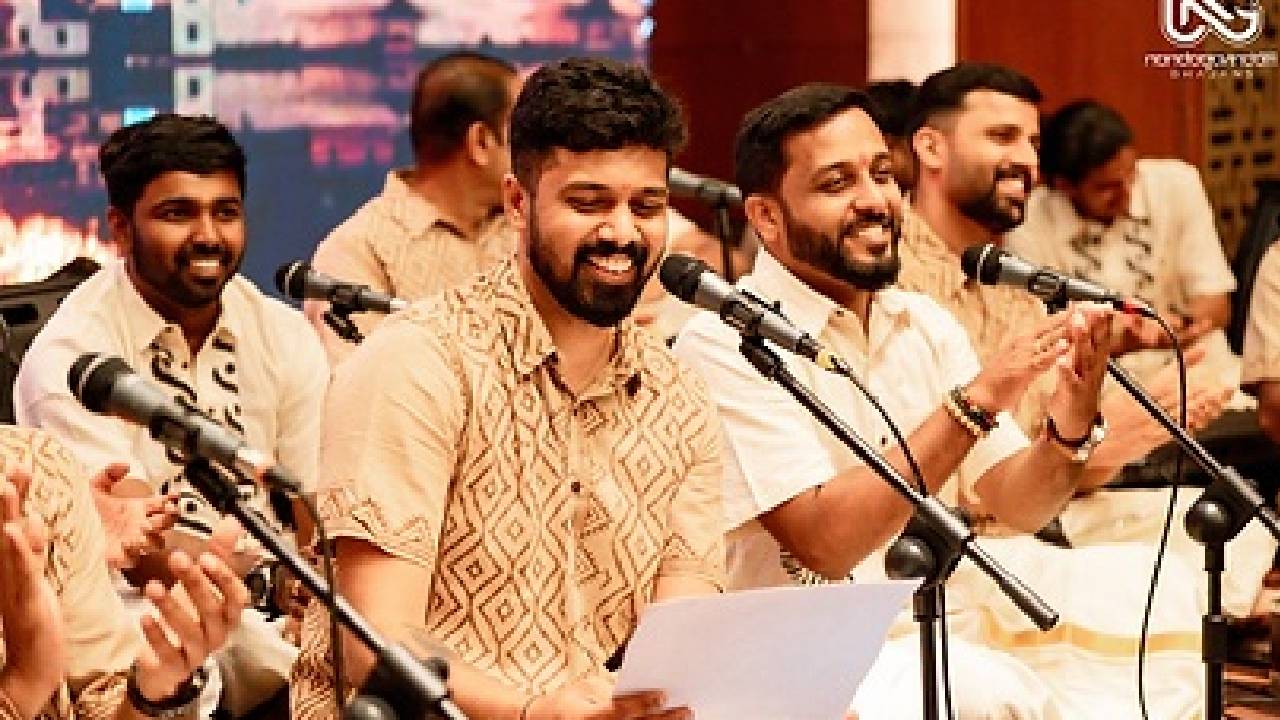
Before singing the hymn, Naveen Mohan spoke about the secular nature of the place. (Pic: Nandagovindam Bhajans)

Somewhere between a bhajan and a hymn, between a temple courtyard and a church parking ground, Kerala found itself arguing—again—about what it really believes in.
It began without drama. A modest stage. A fundraising programme tied to the reconstruction of a local shrine.
The familiar, unhurried rhythm of devotional music.
Then Nandagovindam Bhajans, a devotional music band led by singer Naveen Mohan, slipped in something unexpected—“Ee Paradevanaho,” a Christian devotional written by the late Justus Joseph, fondly remembered as Vidwaankutty Achan.
For those seated under the shamiana that evening near the Vembinkulangara Sree Maha Vishnu Temple, in Kottayam, it didn’t feel like a transgression. It felt like a thank-you note set to music.
Outside that circle, the internet had other plans.
Also Read: Sangh Parivar outfits see Islamic hand in the death of poet Kumaran Asan
The performance wasn’t staged inside the temple. There wasn’t enough space. The venue spilled out beyond the compound wall, into a shared neighbourhood where logistics often depend less on doctrine and more on goodwill.
The nearby church had opened its grounds for parking.
Parishioners had pitched in during the temple’s reconstruction.
In return, the bhajan troupe offered a gesture—part gratitude, part habit. In many parts of Kerala, such gestures don’t require explanations.
Still, Naveen Mohan offered one.
On stage, before the song, he spoke about studying in a church-run school, about lamps being lit across religious spaces during festivals, about a place where such overlaps were never treated as cultural experiments.
That speech, clipped and uploaded, travelled faster than the song itself.
The backlash found its most quotable line through KP Sasikala, chief patron of Hindu Aikya Vedi.
Her analogy was simple enough to fit inside a WhatsApp forward and sharp enough to stay there: chicken masala is fine, she said, but don’t mix it with payasam (gheer).
A warning followed—don’t cut the branch you’re sitting on.
It was less a critique and more a metaphor that refused to stay metaphorical.
Within hours, “payasam vs masala” became shorthand for everything—purity, dilution, boundaries, even culinary patriotism.
Those who agreed argued that temples are not rehearsal spaces for secularism. That rituals have grammar. That not every well-meaning gesture deserves a microphone.
Others found the outrage oddly misplaced.
After all, this wasn’t a ritual. No priest had paused a puja to accommodate a hymn. No sanctum doors were involved. It was, as the organisers later clarified, a public programme tied to a community effort.
If there was pressure, the temple committee didn’t show it.
In a statement that read less like damage control and more like mild irritation, they pointed out the obvious: the event was outside the temple walls, the performance was free, and the cooperation came from all sides—Hindus, Christians, everyone who lives there without needing labels for daily interactions.
They added a line that sounded almost like a warning of its own—don’t manufacture discord where none exists.
That clarity didn’t end the debate. It merely shifted it.
The video’s afterlife turned into a familiar spectacle. Comment sections split neatly into two camps.
One side insisted that intent doesn’t override context. A temple event, they argued, carries expectations. Break that frame, and you risk turning devotion into performance art.
The other side dismissed the outrage as imported anxiety—something Kerala borrows occasionally, like a trend that doesn’t quite fit but gets worn anyway. Many pointed out that shared festivals, borrowed spaces, and overlapping rituals are not new here. They are, in fact, the default setting.
Somewhere in the middle sat a quieter question: when did everyday coexistence start needing ideological clearance?
Caught in the swirl, Nandagovindam Bhajans chose restraint over rhetoric.
Their statement didn’t wander into theory. It stayed with intent. Music, they said, was a way of expressing gratitude and connection. Nothing more ambitious than that. Nothing designed to provoke.
Privately, the explanation was even simpler. The church helped. The village showed up. The song followed.
There was no grand experiment in secularism. No calculated statement. If anything, the trouble began because something routine was suddenly treated as radical.
What makes this episode linger isn’t the outrage. Kerala has seen louder ones. It’s the discomfort it reveals.
There is, clearly, a section that wants sharper lines—clearer definitions of where one faith ends and another begins.
For them, the metaphor of payasam and masala isn’t just clever—it’s necessary.
And then there’s the other Kerala. The one that rarely announces itself. The one that borrows chairs from a church for a temple function and returns them without turning it into a statement on pluralism. The one that lights lamps across compounds without checking theological compatibility.
That Kerala doesn’t trend. But it endures.



