

Published Sep 01, 2026 | 12:41 PM ⚊ Updated Sep 01, 2026 | 12:41 PM

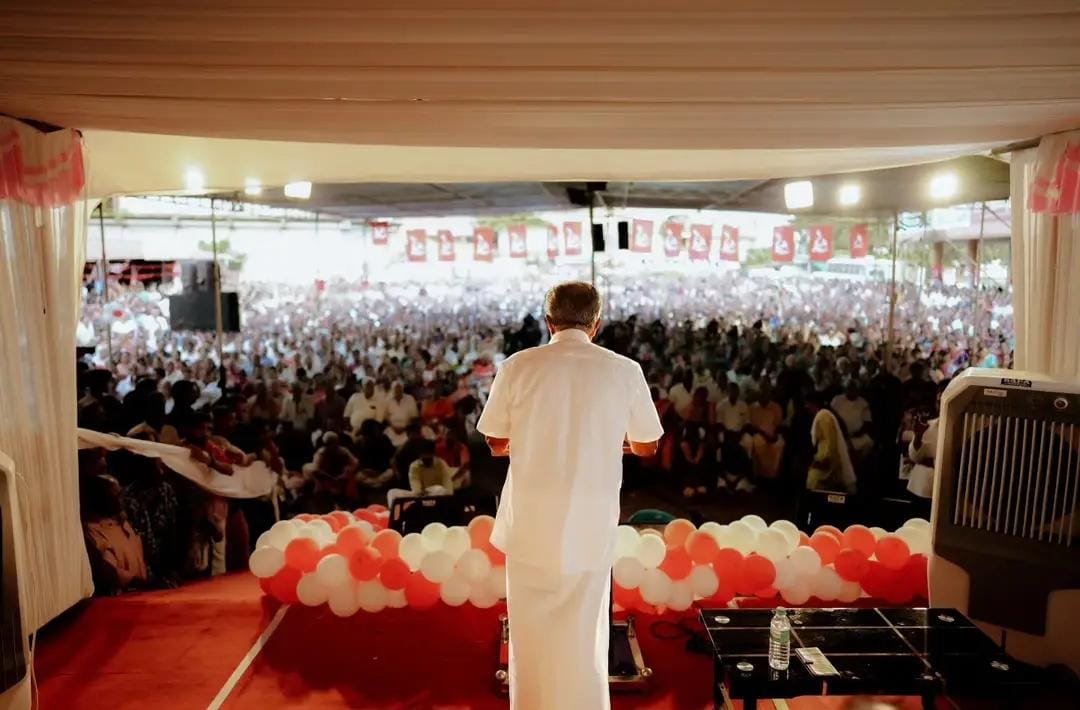
Leader of Opposition Pinarayi Vijayn speaking at a party gathering in Taliparamba.

Synopsis: CPI(M)’s post-election review has exposed a growing tension between Pinarayi Vijayan’s public blame on rebels and cadre and the party’s own admission of leadership and candidate-selection failures. As the party prepares for a crucial organisational review, the central question is whether it will merely defend its old line or honestly confront the deeper disconnect with its workers and voters.
The CPI(M) Keralam unit is heading for a crucial organisational review after its setbacks in the 2026 Assembly elections. It will hold an extended state committee meeting in September to discuss the political and organisational issues flagged in the election review adopted by the Central Committee in July.
Against this backdrop came Leader of the Opposition Pinarayi Vijayan’s latest remarks during the political explanatory meetings held in two CPI(M) strongholds where the party suffered embarrassing defeats, Payyannur and Taliparamba.
Speaking at the meetings on August 29 and 30, the former Chief Minister, who is considered to be the final word in the party’s state unit, blamed sections of the party cadre and rebel candidates for the electoral reverses. He also launched a sharp attack on V Kunhikrishnan and TK Govindan, who had contested as rebels and went on to win the Assembly elections.
The remarks came at a time when calls for introspection are intensifying from within the party, while a section of the cadre and the central leadership have also sought changes in the functioning of the state unit.
Pinarayi’s statements have brought the focus back to a familiar question within the organisation: who takes accountability for poll debacles? Does the old tactic of ‘party was right, rebels were wrong’ still work?
At the meetings, Pinarayi blamed the party rebels and those who supported them for the CPI(M)’s setbacks in the Payyannur and Taliparamba Assembly constituencies in the recent election, while also noting that the party must work towards regaining the confidence of voters who had moved away from it.
However, Vijayan said the defeats in the two constituencies could not be viewed as a permanent shift in people’s political allegiance.
In Payyannur, he accused former CPI(M) leader and independent MLA Kunhikrishnan of working with the party’s opponents while he was still part of the organisation. Kunhikrishnan, who had raised corruption allegations against party leaders before being expelled, contested the election as a UDF-backed independent and won.
Vijayan said the CPI(M)’s vote share in Payyannur had fallen from more than 62% in 2021 to about 44% in the latest election, while the UDF polled around 49%. He said the loss of about 18% of the votes that had previously gone to the party was a matter of serious concern.
Describing Kunhikrishnan as an “axe-handle in the hands of the enemy”, he said his actions had sought to damage the party rather than help it.
In Taliparamba, Vijayan said some LDF supporters who voted for UDF-backed Independent TK Govindan might now regret their decision. The LDF’s vote share fell from over 52% in 2021 to about 41%, while Govindan secured around 47%.
He noted that the CPI(M) never had to let go of the Taliparamba seat from 1965 to 2021, except once. The former CM alleged that the celebration by CPI(M) opponents after the election results came out reflected the impact of “propaganda” directed against the party.
At both meetings, he stressed that the party should recognise its weaknesses, restore organisational unity and reconnect with voters, and urged those who had moved away from the CPI(M) to return to its political line.
Pinarayi Vijayan’s explanation for its electoral setbacks appears to be opening a fresh question within the party: if rebels and sections of the cadre were responsible for the losses, how does that square with the party’s own review admitting lapses at the leadership and candidate-selection levels?
The Central Committee report, while examining the defeats of party candidates in Taliparamba, Payyannur and Alappuzha, specifically referred to the three defectors who contested against CPI(M) candidates and won in traditional party strongholds. The report described the episode as evidence of the emergence of “parliamentary opportunism” within the party. More importantly, it identified a deeper problem—the widening gap between the leadership and the rank and file and the resulting erosion of the party’s mass base.
The report called for urgent steps to bridge that gap, correct the party’s style of functioning and fight parliamentary deviation.
The same Central Committee review also reproduced a finding from the State Committee on candidate selection in Taliparamba and Payyannur.
The State Committee had admitted that the selection process was not handled with sufficient care.
The Kannur District Committee’s review was even more self-critical. The report pointed out lapses from the part of the State Secretariat and Committee in approving the candidates recommended by the district committee. That admission has created confusion among party workers over how the defeat is being explained now.
“We were told after the review that the party would correct its mistakes. But the message reaching the grassroots now appears different. Workers are hearing that those who voted for the other side should realise their mistake. What about the mistakes that the party itself has admitted?” asked a local committee worker from Kannur.
Meanwhile, an ordinary party supporter in Payyannur said the review had failed to settle the bigger question of where the party had actually gone wrong.
“There is still no clarity on where things went wrong. Was the failure at the level of the local committee, the district leadership, the state leadership, or in the selection of the candidate? The party’s own review points to shortcomings at different levels. Workers deserve an honest explanation,” the supporter said.
According to him, rebuilding the party’s connect with voters would require more than urging the cadre to step up their efforts.
“The call to regain the confidence of voters is welcome. But speeches alone will not bring people back. The party has to show that it has truly understood what went wrong in Payyannur and Taliparamba. Only then can it begin to rebuild that confidence,” he said.
For a section of party workers in Kannur, the issue is not whether rebels contributed to the defeats. It is whether the party is willing to confront the mistakes it identified in its own review with the same candour with which it is asking its cadre and voters to accept responsibility.
Also Read: The making and unmaking of a political equation— and the CPI(M)’s dilemma
The CPI(M)’s response to the present crisis reflects a familiar pattern in the party’s history, according to political commentator NM Pearson.
Whenever serious criticism emerged from within, the party traditionally maintained that its position was correct and those who raised dissent were wrong. The episodes involving MV Raghavan and KR Gouri stand as prominent examples, Pearson said.
He argued that Pinarayi Vijayan was attempting to deal with the present crisis through the same political approach. But the circumstances have changed.
“This time, the crisis is different because the party cadre itself has begun questioning the party,” Pearson said.
According to him, cadres and ordinary supporters are now convinced that the candidate selection in Payyannur and Taliparamba was influenced by certain leaders in the state unit rather than reflecting the broader sentiments prevailing among local and district-level leaders, as well as sections of the state leadership.
That has created a fundamental problem for the party’s official position.
“The party cannot simply repeat that it was right and everyone else was wrong,” Pearson said, adding, “Pinarayi Vijayan is trying to address the issue through an old strategy, but that strategy may no longer be effective.”
He said the party has failed to follow one of the basic principles it has always upheld—listening to the people and recognising popular sentiment. In this instance, the wider sentiments within the party and among its supporters were not given due consideration, he pointed out.
At the same time, Pearson argued there could be a political defence available to Pinarayi Vijayan. What is discussed and accepted within closed party forums need not necessarily be stated in the same manner on a public platform. Pinarayi could argue that his public position was taken in accordance with the party’s collective decision.
But Pearson believes such explanations have limited appeal in the present political climate.
“Such narratives may have worked in the past. They will not necessarily work now,” he said.
What the cadre and ordinary supporters expect today, according to Pearson, is not merely a defence of the party line.
“They expect honesty,” he stated.
Also Read:
The making and unmaking of a political equation— and the CPI(M)’s dilemma
(Edited by Fayisa CA)



