


Published Jan 25, 2026 | 8:47 PM ⚊ Updated Jan 25, 2026 | 8:47 PM

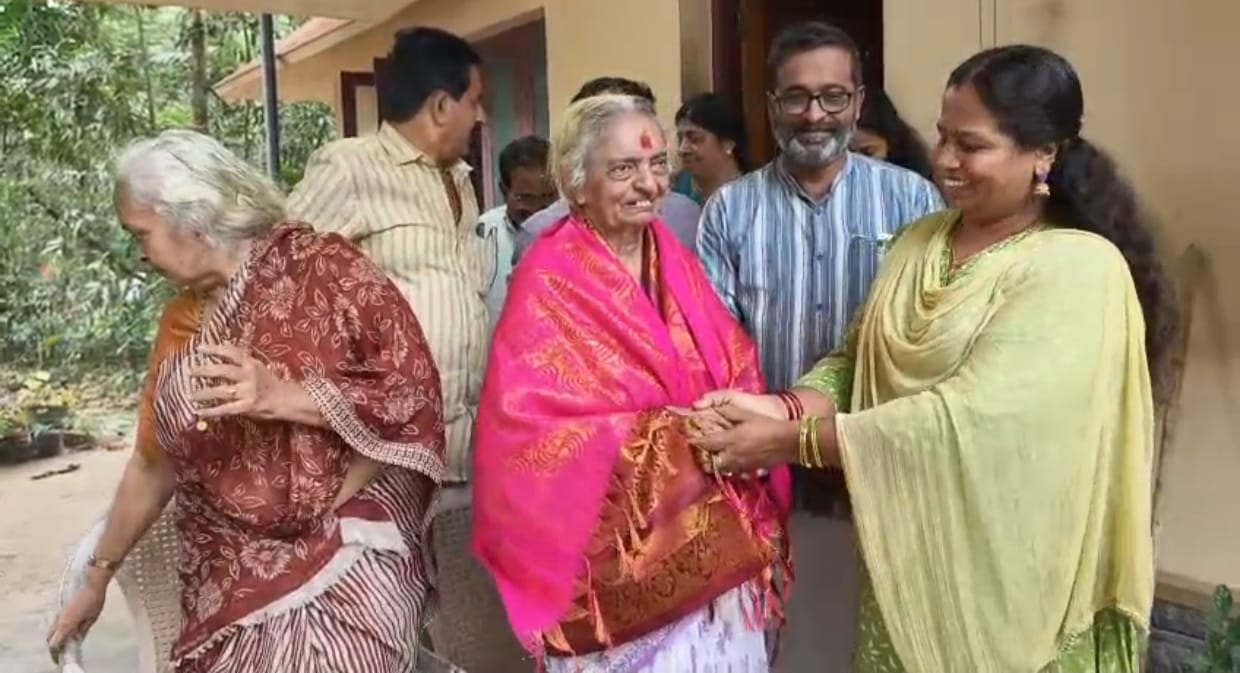
Villagers celebrate Devaki Amma’s Padma Shri honour on Sunday.
Synopsis: Devaki Amma’s Tapovanam now stretches across five acres and contains more than 3,000 trees, shrubs, and medicinal plants. It includes mango, jackfruit, tamarind, bur flower, and the Bodhi tree, alongside rarer species like the peacock plant and the calabash tree. The hard shell of its fruit was historically used by sages as a water container.
Surrounded by a battery of journalists, 92-year-old Kollakkayil Devaki Amma G was in a jovial mood on Sunday, 25 January, evening.
A peal of laughter followed after she responded to South First. “Yes, I am,” she replied with a chuckle when asked, “Is this Padma Shri Devaki Amma?”
Barely a few hours ago, on the eve of the Republic Day, the Union Ministry of Home Affairs had announced the Padma awards, one of the highest civilian awards. Devaki Amma’s name figured among those selected for the Padma Shri, recognising her social work in afforestation.
Devaki Amma has spent over 44 years nurturing a five-acre manmade forest called Tapovanam in Alappuzha, transforming barren land into a lush, thriving ecosystem.
The forest now shelters more than 3,000 trees and plants, providing a home for countless birds, fish and other wildlife, while also serving as a living classroom for students and nature enthusiasts.
Born in Muthukulam, Alappuzha, a district known for its backwaters and paddy fields but virtually no forests or highlands, Devaki Amma developed a love for horticulture, inspired by her grandfather.

Kollakkaiyil Devaki Amma, Padma Shri awardee from Kerala, has spent over 44 years nurturing a five-acre manmade forest called Tapovanam in Alappuzha.
She married Gopalakrishna Pillai, a schoolteacher, and together they worked on paddy fields to sustain their family.
In 1980, a car accident changed everything. She was bedridden for three years and could no longer continue farming.
”Those were years of total helplessness. I felt like my entire life had been uprooted.” she recounted. But Devaki Amma chose not to surrender to despair.
Instead, she turned to the land around her ancestral home and began planting saplings, one at a time, each day. What started as a small act of hope grew into a lifelong commitment, and over the decades, a barren yard became a thriving forest.
Tapovanam now stretches across five acres and contains more than 3,000 trees, shrubs, and medicinal plants.
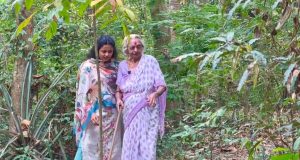
Devaki Amma with her great-grandchild at Tapovanam.
It includes mango, jackfruit, tamarind, bur flower, and the Bodhi tree, alongside rarer species like the peacock plant and the calabash (kamandalu) tree. The hard shell of its fruit was historically used by sages as a water container.
What makes Tapovanam even more remarkable is that it predates the urban Miyawaki forest trend.
The Miyawaki method, developed by Japanese botanist Dr Akira Miyawaki, creates dense, self-sustaining forests in a short period, usually around ten years. Long before this became popular in cities, Devaki Amma had been building her multi-layered forest with patience and an intimate knowledge of her land’s ecology.
She cultivated the forest using cows, buffalo, and oxen, along with simple techniques such as rainwater harvesting, ensuring that each sapling had the best chance to thrive.
Nestled in the heart of Alappuzha, with its endless backwaters and sandy soil, Tapovanam now supports a full ecosystem. Birds like Amur falcons, paradise flycatchers, and bluethroats regularly visit, while ponds are home to catfish and murrels, creating a complete natural cycle.
Medicinal plants in the forest provide free remedies to locals, reflecting Devaki Amma’s belief that nature’s gifts should be shared, not sold.
Devaki Amma’s bond with Tapovanam was born of suffering.
After the car accident, she had to relearn to walk using a stick, taking small, deliberate steps. During those early years, her emotional and physical pain was immense. Yet, by dedicating herself to planting trees, she found a sense of purpose. Watching each sapling grow became her daily meditation, a symbol of resilience and hope.
Over 44 years, Devaki Amma transformed her ancestral home’s eastern and western yards, previously barren and sandy, into a thick, green oasis.
Shrubs filled every available space, cooling the environment and creating shade, while trees grew to their full height, supporting a thriving ecosystem. Her hands nurtured each sapling as a mother nurtures her child.
Advocate Rajagopal, a local activist and politician, shared the excitement of the village with South First.
”It was surprising. She has received many awards before, but we never thought the Padma Shri would come to her. Our village plans to celebrate it colourfully, but in a nature-friendly way.” he told.
Devaki Amma’s recognition has inspired a sense of pride and joy across the community. People, young and old, visit Tapovanam daily, both to admire the forest and to learn from it.
The forest functions as a living classroom, where students can observe plant species, learn about ecosystems, and understand the delicate balance between humans and nature.
Devaki Amma’s simple message to all visitors is clear: ”At least plant a tree and help it survive.”
Tapovanam is more than just flora and fauna. It provides clean air, fresh water, medicinal plants, and a tranquil environment for the surrounding community. Visitors are encouraged to learn, plant, and care for the forest themselves.
Devaki Amma’s life demonstrates that even without wealth, formal education, or public recognition, an individual’s consistent efforts can create a monumental impact.
Her story reminds us of three fundamental lessons: life’s challenges can be transformed through care for the natural world; small, daily actions compound into significant change; and nature’s value transcends money, providing healing and hope to all.
Devaki Amma continues her daily walk among the trees she planted, a living testament to what dedication, love, and patience can achieve.
Her Padma Shri is not just an award; it is a celebration of a life devoted to creating healing and sustainability.
In a world where forests are disappearing, and environmental threats loom large, Devaki Amma’s story is a beacon of hope—a reminder that one person’s quiet, persistent effort can inspire generations and transform even the most barren land into a green sanctuary.
Besides Devaki Amma, AE Muthunayagam (Science and engineering) and Kalamandalam Vimala Menon, too, will be presented the Padma Shri.
Among the Padma Vibhushan awardees are former Supreme Court judge Justice KT Thomas (Public Affairs), P Narayanan (Literature and Education), and former chief minister and Marxist leader, the late VS Achuthanandan (Public Affairs).
Movie actor Mammootty and SNDP Yogam general secretary Vellappally Natesan will be awarded the Padma Bhushan at the investiture ceremony to be held at the Rashtrapati Bhavan in March or April.
(Edited by Majnu Babu).


