

Published Jun 17, 2026 | 5:08 PM ⚊ Updated Jun 17, 2026 | 5:08 PM

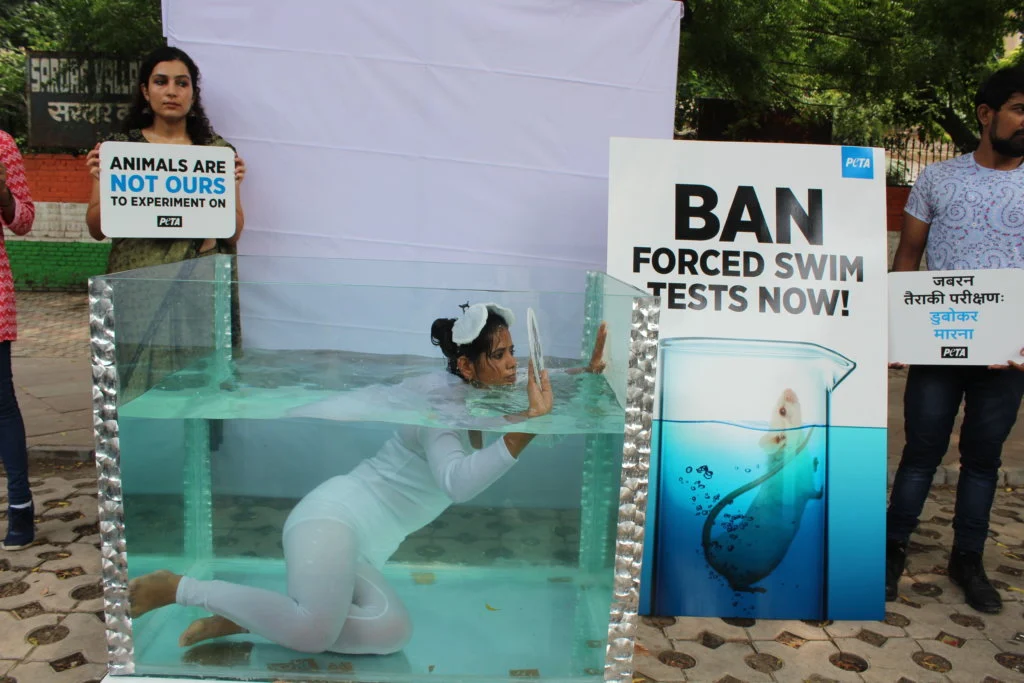
People for the Ethical Treatment of Animals has been advocating a total ban on the forced swim test. (File pic/PETA India)

Synopsis: The Forced Swim Test is an experimental paradigm in which rodents such as mice and hamsters are placed in a confined, water-filled apparatus and, after initial escape attempts, adopt an immobile posture. The experiment has been heavily criticised since scientists felt that the animals giving up and floating was not a sign of depression or despair, but rather a sign of adaptive energy conservation.
Thodupuzha, Idukki-based Al-Azhar College of Pharmacy has backed a full ban on the controversial Forced Swim Test (FST) — an experiment conducted for predicting the efficacy of antidepressants in rodents.
FST, originally developed by scientists at Synthelabo, is an experimental paradigm where rodents such as mice and hamsters are placed in a confined water-filled apparatus and, after initial escape attempts, adopt an immobile posture.
The college’s decision to support the total ban follows a rigorous campaign by PETA India highlighting the test’s inherent cruelty and scientific failure.
PETA’s intervention has already seen Guru Angad Dev Veterinary and Animal Sciences University in Ludhiana, Himachal Institute of Pharmacy in Himachal Pradesh, Chitkara University in Chandigarh and CT University in Ludhiana dropping the FST.
Also Read: PETA alleges severe animal abuse at Telangana testing lab
The experiment has been heavily criticised by scientists who argue that the animals giving up and floating is not a sign of depression or despair, but rather an indicator that the animals are simply saving energy and adapting to a new environment.
Research suggests the test may even be less reliable than a coin toss at determining the effectiveness of antidepressant medications.
In an email to PETA India, the Principal Prof. Dr Shyamkumar B of the Al-Azhar College of Pharmacy confirmed that they “support the blanket ban on the Forced Swim Test, as alternative methods are available.”
The Pharmacy Council of India has twice directed all agencies under its purview (in April 2025 and again in January 2026) to review and take necessary action on PETA India’s request to end the use of the widely debunked experiment.
More than 100 scientists and scientific experts have also joined PETA India’s call, urging regulators and institutions to end the use of the forced swim test.
“Al Azhar College of Pharmacy’s response reflects a growing shift toward humane and scientifically progressive educational practices in India,” says Dr Anjana Aggarwal, PETA India’s Scientist and Research Policy Advisor.
“The institution’s support for a blanket ban on the Forced Swim Test sends an encouraging message to other colleges and universities across the country.”
Other government agencies, universities, and pharmaceutical companies around the world have pledged not to permit, conduct, or fund the FST after hearing from PETA entities.
PETA India is intensifying efforts to urge the Committee for Control and Supervision of Experiments on Animals (CCSEA) to ban the cruel experiment at the national level.



