


Published Dec 27, 2025 | 1:00 PM ⚊ Updated Dec 27, 2025 | 1:00 PM

For the first time, the IMUL has succeeded in winning representation in all 14 districts of Kerala.
Synopsis: The Indian Union Muslim League has recorded its strongest-ever performance in Kerala’s local body elections, winning a record 3,203 seats and securing representation in all 14 districts, breaking the decades-long perception that it is a party limited to Kerala’s Malabar. With a higher vote share than the CPI and growing influence in urban centres such as Kochi, the party is now a key power broker within the Congress-led United Democratic Front.
For much of the post-Independence period, the Indian Union Muslim League (IUML) was viewed largely as a Malabar-centric party, with a base in Muslim-majority regions of north Kerala and as a dependable ally within the Congress-led UDF.
It gained brief national prominence in 2019, when Rahul Gandhi chose to contest from Wayanad, a traditional IUML bastion. This prompted Uttar Pradesh Chief Minister Yogi Adityanath to infamously cite it as evidence of the Grand Old Party’s affliction by a “Muslim League virus”.
Six years on, the local body polls have marked a turning point for the IUML. It recorded its strongest grassroots performance in decades, winning a record 3,203 seats across local bodies, against all assumptions.
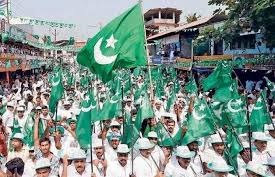
The viral photo from Rahul Gandhi’s Wayanad campaign
For the first time, it has also succeeded in winning representation in all 14 districts of Kerala.
“We have demonstrated that the IUML is not a party confined to Malappuram district,” IUML state secretary Abdurahman Randathani told South First, noting that the party secured seats “from Thiruvananthapuram to Kasaragod”.
More significantly, the party won more seats outside Malappuram than within it, altering the power equations within the UDF.
With its national headquarters now established in New Delhi and a renewed organisational assertiveness, the IUML is signalling ambitions beyond Kerala, positioning itself for a more visible national role.
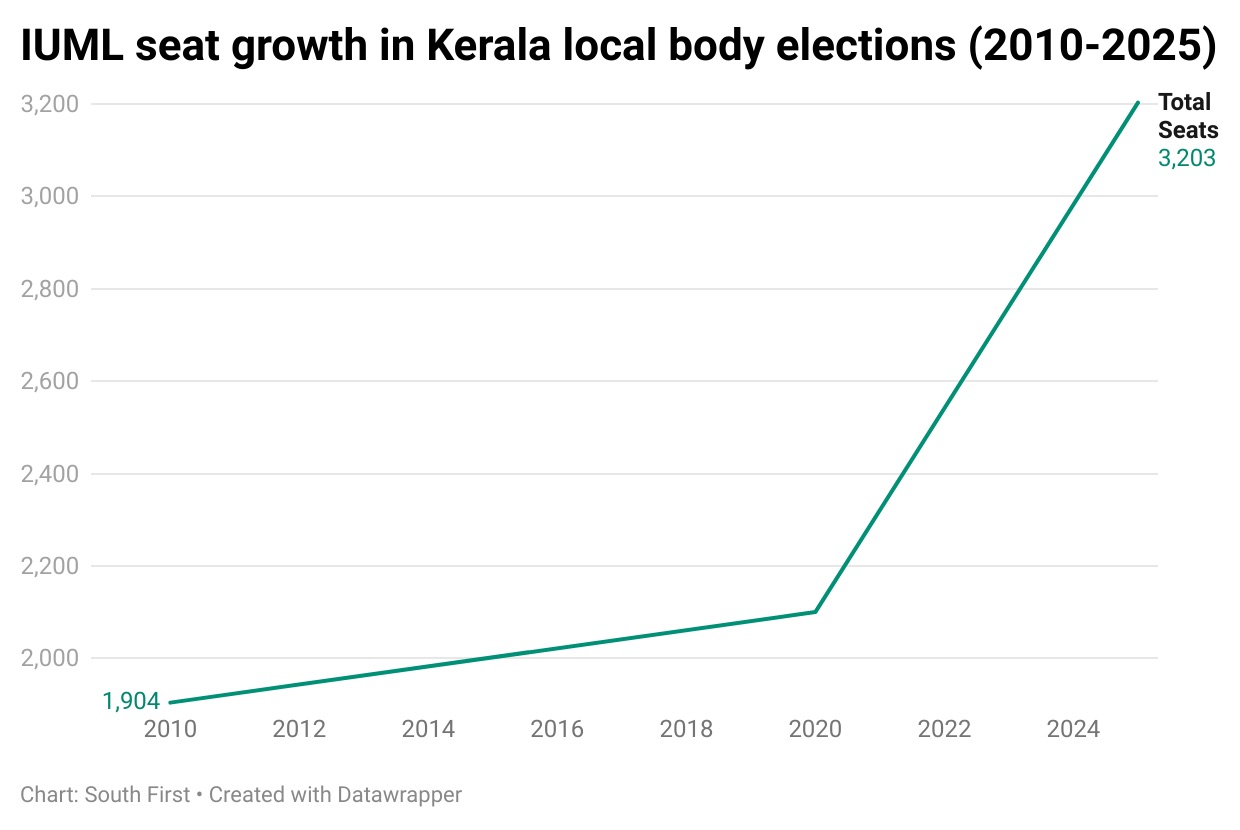
IUML seat growth in Kerala local body elections (2010-2025)
Its ambition can be best understood through its electoral trajectory. In the 2010 local body elections, the party won 1,904 seats, with its influence largely concentrated in Malabar.
A decade later, in 2020, that number rose modestly to just over 2,100. The 2025 elections, however, added nearly 1,000 more seats, including 2,843 secured on the party’s “ladder” symbol.
This tally places the IUML just behind the Congress and the CPI(M) in total seats statewide. The party won 2,248 grama panchayat seats, 300 block panchayat seats, 51 district panchayat seats, 568 municipal seats and 36 corporation seats.
Most notably, the IUML overtook the CPI in vote share, securing 53,69,745 votes (9.77 percent), while the CPI polled 30,66,476 votes (5.58 percent).
The IUML dominated its bastion of Malappuram, winning 114 of the district’s 122 local bodies, including all 33 district panchayat seats, in alliance with the UDF. The party also dominated municipalities, block panchayats and village councils across the district.
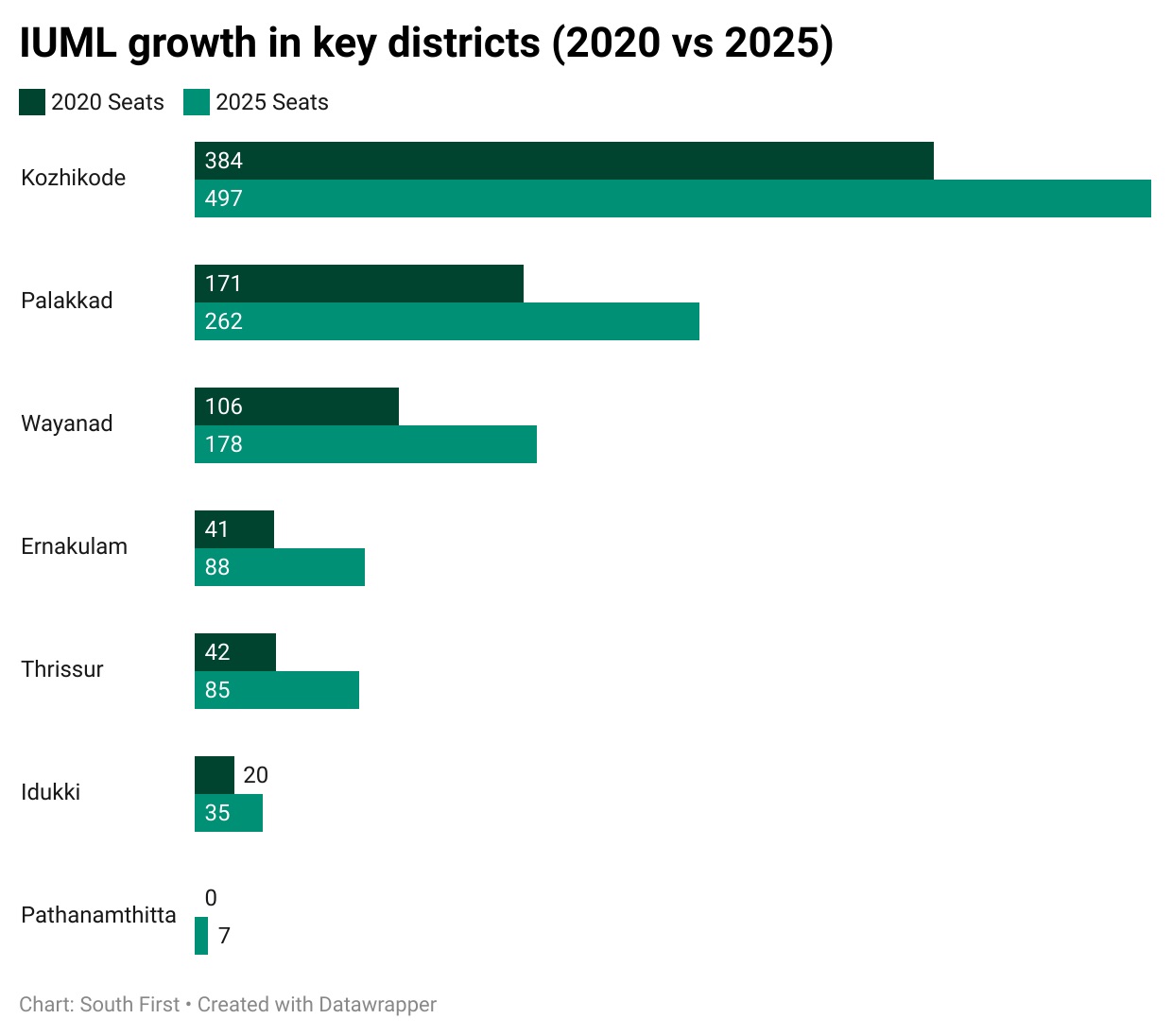
IUML growth in key districts (2020 vs 2025)
Elsewhere across the state, it recorded significant gains.
In Kozhikode, its tally rose from 384 to 497 seats. In Wayanad and Palakkad, it recorded substantial gains, from 106 to 178 seats and from 171 to 262 seats respectively. In districts such as Thrissur and Ernakulam, its presence more than doubled, from 42 to 85 seats and from 41 to 88 seats respectively, while in Idukki it rose from 20 to 35 seats.
Pathanamthitta, where the IUML had no representation earlier, returned seven members this time.
Across south Kerala alone, the party now has 285 elected representatives in panchayats, municipalities and corporations.
Several non-Muslim candidates, including Christians, were elected on the IUML symbol, an outcome party leaders cite as evidence of its widening social base.
Perhaps the clearest marker of the IUML’s enhanced stature is its emergence as a key stakeholder in the Kochi Corporation, one of Kerala’s most politically consequential urban bodies.
For the first time, the party has translated electoral presence into tangible power-sharing leverage in Kochi’s civic administration.
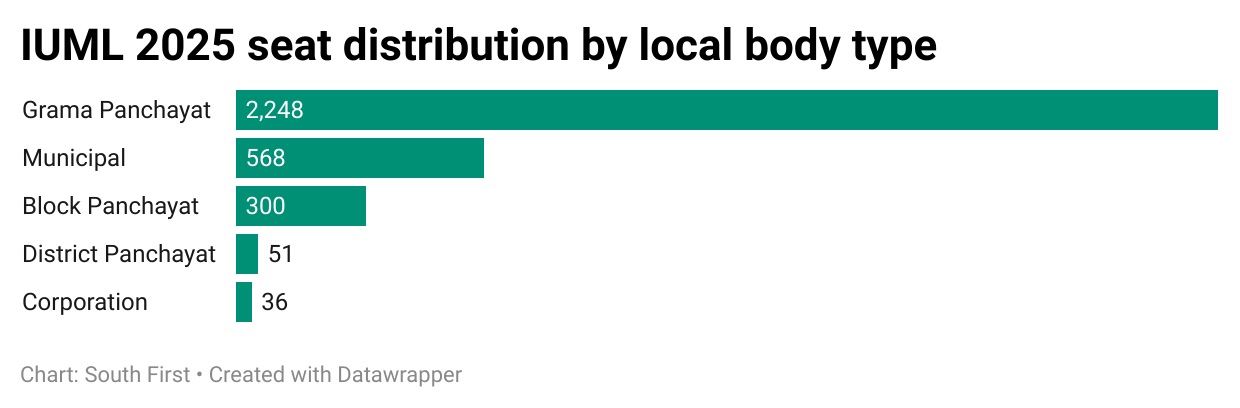
IUML 2025 seat distribution by local body type
IMUL leaders had expressed strong displeasure over the Ernakulam DCC’s initial decision to announce two Congress candidates for a split-term deputy mayorship without consulting allies.
The matter was escalated to the UDF state leadership, prompting direct intervention by senior leaders, including IUML national general secretary PK Kunhalikutty and Leader of the Opposition VD Satheesan.
After days of tension within the UDF, the Congress agreed to allocate a one-year deputy mayor term to the IUML. Deputy Mayor TK Ashraf will assume office under the revised arrangement, with the Congress nominee’s tenure curtailed to accommodate the ally.
The choice of Ashraf is politically significant.
A five-time councillor, he had parted ways with the IUML in 2020 and won as an independent, later aligning with the LDF and serving as health standing committee chairman.
His return to the IUML fold ahead of the 2025 polls, followed by a victory from Kaloor North, a seat outside his traditional West Kochi base, symbolises the party’s pragmatic approach to consolidating urban influence.
Growing minority unease with the CPI(M) offered a crucial opportunity for the IUML’s expansion. According to party leaders, the Left’s political messaging underwent a noticeable shift after the 2024 Lok Sabha elections, moving away from minority outreach towards appeals aimed at consolidating majority sentiments.
“What aided us was the fact that the LDF changed its strategy after the Parliament elections,” Randathani said, adding that this shift backfired badly in Malabar.
He also pointed to controversies that increased mistrust, including remarks allegedly linking Malappuram to gold smuggling and the CPI(M)’s stand on the PM SHRI project.
“These positions created the impression of a hidden agenda,” he said.
Randathani noted that even amid provocative statements by public figures, the IUML chose restraint.
“Despite the nature of the comments, we responded in a mature way,” he said, adding that the party’s handling of sensitive issues, including the Munambam waqf land dispute, was widely appreciated.
IUML leaders insist the party’s growth is a result of sustained organisational work. State General Secretary PMA Salam credited early groundwork and disciplined candidate selection for the results.
“In the past five years alone, we have increased our tally by nearly 1,000 seats,” Salam said, pointing out that the party won around 80% of the seats it contested in southern districts. “No other party has such a record.”
The IUML has also placed renewed emphasis on youth and women.
Party President Syed Sadikali Shihab Thangal said he was particularly encouraged by the number of educated women elected on the IUML ticket, describing it as a reflection of the party’s long-standing commitment to social empowerment.
The local body election results underscore a subtle but consequential shift in Kerala’s political balance. The IUML has evolved from a region-specific ally into a statewide force with urban relevance, expanded social reach and enhanced negotiating power within the UDF.
As the state heads towards the 2026 Assembly elections, the IUML is no longer a peripheral player in Kerala politics, but a central actor that allies and rivals can no longer afford to ignore.
(Edited by Dese Gowda)


