

Published Apr 08, 2026 | 7:00 AM ⚊ Updated Apr 08, 2026 | 7:00 AM

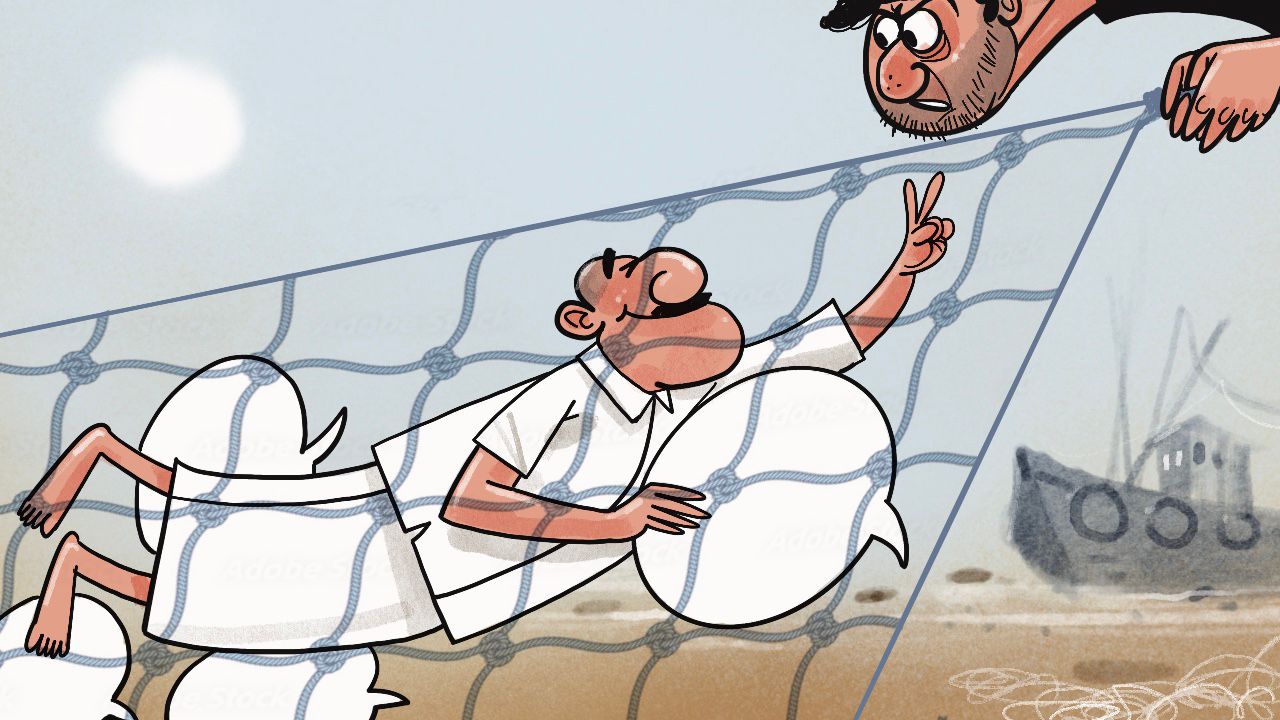
Fisherfolk communities Kerala.
Synopsis: As Kerala is set to vote on 9 April, the votes of the fisherfolk communities are crucial for all three fronts. Across nine coastal districts spreading across the 590-kilometre coastline, nearly 10.5 lakh fisherfolk are weighing their choices. In coastal Kerala, elections are rarely about ideology alone. They are shaped by memory: Of promises kept, and more often, promises forgotten.
The sea is never still. And along Kerala’s long, restless coastline, neither are the people who depend on it.
As the state heads into the 9 April Assembly elections, the conversations in fishing hamlets — from Thiruvananthapuram to Kasaragod — are not about ideology or rhetoric. They are about water to drink, fish to catch and land that doesn’t disappear overnight.
Across nine coastal districts — Thiruvananthapuram, Kollam, Alappuzha, Ernakulam, Thrissur, Malappuram, Kozhikode, Kannur and Kasaragod — spreading across the 590-kilometre coastline, nearly 10.5 lakh fisherfolk are weighing their choices with less than 48 hours left for the polls.
Not as a single bloc, but as a fragmented, pragmatic electorate that knows its power in a state where margins are often wafer-thin.
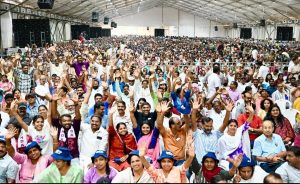
Members of the Dheevara community during the Golden Jubilee Sangamam of the Akhila Kerala Dheevara Sabha in Ernakulam, attended by Narendra Modi.
The idea of a unified “fisherfolk vote” in Kerala doesn’t quite hold up on the ground.
Latin Catholic communities dominate much of the southern and central coast, their choices often shaped by parish discussions and Church positions. In the North, Muslim fisher families tend to lean towards the Indian Union Muslim League (IUML).
Among the Dheevara community — Hindu fisherfolk — there has been a visible shift in recent years, with sections warming to the BJP’s outreach.
Yet, these lines blur when survival is at stake.
However, if there is one thread tying them together, it is this: loyalty is conditional.
“We don’t vote for a party forever,” Lincy, a fish vendor from Anchuthengu in Thiruvananthapuram, told South First. “We vote for whoever understands our problems at that time. If they stop listening, we change.”
This fluidity makes coastal constituencies unpredictable — and intensely contested.
A parish committee member in coastal Ernakulam put it plainly: “People here listen to everyone. But in the end, they ask one question — who actually did something when we needed it?”
Union networks and Church structures still matter. In places like Vypeen and Chellanam in the district, a few thousand votes — mobilised quietly — can tilt an entire constituency. But this time, there is visible hesitation.
No one is committing too early.
The ruling LDF, now seeking a third consecutive term, points to a decade of welfare interventions.
Housing schemes like “Punargeham” have relocated families from erosion-prone zones. Insurance coverage has doubled. Fishing harbours — from Koyilandy in Kozhikode to Thanur in Malappuram — have been upgraded or newly built. Budget allocations continue to highlight fisheries as a priority sector.
On paper, the progress is visible.
In parts of Alappuzha, families who once feared monsoon tides now live in concrete homes set back from the sea. In Ernakulam district, harbour improvements have eased docking for some mechanised boats.
Nevertheless, these gains feel uneven for many.
“Yes. The house is there,” Marykutty, who moved under a rehabilitation scheme, told South First. “But our work is here, near the shore. Where do we keep our boats? How do we go back and forth every day?”
It’s a question that surfaces repeatedly — development that doesn’t always align with livelihood.
Beneath the welfare narrative lies a long list of unresolved issues, many of them festering for years; fuel remains a major flashpoint.
Traditional fishers receive subsidised kerosene, but the quantity barely covers a single trip. Mechanised boat operators struggle with high licence fees and mounting operational costs.
“There are days we don’t go out,” said a fisherman from Kollam. “Not because the sea is rough, but because diesel is too expensive.”
Regulation is another sore point. The continued use of banned nets — despite repeated protests — has angered traditional fishers, who say it is destroying juvenile fish stocks.
“They’re fine people,” one union member told South First, “but they don’t stop the practice. What is the point?”
Then there are the middlemen. With limited access to formal credit, many fishers still depend on private financiers who take a cut of the catch. “You catch the fish,” said a fisherman from Poovar, “but someone else decides your price.”
If there is one issue that cuts across districts, religion, and politics, it is the sea itself. Fishermen speak of it in uneasy terms now.
“The sea is not the same,” Rahman, a fisherman from Vizhinjam, told South First. “Earlier, we could predict it. Now, even elders cannot say what will happen.”
Fishing seasons have shrunk. In some stretches, viable fishing days have dropped to just three or four months a year. Catches have declined, forcing longer trips and higher fuel costs.
Climate change is often cited, but for those on the coast, it is less a concept and more a daily disruption.
“You go out hoping for a catch,” said Babu from Kollam. “Sometimes you come back with nothing. But the diesel money is already spent.”
Coastal erosion continues to eat into homes and livelihoods. Seawalls offer partial protection, but many stretches remain vulnerable. In Chellanam, families still recount nights when waves entered their homes without warning.
Drinking water scarcity adds another layer of hardship. In some coastal pockets, families buy water daily — an expense that cuts into already unstable incomes.
Few issues capture the community’s frustration like Muthalapozhi Harbour in Thiruvananthapuram.
Intended as a functional fishing harbour, it has instead become synonymous with danger. Sandbars at the river mouth make navigation treacherous, leading to frequent accidents.
“We go out with fear,” said a young fisherman from Chirayinkeezhu. “Sometimes we don’t know if we’ll come back.”
Despite repeated promises of dredging and safety measures, progress has been slow.
Further South, Vizhinjam Port stands as one of the state’s most ambitious infrastructure projects. To policymakers, it represents economic transformation. To many fisher families nearby, it carries a different meaning.
“Development is good,” Selvi, who lives near Kovalam, told South First. “But why does it always take something from us?”
Displacement, shifting coastlines, and uncertain livelihoods have left sections of the community uneasy. Promised jobs, they say, have not materialised in the numbers expected.
Meanwhile, basic issues persist. “We still buy drinking water,” Selvi adds. “What kind of development is this?”
Despite the frustration, there is no sweeping anti-incumbency wave — at least not yet. What exists instead is a quiet, calculating mood.
Fisher unions have met representatives from all three fronts. Assurances have been made. Promises have been noted.
But there is no blanket endorsement.
Jackson Pollayil of the Kerala Swathanthra Matsya Thozhilali Federation summed up the approach: “We are not backing any party. We will support those who stood with us — not just now, but over the last five years.”
District units, he said, will decide based on local experience.
That means sitting MLAs could benefit — or suffer — depending on their track record.
In coastal Kerala, elections are rarely about ideology alone. They are shaped by memory: Of promises kept, and more often, promises forgotten.
“There was some benefit earlier,” Valerian, a union member from the Thiruvananthapuram coast, told South First. “But in the last few years, we feel ignored.”
That sentiment, repeated in different forms across districts, could influence outcomes in closely contested seats.
That is where comparisons between J Mercykutty Amma and Saji Cherian quietly emerge in conversations among fisherfolk. Ask around in harbours, the difference is often described in personal terms rather than policy.
“With Mercykutty Amma, we could walk in and speak,” said a boat owner from the Alappuzha coast. “Even if she couldn’t solve everything immediately, she would hear us out. That mattered.”
Her tenure as fisheries minister in the LDF’s first term is still recalled as a period when communication felt more direct. Union leaders say meetings were more frequent, and grievances — ranging from fuel subsidies to safety concerns — were at least acknowledged without delay.
“She knew the pulse of the coastal belt,” said a veteran union member from Kollam. “There was a sense that someone was paying attention.”
The contrast, they say, became sharper in the LDF’s second term.
“With Saji Cherian, it is not the same,” remarks a federation representative from Ernakulam district, choosing his words carefully. “We don’t feel that same openness. Many of us stopped going to the office because we felt nothing would move.”
The criticism is not always loud, but it is persistent. Several union leaders describe a growing distance — appointments harder to secure, follow-ups slower, and responses less assured.
“It’s not just about decisions,” said Joseph, a fisherman from Chellanam. “It’s about whether the minister understands our urgency.”
To be fair, some within the government point out that administrative pressures and the scale of issues have increased in recent years. Coastal challenges today — climate change, declining fish stocks, and policy conflicts — are far more complex than before.
Yet, on the ground, perception often outweighs explanation. “In our life, access is everything,” said Lincy, a union leader. “If we can’t reach the minister, how will our problems reach the government?”
Concerns are not limited to local governance. Proposed central policies — ranging from offshore mining to new fishing regulations — have sparked anxiety among fisher communities.
Areas like Kollam Parappu, known for rich marine biodiversity, are seen as vulnerable to industrial exploitation.
“We are not against development,” says a union member from Kozhikode. “But if big companies take over the sea, what will we do?”
Across the nine districts, the demands are strikingly consistent,
There is also growing concern over central policies, particularly those related to offshore mining and deep-sea fishing, which many fear could marginalise traditional fishers.
For Kerala’s fisherfolk, the election is not a moment of ideology. It is a reckoning drawn from lived days — of tides that no longer behave, of catches that don’t come, of promises that arrive late or not at all.
They are not looking for grand assurances. They are measuring who stood by them when the sea turned rough, who answered when they called, who understood that a missed fishing day is not an inconvenience but a loss that lingers.
For them, the sea dictates everything: when to work, when to wait, and increasingly, when to worry.
(Edited by Muhammed Fazil.)


