

Published Jan 15, 2026 | 9:00 AM ⚊ Updated Jan 15, 2026 | 10:25 AM

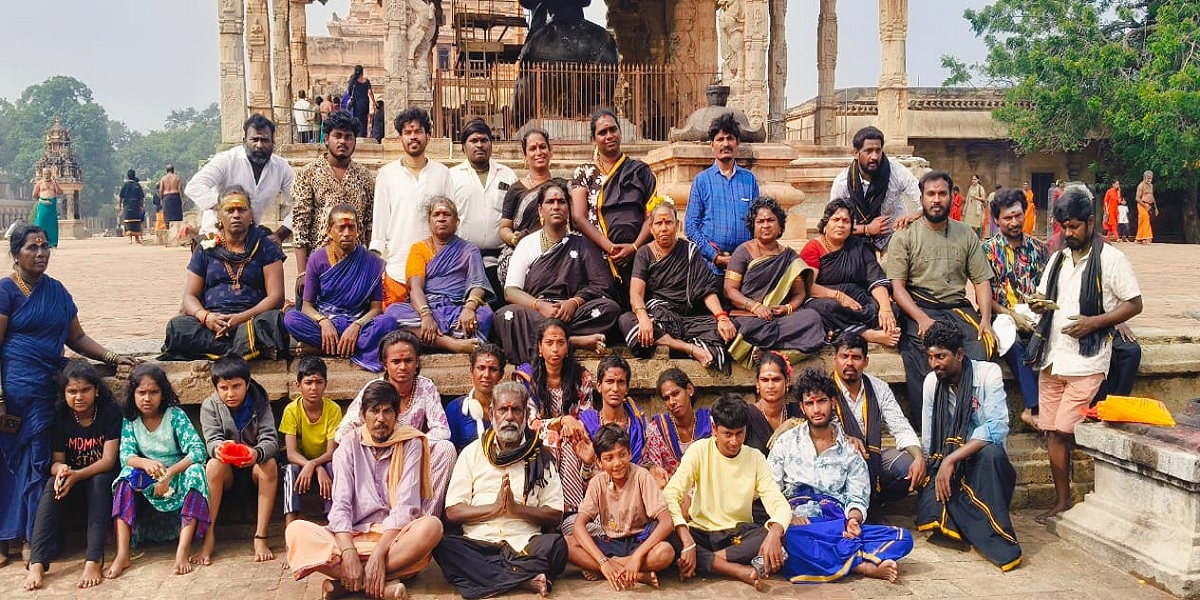
Anusree and other pilgrims posed for a photograph before leaving Chennai for Sabarimala.
Synopsis: A police officer insisted that transwomen were not allowed at the hill shrine. Some women officers, however, said that the pilgrims were not women but transgender persons, and there was no restriction on transgender pilgrims visiting Sabarimala. But the officer was allegedly adamant.
Fifteen transwomen from Chennai and Hyderabad returned all the way home from Pamba in Kerala, disappointed and scared, wondering about their unknown link with the misappropriation of gold at the Sabarimala Sree Dharma Sastha Temple.
Anusree, a member of the Tamil Nadu Transgender Welfare Board, was one among them. The experience left her terrified, so the transwoman kept mum till she reached Chennai, her hometown.
For her, the beginning of the planned pilgrimage was not as fearsome as the end. She had observed the 41-day vrutham — or the spiritual purification ritual — before embarking on the pilgrimage with 84 others, which also included 10 transpersons, including Anusree.
The journey was eventless until they reached Pamba, the base camp of Sabarimala, in the Pathanamthitta district. After the ritualistic holy dip in the River Pamba, and offering prayers at the temple dedicated to Lord Ganapathy, the remover of obstacles.
Chants praising Ayyappa reverberated as the group proceeded towards the check-post on Saturday, 10 January.
The check-post was erected primarily to prevent women of menstruating age, defined as those aged between 10 and 50, from proceeding further to the shrine of the celibate god.
The group was excited as they saw the imposing Neelimala rising before them. Five kilometres more, and they will be at Sannidhanam, the abode of Lord Ayyappa. The excitement, however, was short-lived.
Police officers manning the checkpoint stopped them. Anusree and the other transwomen were not allowed, they told the pilgrims.
Little did the transwomen then know that they would soon be dragged through more than eight harrowing hours.
The police herded them to the Pamba station, where they were seated near the toilets. The pilgrims kept pleading with the officers to allow them to proceed, but their prayers fell on deaf ears.
At the police station, Anusree and others from Chennai saw a group of five transwomen from Hyderabad, silent as if they had succumbed to fate. They, too, have been prevented from trekking to Sabarimala.
Of the 10 transwomen from Chennai, five were aged above 50, and two had not undergone gender-affirming surgeries.
They produced their Aadhaar and transgender identity cards, but the police officers refused to accept their request.
”Some women officers at the check post tried to intervene. They told the officer that we are not women but transgender persons, and that there is no restriction on transgender pilgrims visiting Sabarimala. But he was adamant” Anusree told South First over the phone from Chennai.
She said the officer took them to the station, saying a gynaecologist would examine them before making any decision on their pilgrimage.
”It was humiliating, but still we were ready to go to the Pamba police station,” she said.
What followed at the police station was ”heartbreaking” Anusree recalled.
The transwomen were made to sit near the washroom area and were denied refreshments for hours. Even basic requests for a cup of tea were ignored. Their mobile phones, which had been taken by the police, were not returned despite repeated requests.
”No gynaecologist came. Even after facing insults, we were prepared for a medical examination, despite carrying valid identity cards,” she said.
Later, a senior police officer arrived and spoke to them about the recent controversy surrounding the gold theft at Sabarimala.
”I couldn’t understand why that was being told to us. We were not there to steal anything. We came with devotion to offer prayers to Lord Ayyappa. But we were treated with suspicion,” Anusree added.
Even as the transwomen were kept at the police station, others in the group were allowed to proceed to Sabarimala.
Advocate Padma Lakshmi, a transgender lawyer at the Kerala High Court, criticised the police action against the transwomen pilgrims.
She stated that there was no legal barrier to women’s entry at Sabarimala, as the Supreme Court’s 2018 verdict had struck down the ban on women aged 10–50 as unconstitutional.
Though review petitions are pending, the verdict has not been stayed, and women have entered the shrine since then, including activists, without legal obstruction.
”If women are legally allowed to enter, on what grounds are transwomen being denied entry?” she asked.
Lakshmi also noted that Kerala had, over the years, introduced several transgender-friendly policies, including guidelines on detention and treatment by law enforcement.
”That progress seems meaningless if police officers on the ground are unaware of the law or unwilling to update themselves. Until that changes, such violations will continue,” she said.
Transgender activist Fred R from Tamil Nadu echoed similar concerns. He said all pilgrims carried valid transgender identity cards.
Fred explained that transgender women in India can legally identify as ”Female” on documents such as Aadhaar, PAN, passport and voter ID, and can also obtain a separate transgender identity certificate for welfare purposes.
“Recent court rulings have affirmed the legal recognition of trans women as women for protection under the law. Gender identity is based on self-perception, and transgender persons can obtain male/female id certificates by producing proof of medical intervention in the National Portal for Transgender Persons, as laid out under the Transgender Persons(Protection of Rights) Act, 2019, which is the law of the land. This law was formulated to prevent discrimination faced by the transgender communities in all spheres of life. Yet we transgender communities face discrimination day in and day out,” he told South First.
Pamba Police Circle Inspector CK Manoj was reportedly present at the station when the incident occurred. He justified the action, citing the ongoing legal debate around women’s entry to Sabarimala.
”The case regarding women’s entry is still under consideration. Since they appear like women, allowing them could create issues among other devotees. We stopped them to prevent further problems,” he told South First.
When asked why transwomen who do not menstruate were being linked to the women’s entry controversy, the officer continued to rely on the unresolved status of the Sabarimala case.
Meanwhile, the Kerala State Transgender Crisis Intervention Cell stepped in on the same day. Anusree spoke to Arun S Nair, IAS, the Additional District Magistrate (ADM) at Sabarimala.
However, no resolution was offered. The group was instead asked to leave the area.
In the last week of December 2025, the Supreme Court indicated it was considering the formation of a nine-judge Constitution Bench to revisit the issue. Chief Justice Surya Kant, in an interview, said the proposal was under examination, though no timeline has been fixed.
The bench is expected to look at broader constitutional questions involving religious freedom, gender equality, and the extent of judicial intervention in religious practices.
Issues such as women’s entry into mosques may also come under its ambit.
A similar nine-judge bench was constituted in 2019 under then Chief Justice SA Bobde, with hearings beginning in January 2020. However, the retirement of seven judges stalled the process.
With Justice Surya Kant now serving as Chief Justice, the bench is likely to be revived. The Sabarimala case itself dates back to 1990, when the Kerala High Court treated a letter by S Mahendran as a public interest litigation, eventually leading to the landmark 2018 verdict allowing women’s entry.
At the police station in Pamba, none of these mattered.
”Police officers from Pamba accompanied us to the Ernakulam KSRTC bus stand to ensure that we didn’t return. We agreed to go back, so that no further trouble would fall on the others in our group” Anusree said.
During the journey back, she was too scared to speak to South First, fearing possible reprisal. She spoke only after reaching Chennai.
The Sabarimala temple is set to close on 20 January. Yet, Anusree and her friends continue to observe the vrutham, holding on to faith and hope that they will be allowed a moment of darshan at the Sanctum Santorum, now swirling in the vortex of a misappropriation controversy.
(Edited by Majnu Babu).


