

Published Aug 22, 2026 | 10:00 AM ⚊ Updated Aug 22, 2026 | 10:00 AM

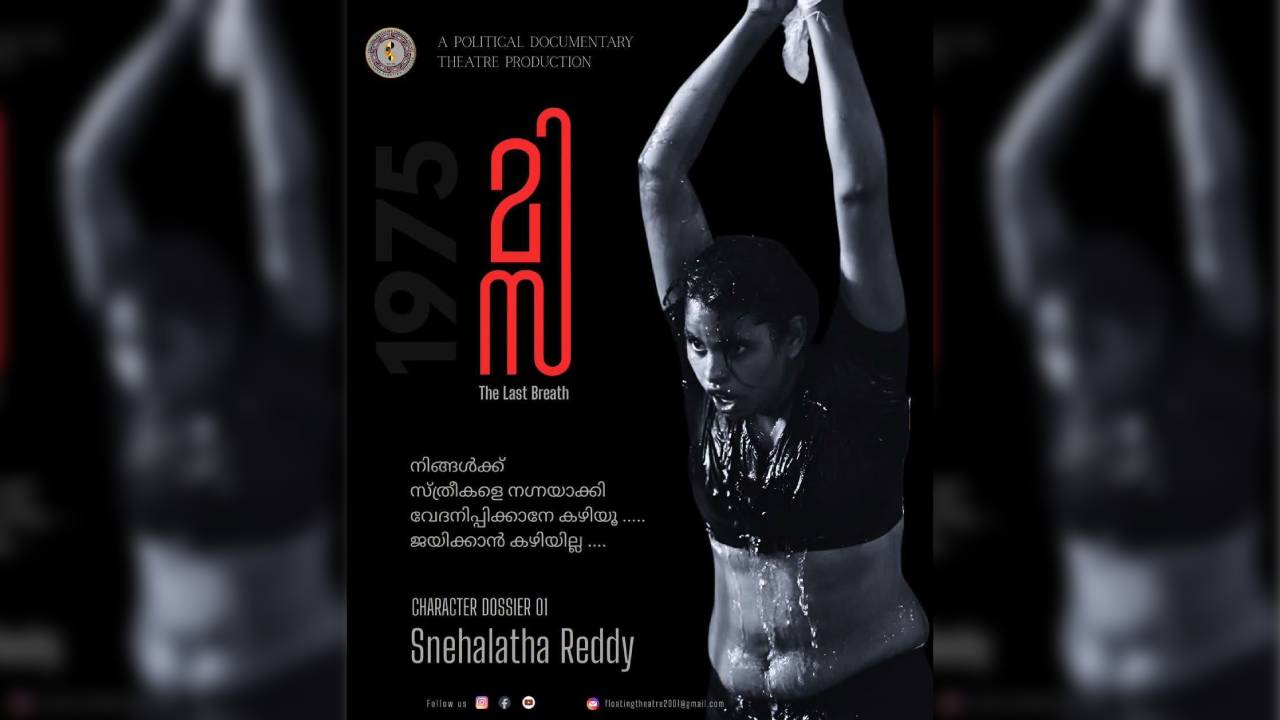
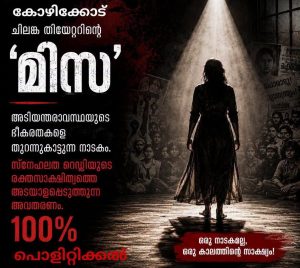
A poster of the play, MISA: The Last Breath.

Synopsis: A play on Emergency-era repression has sparked controversy in Keralam after a torture scene depicting theatre artist Snehalatha Reddy drew criticism over nudity and obscenity. While a viral clip triggered the backlash, the makers say it stripped the scene of its historical context, turning the debate into a wider argument over artistic freedom, theatre and public morality.
A play staged to portray the brutality of the Emergency has become the subject of a controversy over nudity, obscenity and artistic freedom in Keralam. It also revived memories of Snehalatha Reddy, a woman who paid the ultimate price for standing up to state repression.
The controversy erupted after Kozhikode-based Chilanga Floating Theatre staged ‘MISA: The Last Breath‘, based on the life and incarceration of actor and theatre artist Snehalatha Reddy, at the 16th State Conference of the Democratic Youth Federation of India (DYFI) in Thrissur.
The debate centred on a short video clip from the performance that was widely circulated on social media.
Critics questioned the appearance of a scantily clothed woman and alleged nudity and the staging of such a scene at a major political conference. Those associated with the production said the clip did not convey the scene’s context and had led to the play being discussed mainly in terms of obscenity and public morality.
The controversy has also brought artistic freedom and the standards expected of performances in public spaces into the discussion.
The DYFI state leadership has said it will legally and politically counter what it described as propaganda against the play. The organisation has decided to stage ‘MISA: The Last Breath‘ again on Saturday, 22 August, at the main venue of its state conference.
Also Read: Why does the powerful Bishops Council want a ban on Kakkukali
The drama revisits the life of Snehalatha Reddy, the Kannada actor and theatre personality who died after months of detention.
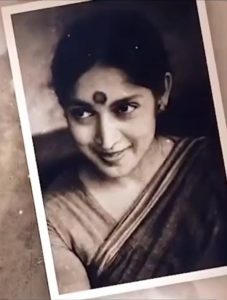
Snehalatha Reddy
Titled “MISA: The Last Breath,” the production drew its name from the Maintenance of Internal Security Act (MISA), the law extensively used during the Emergency to detain political opponents and dissenters without trial.
Theatre organisers described the production as a “character dossier” on Reddy, focusing on her arrest, imprisonment and the physical and mental trauma she endured in custody.
According to the group, the play centred on a woman who refused to give up her opposition to the Emergency despite the punishment inflicted on her.
Andhra Pradesh-born Reddy was an actor, theatre artist, producer, director and social activist.
She was arrested in May 1976 in connection with the Baroda dynamite case and detained under MISA. She was held at the Bangalore Central Jail, where she remained without trial for several months.
“She was a Kannada actress. But when Indira Gandhi declared the Emergency in 1975, Snehalatha did not think twice before taking to the streets against the decision,” an organiser said. “It is hard to believe that Snehalatha died at the age of 44. Her detention, including virtually eight months of solitary confinement, ruined her already frail health.”
Reddy had also played a significant role in the theatre movement in Madras (Chennai). After she and her family settled in Bangalore (Bengaluru), she became closely associated with the city’s artistic and political circles.
Her experiences in jail were later recorded in ‘A Prison Diary.’
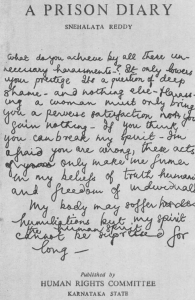
Snehalatha Reddy on the harassment she faced in jail.
In one entry, reproduced in a publication compiled by the Human Rights Committee- Karnataka State, she wrote about the humiliation faced by women prisoners.
“As soon as a woman comes in, she is stripped in front of everyone else. When a human being is sentenced, they are punished enough. Must the human body be degraded and humiliated as well? Who is responsible for these perverse methods?”
Reddy’s health deteriorated during her imprisonment. She suffered severe asthma and, on two occasions, reportedly went into an asthmatic coma.
She was eventually released on parole in January 1977 after her health had worsened considerably. Five days after her release, Reddy died at the age of 44 from complications linked to chronic asthma and a serious lung infection.
The Emergency, declared on 25 June 1975, was lifted on 21 March 1977. Reddy did not live to see its end.
For the theatre group, “MISA: The Last Breath” tells the story of a woman imprisoned for political dissent, at a high personal cost. The production uses her life, her prison experiences and her own diary writings to revisit that period.
Also Read: BBC documentary on PM Modi screened across Kerala
It was a scene depicting the torture meted out to Reddy which triggered the controversy after a short video—showing only a small part of the play— from the performance circulated widely on social media.
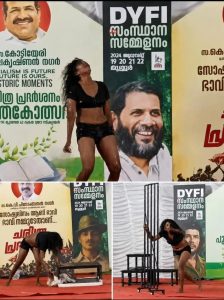
Screengrabs from the clip that triggered calls of nudity and obscenity.
The footage drew criticism over alleged nudity, obscenity and indecency, with some questioning the staging of such a scene at a major political conference. Those who objected said the woman artist appeared with limited clothing.
Those associated with the production, however, said the viral clip did not represent the scene in its entirety and had removed it from the larger narrative of the play.
They pointed out that the full sequence places the scene within the atmosphere of the Emergency, when questioning authority, writing poetry and performing theatre could be treated as acts of conspiracy. The torture depicted in the play forms part of its portrayal of Reddy’s experience of state repression during the period.
The production team said the play had previously been performed at several venues without attracting similar controversy.
DYFI state secretary VK Sanoj defended the play and said the criticism of the isolated scene should not obscure the history it portrayed.
“Snehalata’s life was one of severe government persecution during the Emergency for being an artist and asking questions. The play ‘MISA‘ tells the story of that Snehalata,” Sanoj said.
Sanoj also criticised those who, he said, had circulated only one scene and viewed it through the lens of morality.
“Those who cut out only one scene and look at it through the lens of morality are trying to hide and forget the intense suffering experienced by people during the dark days of the Emergency,” he said.
Chinoos Chilanka, who portrayed Reddy in the play, also defended the production. She said the criticism would not deter artists or the theatre medium.
Also Read: Vandalism of ‘obscene’ art at Kochi gallery sparks clash over artistic freedom
Artists and writers came out in support of the play.
DYFI said it will stage Misa: The Last Breath once again on Saturday.
Actor Joy Mathew said drama and its forms have evolved, arguing that the human body has long been used as an important medium in theatre.
Referring to Polish theatre director and dramatic theorist Jerzy Grotowski’s concept of “poor theatre”, he said the body itself can be the principal sensory medium of a performance. He also recalled watching a European play in which two actors appeared completely nude. He said nudity in such contexts was dictated by the demands of the performance rather than intended to provoke sexual responses.
At the same time, Mathew said the manner and setting of a performance also matter. He pointed out that staging the play with the images of a martyr and a deceased political leader in the background provided an opportunity for ridicule. A curtain covering it or a different backdrop, he said, could have made the presentation more appropriate.
The background had the portraits of Bhagat Singh, Che Guevara and CPI(M)’s former state secretary, the late Kodiyeri Balakrishnan, put up by DYFI. A portrait of DYFI worker Pushpan, who was injured in the Koothuparamba police firing near Kannur on 25 November 1994. He had been bedridden ever since the police firing and passed away in September 2024.
Writer Smitha Sailesh also defended the scene, saying an actor’s body is a tool of artistic expression and that theatre cannot be judged merely by the appearance of the performer. Citing examples from Indian cinema and theatre, she said actors have used nudity or minimal clothing when required by their characters.
Sailesh also placed the scene in the play’s political and historical context, which represented the Emergency period. She referred to episodes from the history of women’s struggles, including the protest by women in Manipur who publicly stripped in protest. She argued that the scene should be viewed in connection with the history being portrayed.
She said the female body on stage cannot be viewed solely through a sexual or moral lens.
Sailesh also criticised those who focused on a single scene without considering the play’s political context.
“Some things cannot be measured by moral sense. Some things should be measured by historical sense and social sense,” Sailesh said.
(Edited by Majnu Babu).



