

Published Jan 23, 2026 | 4:37 PM ⚊ Updated Jan 23, 2026 | 4:37 PM

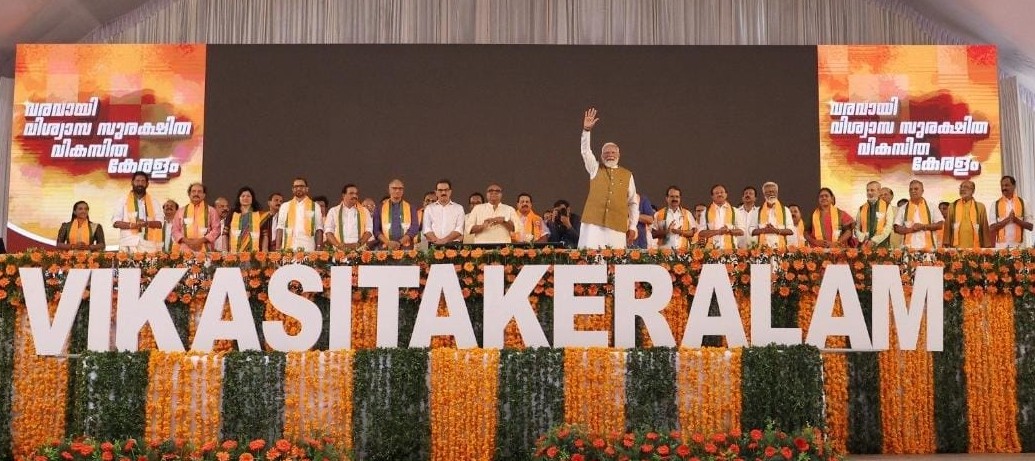
Prime Minister Narendra Modi greets the audience at a BJP rally in Thiruvananthapuram on Friday, 23 January.
Synopsis: Addressing a BJP rally, Modi described the party’s victory in the Thiruvananthapuram Corporation election as “legendary” and “extraordinary,” insisting that its political significance extended far beyond the city limits.
Prime Minister Narendra Modi on Friday, 23 January, set the BJP ‘s poll campaign machinery rolling in Kerala, saying a new side, the BJP-led NDA, will end the state’s political duopoly.
Terming the BJP’s recent victory at the Thiruvananthapuram Municipal Corporation election as the first visible tremor of a larger political shift ahead of the 2026 Assembly polls, Modi said, “what has not changed will now change.”
His target was unmistakably Kerala’s long-entrenched bipolar politics dominated by the Left Democratic Front (LDF) and the United Democratic Front (UDF).
For seven decades, he said, these two fronts had stalled Kerala’s growth. Now, he argued, a third side—the BJP-led NDA—has emerged as the side of development.
Addressing a BJP rally, Modi described the party’s victory in the Thiruvananthapuram Corporation election as “legendary” and “extraordinary,” insisting that its political significance extended far beyond the city limits.
“The entire country is hearing the ripples of this victory,” he said, thanking voters for placing their faith in BJP and claiming that the win had laid the foundation for the party’s long-term growth in Kerala.
The BJP, which has historically struggled to convert its vote share into power in the state, has been projecting the Thiruvananthapuram win as a launchpad.
Modi repeatedly returned to the idea that major political transformations did not begin with sweeping statewide victories but with small, symbolic breakthroughs that altered perception and confidence.
To underline his point, Modi revisited the BJP’s journey in Gujarat.
Before 1987, he recalled, the party was electorally insignificant, suffering repeated defeats and barely making news. That year, the BJP won the Ahmedabad Municipal Corporation—a modest victory, but one that allowed people to see the party govern.
“People saw how the BJP worked and supported us,” Modi said, tracing the party’s rise from municipal control to state power and then to national dominance.
The “triumphant journey” that began in a Gujarat city, he argued, was now being mirrored in Kerala—starting with Thiruvananthapuram.
By invoking this parallel, Modi sought to normalise the BJP’s incremental approach in the state and position the current moment as a quiet turning point rather than an overnight upheaval.
At the core of Modi’s message was a familiar but locally tailored argument: that Kerala needed a “dual-engine government”—with the same party in power at both the Centre and the state—to unlock development and job creation.
The NDA, he said, has plans to generate employment for youth, but Kerala could benefit fully only if it aligned politically with New Delhi.
Modi spoke of the need for a long-term, 25-year development plan and promised full central support to make Thiruvananthapuram “the best city in the country.”
Flagging off new rail projects, including Amrit Bharat trains, he presented infrastructure expansion as evidence of what alignment with the Centre could deliver.
“This election will change the future of Kerala,” he asserted.
“Till now, the state has seen only two sides: the Left (LDF) and the Right (UDF). Now there will be a third side: development,” he stated.
Modi’s critique of the state’s traditional fronts was unsparing.
Although the LDF and UDF have different symbols, he said, their agenda was effectively the same, marked by corruption, appeasement, and what he called “adjustment politics.”
He cited Tripura and West Bengal as cautionary tales, where the Left ruled for decades before being electorally wiped out.
“In Tripura, the CPI(M) ruled for 30 years. Today they are not even visible. In Bengal, after 35–40 years, they cannot even field candidates,” Modi said, asking why Kerala should believe that endless alternation between the LDF and UDF would produce different results.
For Kerala to be “saved,” he argued, the Left-Right arrangement must end.
Alongside development, Modi placed protection of faith firmly on the BJP’s campaign agenda.
Referring to controversies surrounding Sabarimala, he accused those in power of repeatedly betraying the trust of devotees and alleged corruption linked to temple affairs.
“If the BJP government is formed, all allegations will be investigated,” he said, promising that those who committed wrongdoing would be sent to jail.
Repeating the phrase “Modi’s guarantee,” he vowed to recover money allegedly stolen from cooperative banks and to punish those responsible for financial scams that has hurt ordinary people.
“We will recover money from those who stole,” he said, framing accountability as both a moral and economic imperative.
Modi also sharpened his attack on the Congress, claiming it had lost any coherent development vision.
In one of his most provocative lines, he alleged that the party had turned into a “Muslim-Maoist Congress,” accusing it of embracing both extremist ideology and communal appeasement.
He charged the Congress with turning Kerala into a “communal experiment” and cultivating separatism, warning that the state must be freed from what he described as its grip.
By launching the BJP’s Kerala campaign from Thiruvananthapuram, Modi has signalled a strategy that blends symbolism with persistence.
The message is clear: “the BJP is no longer content with being a peripheral player in the state.”
Instead, it asked voters to view 2026 not as another routine contest between Left and Right, but as a forking in the road.
While there was widespread expectation that Modi would use the party programme to announce a slew of marquee development projects—especially with the state heading into crucial Assembly election —no major announcements were made.
Instead, the Prime Minister struck a familiar campaign chord, underlining the BJP’s broader political messaging rather than unveiling fresh initiatives.
“For a Viksit Bharat, a Viksit Kerala is essential,” he said, reiterating the centrality of Kerala to India’s development journey.
The phrase “Viksitha Keralam” continues to remain one of the BJP’s core campaign pitches as the party gears up for the 2026 Assembly polls, signalling an attempt to frame the election around development and growth—even as concrete project announcements remain elusive for now.
(Edited by Majnu Babu).


