

Published Aug 01, 2025 | 10:53 AM ⚊ Updated Aug 01, 2025 | 10:53 AM

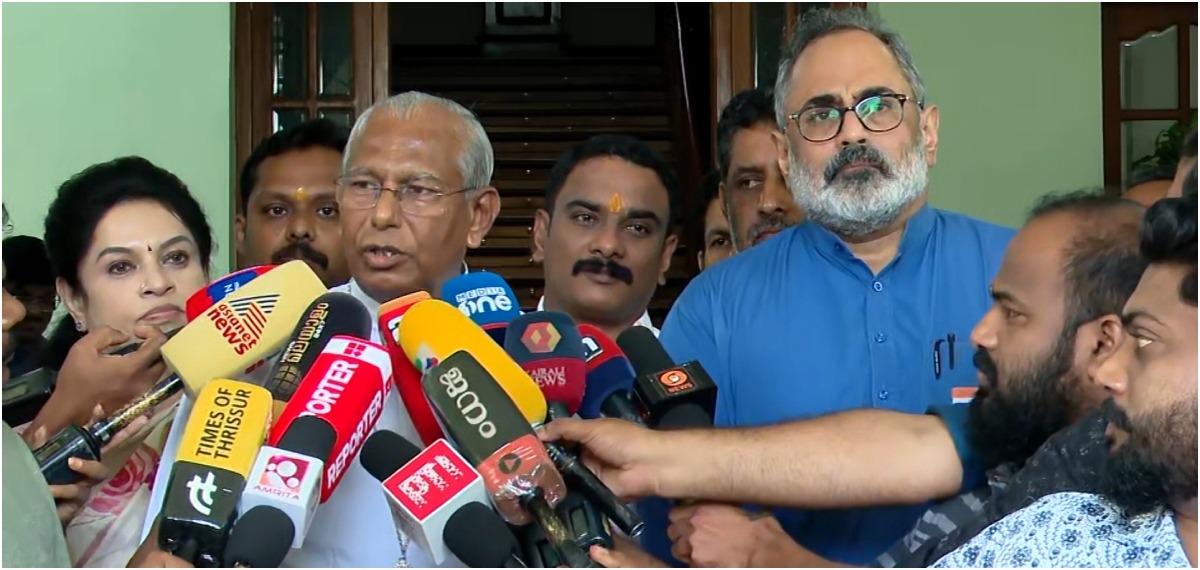
Archbishop Andrews Thazhath speaking to media along with BJP State President Rajeev Chandrashekar.

Synopsis: 21-year-old tribal woman Kamaleshwari Pradhan alleged that Bajrang Dal activists threatened and assaulted her to falsely implicate two Malayali nuns in Chhattisgarh on human trafficking charges.
Adding a fresh twist to the arrest of Malayali nuns in Chhattisgarh on human trafficking charges, 21-year-old tribal woman, Kamaleshwari Pradhan, alleged on Thursday, 31 July, that Bajrang Dal activists threatened and assaulted her to falsely implicate them.
She claimed the police also misrepresented her statement.
Kamaleshwari, a Christian from Narayanpur, said she was travelling voluntarily with the nuns to Agra, with her parents’ consent, en route to a hospital job in Bhopal offering a ₹10,000 salary, food, and lodging.
She said Bajrang Dal members confronted them at Durg railway station and later coerced her at the police station.
Meanwhile, Archbishop Andrews Thazhath, head of the Thrissur Archdiocese and President of the Catholic Bishops Conference of India (CBCI), on Tuesday, termed the arrest of two nuns in Chhattisgarh as a violation of constitutional rights and religious freedom.
Kamaleshwari said that she was introduced to the job by church acquaintance Sukhman Mandavi and denied any coercion or trafficking.
The statement came just hours after Union Home Minister Amit Shah assured MPs from Kerala that neither the Union government nor the Chhattisgarh government would oppose the bail plea of two Malayali nuns arrested in the central Indian state.
Shah directed to file new bail applications in the trial court and expressed confidence that bail would be granted within two days.
Speaking to the media after meeting BJP state chief Rajeev Chandrasekhar, Archbishop Thazhath said the nuns should be released without delay and expressed appreciation that Rajeev was the first to respond positively to the issue.
He emphasised that minorities in India deserve justice and security, and expressed hope that the community would be allowed to live freely as Indian citizens without political targeting. He noted with concern the rising attacks on Christians and said he had conveyed these issues to Rajeev.
Commenting on the arrested women, he clarified that they were adults and were travelling for work. He also thanked the media for highlighting the incident and bringing it to public attention.
In response, Rajeev Chandrasekhar said that a bishop had reached out to him a few days ago, and the matter was also brought to the attention of the prime minister. He added that Union Home Minister Amit Shah had also promised appropriate action.
“We do not treat this as a political matter. When people ask for help, we offer it, irrespective of religion, caste, or political background.”Rajeev said.
He also pointed out that states like Jharkhand and Chhattisgarh are sensitive regions in this context.
When the bail plea of the arrested Malayali nuns came up before the Sessions Court, the prosecution supported the Bajrang Dal’s stance against granting bail. The prosecution also backed the Bajrang Dal counsel’s argument that the Sessions Court was not the appropriate forum to hear the case.
The Bajrang Dal lawyer had warned that granting bail could lead to further religious conversions and potential communal unrest. He had also demanded a more thorough investigation into the matter.
Sisters Vandana Francis and Preeta Mary of the Order of the Assisi Sisters of Mary Immaculate were arrested at Chhattigarh’s Durg railway station on 25 July after pro-Hindu Bajrang Dal activists accused them of attempting to take away three women, including a tribal, to Agra for “forced conversion to Christianity”.
Besides the nuns, a tribesman, identified as Sukaman Mandavi, was also arrested. They have been charged with Section 143 of the Bharatiya Nyaya Sanhita (BNS) for trafficking and under Section 4 of the Chhattisgarh Religious Freedom Act, 1968, punishable with imprisonment of up to 10 years and a fine of ₹2 lakh.
(Edited by Muhammed Fazil.)



