


Published Apr 03, 2026 | 1:00 PM ⚊ Updated Apr 03, 2026 | 1:00 PM

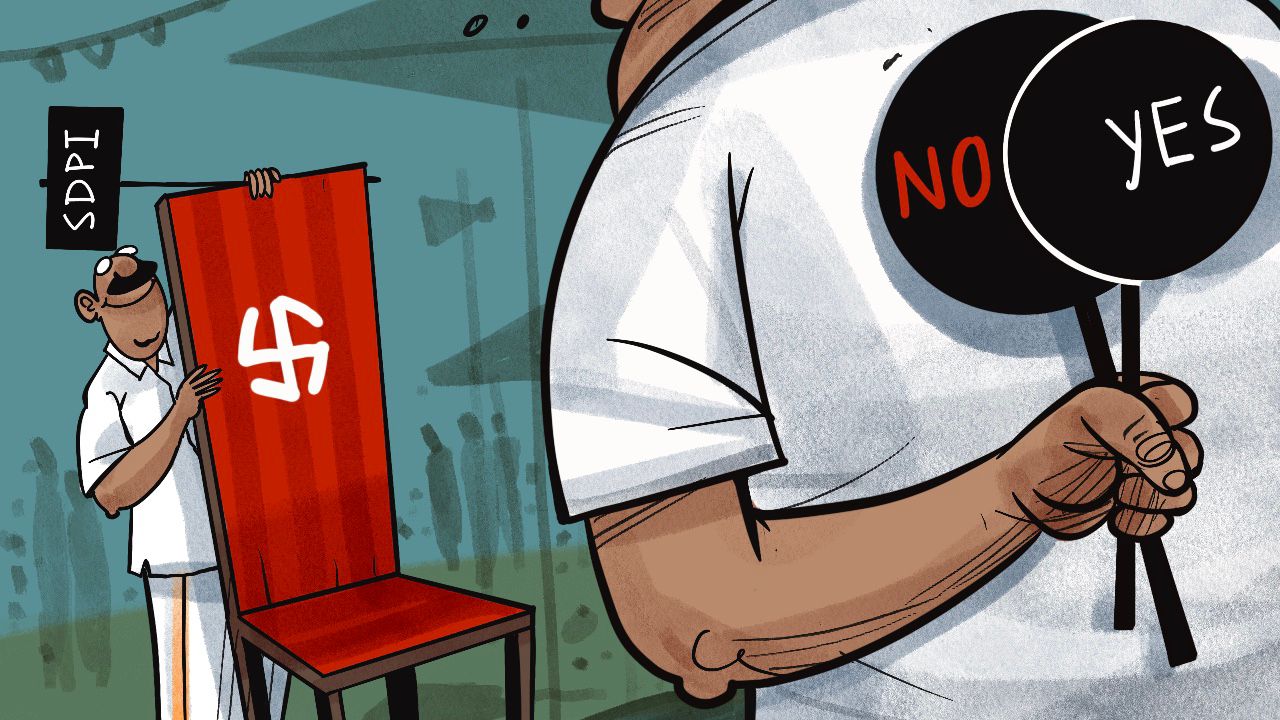
SDPI votes.
Synopsis: SDPI may not be a major player, but its backing matters in Kerala. The LDF is now trapped in the SDPI row, unable to clearly say yes or no to its support. SDPI has already stated that it aims to defeat the BJP and will support other candidates who could help it to achieve its aim. However, ‘others’ are not comfortable in publicly accepting SDPI’s support, but surely hope for its backing.
The Socialist Democratic Party of India (SDPI) may not be a major player in Kerala politics, but it has often emerged as a game-changer in several constituencies.
As the political wing of the banned Popular Front of India (PFI), most major parties in Kerala publicly keep a distance from SDPI.
But in reality, many parties are often accused of keeping their backdoors open to SDPI when electoral calculations demand it. Its support is crucial in some constituencies, at least for spoiling the opponent’s game plan. Places like Malappuram, Kozhikode, Kannur, Kasaragod and parts of Ernakulam and Kottayam are considered SDPI’s traditional strongholds.
SDPI’s 102 candidate victory in the 2025 local body elections also reflects its strong ground presence and influence in selected pockets.
In the 2026 Kerala Assembly elections too, SDPI is contesting in around 100 seats, fielding several non-Muslim candidates as part of a strategy to dilute its communal image and project a more secular face. Former VC of the University of Calicut, KKN Kurup, is contesting from Vallikkunnu in Malappuram, and there are many more such candidates.
Initially, SDPI state president CPA Latheef ruled out any alliance with other parties.
But when it comes to the final days of campaigning, SDPI’s name often becomes a political weapon for both UDF and LDF, with each side accusing the other of drawing silent support from SDPI in crucial seats.
The unexpected shift by SDPI, which had earlier criticised the LDF government for what it called a soft approach towards the Sangh Parivar, has become a major talking point as the election campaign enters its final phase. The development has put the CPI(M) in a difficult position.
SDPI National President MK Faizy.
Until now, the party had been attacking UDF for accepting the support of the Welfare Party of India, describing it as a group that promotes the idea of a theocratic state.
Now CPI(M) finds itself in an awkward spot.
It is unable to openly reject the votes being offered by SDPI, while at the same time, it is equally difficult to publicly welcome the support of an organisation the party has labelled as extremist.
Over the past few days, LDF leaders have repeatedly avoided clearly answering whether they are ready to accept SDPI’s backing. CPI(M) state secretary MV Govindan said he would respond to the question only after Opposition leader VD Satheesan clarifies UDF’s stand on support from the Jama’at-e-Islami.
While Chief Minister Pinarayi Vijayan reiterated the CPI(M)’s firm stand against communal politics and denied seeking SDPI support, the Congress leadership in Kerala had taken a different line during the 2024 Lok Sabha polls. Leaders like Satheesan and MM Hassan publicly rejected support from both majority and minority communal forces, even after the SDPI announced backing for the UDF.
Nemom in Thiruvananthapuram and Manjeshwar in Kasaragod are not random picks for BJP leaders. BJP state president Rajeev Chandrasekhar in Nemom and former state chief K Surendran in Manjeshwar have chosen these seats because the party considers them ”A-class” constituencies with strong winning potential.
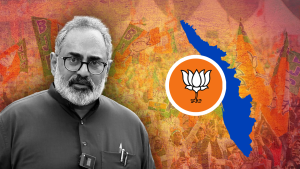
Rajeev Chandrasekhar.
For the BJP, these seats are crucial.
A victory in Nemom after five years would strengthen the narrative that the party’s growth in Kerala is accelerating and could influence nearby constituencies as well. A defeat, however, would raise questions about whether the recent momentum can be sustained.
BJP’s performance in the 2025 local body elections, winning 15 out of 23 corporation wards in the constituency, has boosted confidence like never before. If the BJP cannot turn that into an assembly win now, it may not get another opportunity of this scale anytime soon.
That is where SDPI’s role becomes important.
Nemom has a mixed voter base, with Muslim and Christian minorities making up nearly 30% of the electorate. SDPI has openly declared support for LDF’s V Sivankutty in Nemom, saying the priority is to stop a possible BJP victory. Meanwhile, Jamaat-e-Islami is believed to be leaning towards the UDF, though local-level strategic voting is expected.
SDPI national president MK Faizy has said the party will support whichever front is best placed to defeat the BJP in constituencies where SDPI is not contesting. In Nemom, that support has clearly gone to the LDF.

K Surendran. (X)
SDPI has withdrawn its candidate, Ashraf KM, from the Manjeshwar Assembly constituency, saying the decision was taken to strengthen parties opposing the BJP. The SDPI nominee had also attracted attention because his name was similar to that of IUML candidate AKM Ashraf.
BJP’s K Surendran is once again contesting from Manjeshwar, where he suffered a narrow defeat in 2021 by just 745 votes to AKM Ashraf. In 2016, Surendran lost the seat by a wafer-thin margin of 89 votes.
Since the 2006 Assembly election, the BJP has regularly emerged as the runner-up in Manjeshwar, while the CPI(M) has mostly been pushed to third place from 2011 onwards.
In a constituency where even a few hundred votes can decide the result, SDPI’s withdrawal could prove significant. Party leaders believe that if Surendran manages to win, SDPI could face criticism for dividing anti-BJP votes, which is why they withdrawn candidate this time.
The CPI(M)’s position on support from the SDPI continues to draw criticism from both the Congress and the BJP. Critics point out that in the 2018 murder case of SFI activist Abhimanyu M, police had arrested several activists linked to the SDPI, Campus Front of India and PFI.

Abhimanyu. (File photo)
A Congress leader from Malappuram argued that if the CPI(M) accepts SDPI support, it could create confusion among traditional CPI(M) voters, especially since the party had long opposed the SDPI.
Political observer Dr G Gopakumar told South First that it is difficult to precisely measure the vote share of smaller parties such as the SDPI and the Welfare Party of India, but their support can be crucial in certain pockets.
SDPI leaders, meanwhile, have maintained that there is nothing wrong with backing the LDF in select constituencies. They believe such support can influence results in seats where they have a notable presence.
According to an SDPI leader, the party is likely to back the LDF in constituencies such as Poonjar, Nadapuram and Beypore.
However, Thalassery remains a more complicated case because LDF candidate Karayi Rajan has been linked to the 2006 murder case of PFI activist Muhammad Fazal.
In such local pockets, SDPI may end up playing a decisive role, either by influencing minority votes or by acting as spoilers in closely fought contests.
(Edited by Majnu Babu).


